|
The Only Adult in the Room Was Wearing a Clown Nose
Last week a mountain fell into a river.
On 27 August, a glacier and the rock it was holding together came apart above the Nepal-Tibet border and went down the valley as a wall of ice, mud and boulders. The water rose nine metres in thirty minutes. Nearly 470 people confirmed dead. More than 1,500 missing, including 668 tourists from 34 countries. Pilgrims on their way to a holy mountain, swept away by the holy mountain.
Glacial outburst floods in that region have gone from about seven a decade to thirty-four. Two point one billion people drink from that ice. The scientists have stopped saying "unprecedented" because they have run out of precedents to compare it to, and now they mostly just say "again."
You did not hear much about it. It had a two day run. It lost the slot to a man with a podcast.
Where we are
Let me set the scene for the young people, because the rest of us have stopped being able to see it.
We have forever wars that no longer have names, only budget lines. We have a president whose entire theory of governance is that if you say the number is good, the number is good, and a movement that has moved on from wanting reality to be different to simply declining to attend. We have a class of thirty-eight year old men in Palo Alto, most who attended Stanford University, who have decided that the great obstacle to human flourishing is death, and who are spending fortunes on their own blood chemistry while the water systems of South Asia liquefy on schedule.
They want to go to Mars. Let me say the quiet part. They want to go to Mars because Mars has no tenants, no unions, no press, no elections and no atmosphere, and to a certain kind of man three out of five of those is already paradise.
They are buying elections, govt. and lots of land to create their own Utopia, with little to no regulation, or taxes. As Carlin would say, "it's a big club, and you ain't in it."
And we honour them. That is the part that should keep you up. Not that billionaires exist. Billionaires have always existed, they used to be called dukes and they were also boring. What is new is the worship. We have built the full apparatus: the interviews conducted in the tone nurses use with the recently bereaved, the podcasts, the biographies, the conference stages, the whole thing. A man who has never fixed anything that was actually broken is now our leading authority on being a human being. We ask him about morning routines. He tells us about the cold plunge. Somebody writes it down.
I have been in this business thirty years. I have sat in a great many rooms where the richest person present was, by a comfortable margin, the least interesting.
The wall behind my desk
When I lose the plot, and I do, I turn around.
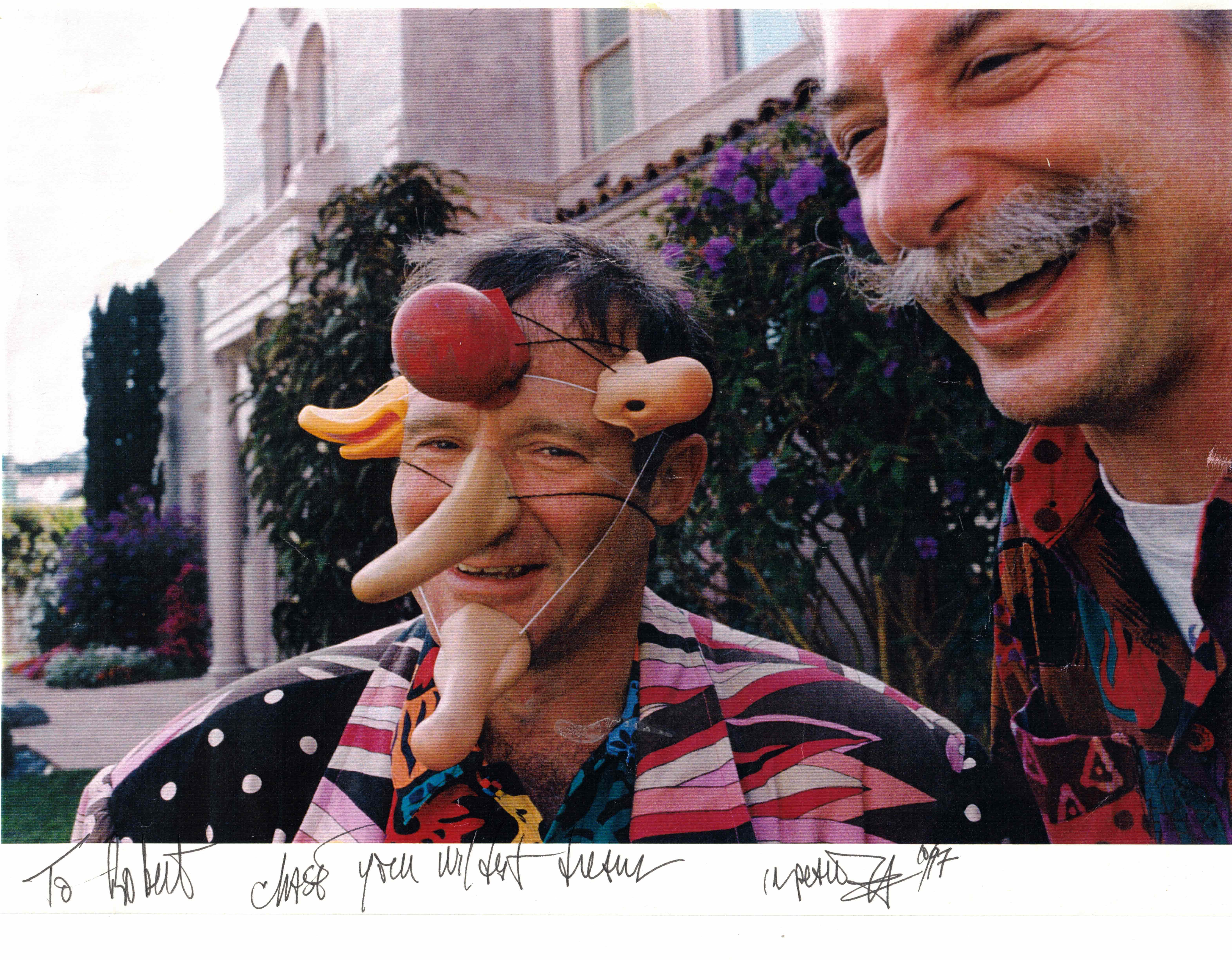
On the wall behind me there is a photograph that Patch Adams sent me. Patch and Robin Williams, together, both of them grinning like they have got away with something. And directly underneath it, a poster of George Carlin.
Two clowns and a prophet. I have never been entirely sure which is which, and I have come to think that was the point.
Leiden, 2006
I met Patch in 2006 at the Veerstichting event at Leiden University. Dutch academia. Which, if you have not experienced it, is a room in which enthusiasm is treated as a symptom.
He arrived dressed like a paint factory had an accident. Trousers of a colour not found in nature. The nose. The hair. Two metres of man in a costume, walking into a hall full of future consultants and central bankers who had come to hear about health care policy.
And then he talked, and within four minutes it was clear that he was the most rigorous person in the building. Not the warmest. The most rigorous. Underneath the clothes was a physician with a fully worked argument about health as a human right, delivered by a man who had actually done the thing rather than convened a working group on the thing.
That is the trick nobody notices. The costume is not there to make him lovable. The costume is there so that he can say things that would otherwise get him thrown out.
Who he actually is
Hunter Adams was hospitalised three times as a young man for suicidal depression. He came out of the last stay having made a decision, which he then kept for sixty years: he would be happy on purpose, he would not have a bad day, and he would treat joy as a discipline rather than a mood.
Then he became a doctor and did something genuinely unhinged. In 1971 he opened the Gesundheit Institute and ran a free hospital out of a house. Twelve years. Thousands of patients. No charges. No malpractice insurance, on principle, because he thought a doctor who is afraid of the patient cannot be trusted with the patient. He has spent decades since taking clowns into war zones, refugee camps, orphanages and disaster areas, which are the places where a clown looks most ridiculous and works the best.
He is eighty-one. He still does it.
Hollywood got hold of this and made a hit film in 1998, and Robin Williams played him, and the film made a fortune. Patch has said publicly, for years, that he was disappointed with it. He did not object to being played by Robin Williams, which is a thing most of us would accept as the high point of our lives. He objected because the film turned a radical argument about who deserves care into a warm story about a funny doctor, and because the money went to a studio while the hospital stayed unbuilt.
Fifty-five years on, it is still not finished. Still fundraising.
Sit with that for a second. A man has a fully costed plan for free health care, a Hollywood film, worldwide name recognition and an unblemished record of delivery, and he cannot raise the money. Meanwhile, in the same fifty-five years, we have collectively found the capital for pet food delivery apps, three separate metaverses, an entire ecosystem of coins named after dogs, and enough rockets to make the world's richest man feel briefly tall.
That is not a funding gap. That is a statement of values with a spreadsheet attached.
And Robin
Robin Williams died in 2014. The funniest man on the planet, and it did not save him.
I mention it because it kills the cheap version of this article, the one where I tell you that laughter is medicine and you feel improved for eleven minutes. Funny is not the same as fine. Patch knew that better than anyone, because he built his whole life out of the same raw material and had to decide, every morning, to keep making the choice.
That is what inspiration actually is, and it has nothing to do with the industry that sells it. It is not optimism, because optimism is a forecast and the forecast is bad. It is not hope, which is passive and mostly a way of arranging your feelings so you can go back to sleep. It is a decision taken daily, in poor conditions, without evidence, by someone who has read the same news you have.
What this is for
Carlin used to say that inside every cynical person there is a disappointed idealist. He was describing himself, and he was describing most of the people reading this, and he was certainly describing me on a Tuesday.
The glaciers are going. The wars will not stop because we are tired of them. The liars are ascendant and, worse, they are being interviewed respectfully. And the correct response to all of that is not to become sophisticated about it. Sophistication is just despair with better tailoring, and it is the most fashionable posture in finance right now: everybody standing around being far too clever to try.
So here is the ask, and it is small, which is the only reason it works.
Pick your version of the free hospital. The thing you would do if nobody paid you and nobody watched. Then do a bit of it this month. Not a strategy for it. A bit of it.
And stop honouring the wrong people. You are not obliged to be impressed. When the next visionary explains that he is going to fix humanity as soon as he has finished optimising his own bloodstream, you are allowed to notice that a man in a clown nose in West Virginia has been fixing actual humans since 1971, for free, and did not once ask you to subscribe.
Patch, if this reaches you, the photograph is still on the wall. You are above Carlin, which in my house is the top of the building.
Thank you for the fifty-five years. And thank you for making it clear, in about four minutes, in a lecture hall in Leiden, that the ridiculous ones are usually the only ones telling the truth.
👉 Follow Robert Rubinstein
Join the Reader Community Radical Truth-My upcoming book about extraction
TBLI Circle
|