 |
|
Tuesday, August 18, 2026 |
|
Author: Robert Rubinstein If you have difficulty reading this email, click here |
The Global Voice of ESG & Impact Investing
|
|
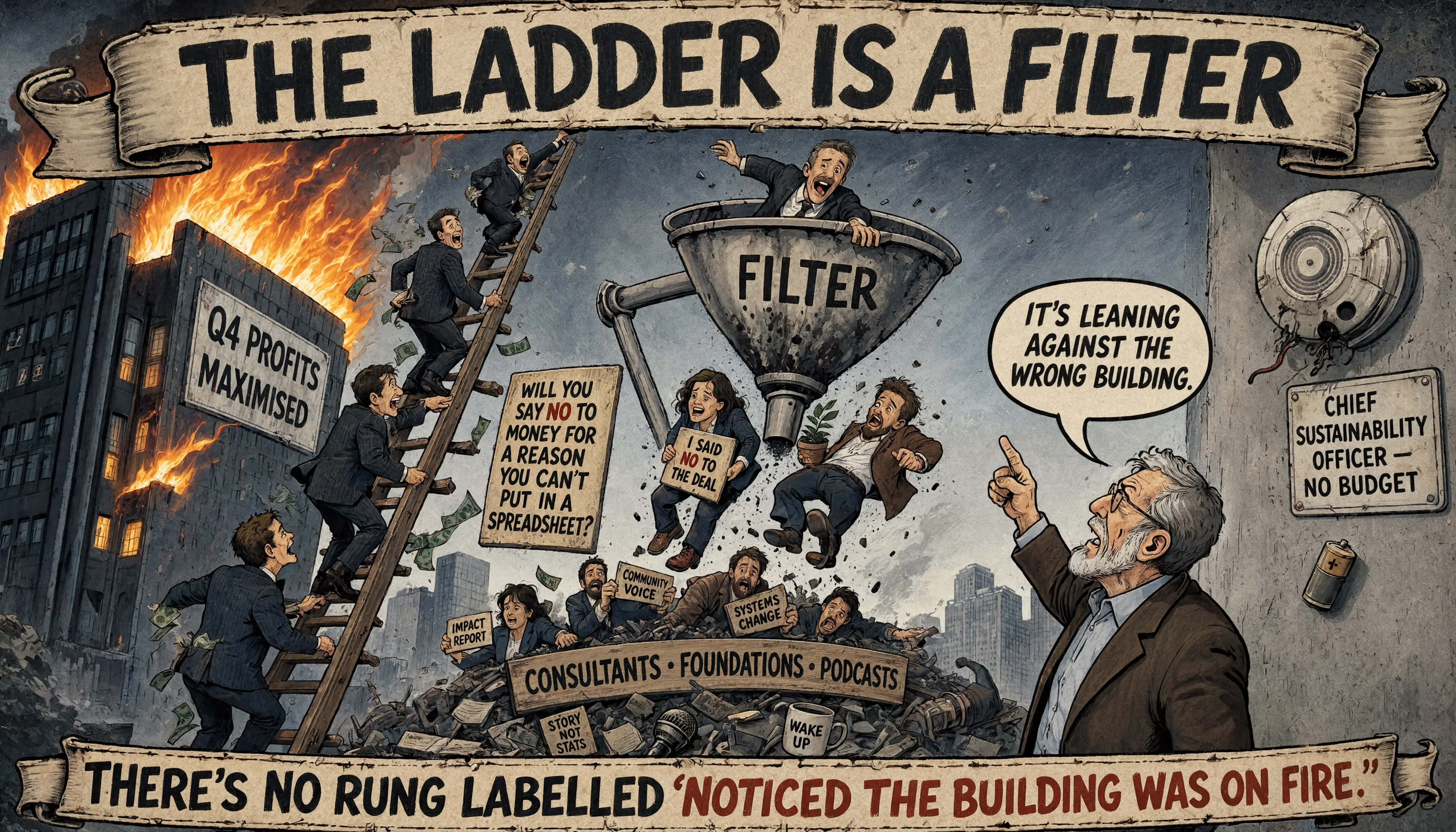
REVE AI Generated Audio VersionPeople Say I'm Arrogant. They are Right.A friend of mine brought up something over dinner that I've been chewing on ever since, which is annoying, because I'd rather chew on the food. He said my problem is arrogance. That I never adapted to the financial system. That I stood outside the tent for thirty years shouting about what was happening inside the tent, and then acted surprised when nobody sent me a wristband. And he's right. That's the irritating part. He's completely right. AdaptLet's start with that word. Adapt. Beautiful word. Very reasonable-sounding. It's the word you use when you want someone to surrender but you'd like it to sound like personal growth. "You need to adapt to the financial system." Sure. And the fish needs to adapt to the oil spill. The tenant needs to adapt to the rent. The frog needs to adapt to the water, which is fine, which is warm, which is honestly quite pleasant, and which is now, if we're being technical about it, soup. Nobody ever says "adapt" to the guy with the money. Nobody has ever, in the history of capital, walked into a pension fund and said, "Gentlemen, have you considered adapting to the planet?" That would be rude. That would be naive. That would be, and I want to use the technical term here, unserious. No. The adapting is done downward. Always downward. Reality adapts to the model, the model never adapts to reality. And when reality refuses to adapt, we don't change the model, we change the reality's data provider. On the subject of my arroganceI want to be fair to my friend, because he's not wrong about the arrogance. I am arrogant. I've been arrogant when it touches my big purpose. Let me just describe the specific arrogance I'm guilty of, so we can all judge it properly. My arrogance was believing that a river has a value. That's it. That's the whole crime. I looked at a river and I thought, someone should probably put that on the balance sheet, and I said so out loud, in a room, with people in it, wearing a suit, like an idiot. Now let's look at the other arrogance in the room. The other arrogance was a group of men deciding, without a vote, without a study, without so much as a raised eyebrow from the risk committee, that the river is worth zero. Not "hard to value." Not "we lack the data." Zero. A rounding error. An externality, which is Latin for "somebody else's grandchildren." So we have two arrogances here. Mine, which says the world is more complicated than your spreadsheet. And theirs, which says the world is exactly as complicated as their spreadsheet and everything outside it is a rounding error. Guess which one got called arrogant. Guess which one got the corner office and the honorary doctorate and the panel slot at Davos on "Rebuilding Trust." I've been in that industry for thirty years and I have never once, not one time, seen a man punished for being confidently wrong about the entire planet. But being right about it early? That, my friends, will cost you. Point two, which is the one that actually hurtsMy friend's second point was worse, because it was kinder, and kind things do more damage. He said: notice that the people who genuinely embraced purpose never made it to the top of the financial ladder. Never. Not one. And I sat there running the list in my head. Everyone I know who took this seriously, who actually meant it, who turned down the mandate, who told the client the truth, who said "I don't think we should finance that." Where are they now? They're consultants. They're on a board of a foundation with an annual budget smaller than one banker's bonus. They're teaching. They're writing a book. They're doing a podcast. Hello. ExceptionThe few that I could say that were the exception to this finding were those who joined a purpose driven Family Office, a DFI or Multilateral, or that rare breed called Green or Sustainable Bank. Not one of them is running a bank, Asset Management, PE Firm. The one’s who were not truly committed or purpose driven have reached the top, whatever that is, or nearly there. And here's the thing: that is not a coincidence, and it is not bad luck, and it is definitely not a talent problem. It's a specification. The ladder is working exactly as designed. Because that ladder is not a ladder. Everybody thinks it's a ladder. It's a filter. And the filter is testing for precisely one thing, all the way up, at every single rung: will you say no to money for a reason you cannot put in a spreadsheet? If the answer is yes, you're out. Not fired. Nothing so dramatic. Just, you know, not quite the right fit for the next role. Wonderful contributor. Very passionate. Maybe a bit ideological. Let's keep him where he is. That's not a career. That's a diagnosis. But what about all the purpose at the top?I know, I know. Look at all those CEOs with purpose in their LinkedIn bio. Look at the foundations. Look at the impact summits with the eleven thousand euro table. Let me explain how that works, because it's actually very simple. They got the purpose afterwards. Purpose, at that altitude, is not a compass. It's a hobby. It's what you buy when the yacht stops being interesting. First you spend forty years extracting, and then at fifty-eight you discover meaning, which is a lovely story, and there's a foundation, and there's a photograph of you with children in it, and the children are always in a country far enough away that nobody's going to fact-check the outcome. Purpose acquired at fifty-eight is not purpose. It's laundry. And then there's the poor bastard they hire to hold the actual purpose. The Chief Sustainability Officer. The corporate equivalent of a smoke detector with the battery taken out, hanging on the wall, looking official, reporting to marketing. Big title. No budget. No veto. Invited to every meeting except the one where they decide things. So here's my answer to my Friend.You're right on both counts. Diagnosis correct, prognosis correct. I failed to adapt, and the people who mean it don't get to the top. But your conclusion assumes I was climbing. I was never on the ladder. I was the guy standing next to it, pointing out that it's leaning against the wrong building. And I understand completely why they don't promote that guy. There's no promotion for that guy. There's no rung labelled "noticed the building was on fire." They promoted the fast climbers. They always do. They're at the top now, and the view is spectacular, and the building is still on fire, and the smoke detector has no battery in it, and someone is telling the fish to adapt. I'll take the arrogance. It's cheaper than the alternative, and unlike a career, you can keep it. #SustainableFinance #ImpactInvesting #TBLI Robert Rubinstein — TBLI Group. Still arguing that finance should serve all stakeholders, and remaining arrogant but authentic. Radical Truth Podcasts |

U.S. to “Take Any Actions Necessary” to Protect Companies from “Unreasonable” EU Sustainability Reporting RegulationsThe U.S. Government has issued a series of requests from the European Union to address concerns with the impact of the EU’s new sustainability due diligence and reporting laws – the CSDDD and CSRD – on U.S. companies. In a comment letter, issued by U.S. Mission to the European Union, the U.S. Government said that the EU Commission’s Omnibus package to simplify its sustainability regulations, including the CSDDD and CSRD “failed to fully address U.S. concerns regarding these directives,” and warns that “the United States will take any actions necessary to address unreasonable burdens on U.S. commerce absent a solution that addresses these concerns.” The Corporate Sustainability Due Diligence Directive CSDDD was initially proposed by the European Commission in 2022, and adopted in 2024, setting out obligations for companies to identify, assess, prevent, mitigate, address and remedy impacts on people and planet – ranging from child labor and slavery to pollution and emissions, deforestation and damage to ecosystems – in their upstream supply chain and some downstream activities. The EU’s Corporate Sustainability Reporting Directive (CSRD) took effect for large EU companies in 2024, and will apply to large non-EU companies that operate in the EU with initial reporting scheduled for 2029. |
|
TBLI Group Herengracht 450, 1017 CA Amsterdam, The Netherlands |