Rewe AI Generated
I've Been in the Impact Space for 30 Years. Stop Asking Me to Scale.
Audio Version (Podcast)
Every week, someone pulls me aside — a conference hallway, a Zoom call, a dinner in Davos or Singapore or Nairobi — and says some version of the same thing:
"Robert, TBLI has incredible reach. Have you thought about scaling?"
I have. The answer is no.
And the shock on their faces tells me everything about what's broken in how we think about finance, business, and purpose.
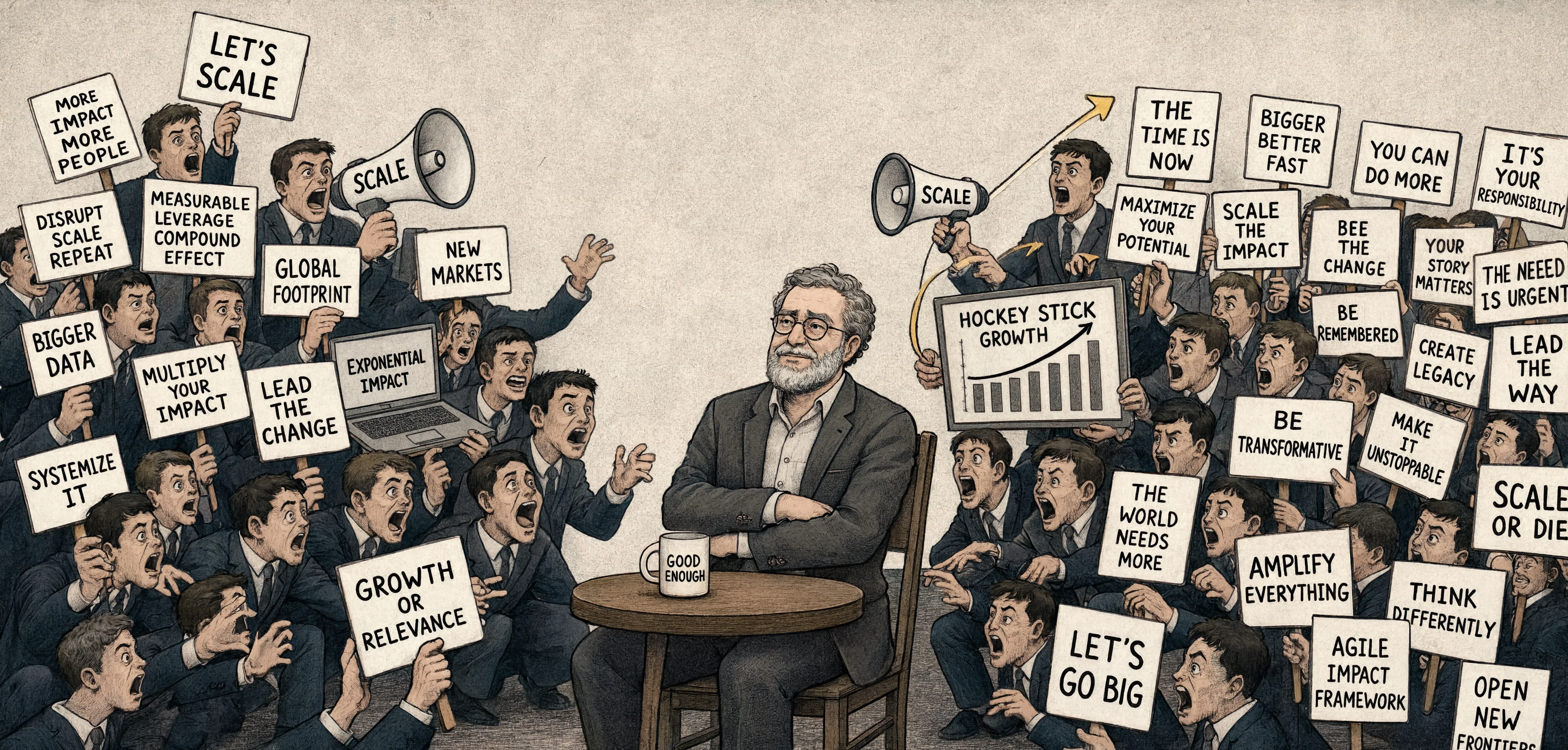
We live in an age that has elevated growth, scale, and extraction to something close to religion. Bigger is better. More is more. The measure of success is the number of zeros on a valuation, the size of the fund, the number of offices on the org chart. We have convinced ourselves that if something is worth doing, it is worth doing at industrial scale — and that anything that stays small is either failing or afraid.
I reject that entirely.
TBLI — the Triple Bottom Line Investing conference and network I have built over three decades — is not small because I have failed to grow it. It is focused because I have chosen to keep it that way. There is a difference. One is a limitation. The other is a philosophy.
What I have spent 30 years doing is not building a company. It is trying to shift a mindset.
The work is this: convincing asset owners — pension funds, family offices, sovereign wealth funds, foundations, endowments — that purpose and impact are not decorative. They are not the ESG checkbox you tick before moving on to the real business of returns. They are not a PR strategy or a regulatory hedge or a generational concession to millennials who want to feel good about their portfolios.
Purpose and impact mean something. For everyone. Including the people who are supposed to only care about risk-adjusted returns.
That is not a message you scale. It is a message you repeat, and deepen, and earn the right to say again — one conversation, one relationship, one room at a time.
The obsession with growth misunderstands what actually changes systems.
Scale optimizes for reach. Influence optimizes for depth. These are not the same thing, and in the world of capital allocation — where a handful of decisions by a handful of people move trillions of dollars — depth is the only thing that matters.
I would rather spend an hour with the CIO of a major pension fund than broadcast to a million followers. I would rather have one honest conversation about fiduciary duty and the long-term cost of ignoring climate risk than publish a hundred reports that confirm what people already believe. I would rather be in the room where the decision actually gets made than run a platform that talks about rooms.
Growth thinking would have me hire a team, open regional offices, build a subscription model, license the brand, create a digital product, and measure success in revenue and headcount. I would spend most of my time managing the organization instead of doing the work.
No thank you.
There is also something worth naming about extraction — the third leg of the triumvirate that defines conventional business success.
The dominant model is still this: find something of value, extract it as efficiently as possible, move on. Value the transaction over the relationship. Optimize the quarter over the decade. Treat the natural world, human communities, and long-term systemic health as externalities — costs to be passed on to someone else, somewhere else, sometime later.
This is precisely the logic that impact investing was supposed to challenge. And yet watch what happens when a promising impact fund gets traction. The pressure comes immediately: grow the AUM, compress the strategy, accept the capital with strings attached, file down the edges that make it inconvenient for the mainstream. The extraction logic swallows it.
I have watched this happen to people I admire. The mission drifts. The language stays. The practice changes.
I am not anti-growth as a concept. Growth that serves people and planet, that builds genuine long-term value, that does not cannibalize the systems it depends on — that is worth pursuing.
But growth as an end in itself? Growth as the proof that you are serious? Growth as the only valid measure of whether your work matters?
That I will not accept.
When I look at Dyson's super-efficient high-tech strawberry farm run by robots and state-of-the-art tech innovation. My only question is, do the strawberries taste as good as traditional farms that are nurtured with love and tradition, and sunlight?
After 30 years, what I know is this: the most important things that have happened in impact investing did not come from scale. They came from a small number of people who were willing to say something uncomfortable, repeatedly, in the right rooms, until the idea became impossible to ignore.
That is what TBLI is. That is what I do.
Ask me again to scale it, and I will smile, and I will explain this to you, and I will go back to work.
👉 Follow Robert Rubinstein for more
Robert Rubinstein is the founder of TBLI Group, which he has led for over 30 years with a focus on purpose-driven capital allocation and impact investing.
#ImpactInvesting #SustainableFinance #PurposeOverProfit #AssetOwners #TripleBottomLine #ESG #SystemsChange #ImpactFirst #growth #postgrowth #degrowth |



 TBLI Connect (Speed Partnerships)