 |
|
Tuesday,June 2, 2026 |
|
Author: Robert Rubinstein If you have difficulty reading this email, click here |
|||||
The Global Voice of ESG & Impact Investing |
|||||
|
|||||
|
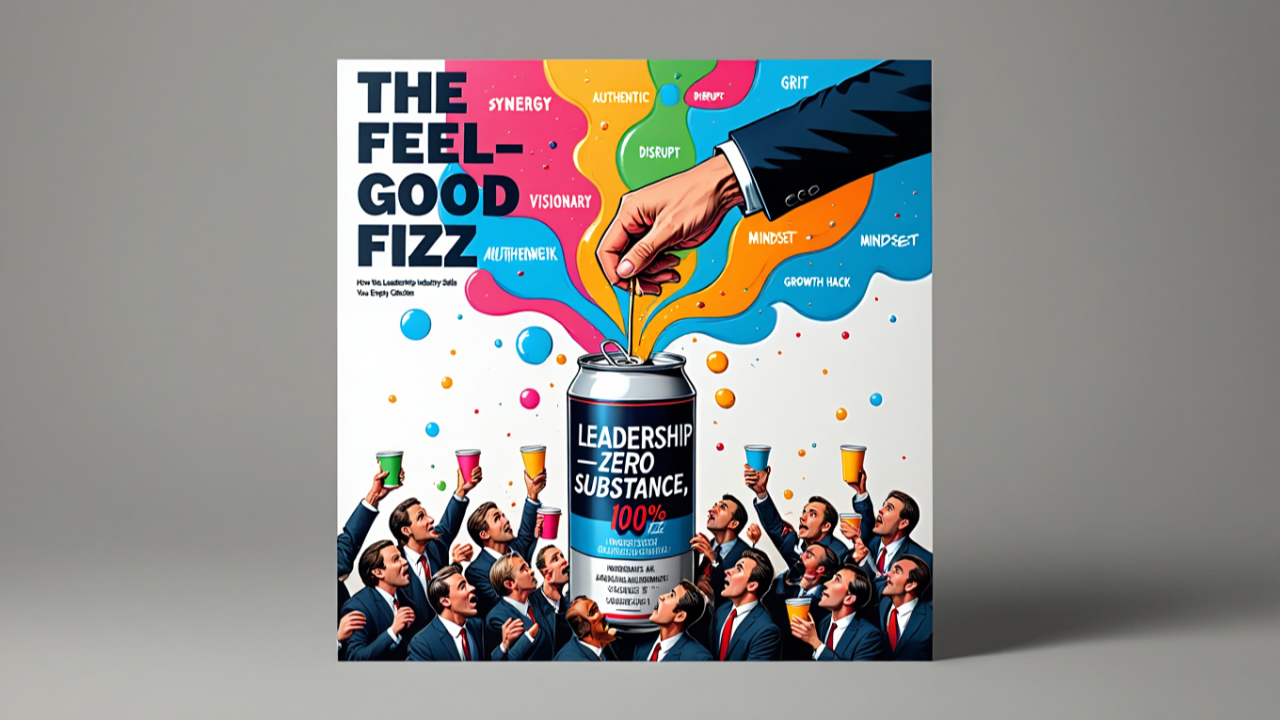
REWE AI Generated High-Fructose Leadership: Sweet, Addictive, and Nutritionally WorthlessRobert Rubinstein Let me tell you about two beverages. One is brilliant, ruthlessly engineered, and consumed by billions. It goes down smooth. It gives you an instant dopamine hit. It's been the same formula for over a century — scientifically calibrated to make you feel something, briefly, and then crave more. It leaves zero nutritional residue in your body and quietly rots your organs from the inside out while sponsoring a feel-good commercial about polar bears. The other? It's raw. It's complex. It's alive with cultures and time. It's an acquired taste. It asks something of you before it gives anything back. And it actually changes your biology. One of these is Coca-Cola. One of these is raw, organic kombucha — or a bottle of genuinely aged wine. And I'm using this metaphor entirely on purpose, because this is exactly what the global leadership and leadership circuit is serving us right now in the form of "Conscience Circus "— and most of us are mainlining the soda and calling it transformation. The Stage Is Set, the Dopamine Is FreeSimon Sinek walks onto a red-carpeted stage. Crisp shirt. Warm smile. He tells you the story of the Wright Brothers again. He draws a circle — a beautiful, simple circle — and inside it he writes the word "WHY." The room erupts. Thousands of middle managers and C-suite executives feel, for a glorious seventeen minutes, like they've had a spiritual awakening. They'll tweet about it. They'll buy the book. They'll put "Start With Why" on their team's next offsite agenda. And then — precisely nothing structurally changes. I want to be fair here. Simon Sinek is a gifted communicator. He is, objectively, a masterful marketer. And he is not alone — he is one of hundreds of articulate, photogenic, TED-certified, airport-bookstore-stocked thinkers who have built empires on the intellectual equivalent of high-fructose corn syrup. They are pleasurable to consume. They are not nourishing. But here's the question that nobody in those conference rooms is asking, because asking it would ruin the vibe: Do they move the needle permanently? Do they change the structural architecture of how capital flows? Do they rewrite the balance sheet? Do they stop the ecological bleeding? Do they alter the deep operating system of capitalism — that system which mandates short-termism, extracts natural capital for free, and rewards sociopathic behavior at an institutional scale? No. They optimize people to function more pleasantly inside a broken machine. The Metacognition Gap — Or, Why You Can't Fix the Dream From Inside the DreamA colleague of mine recently hit the nail squarely on the head when describing this class of thinker: "They are not metacognitive." That's not an insult. It's a precise, surgical diagnosis. Metacognition is the capacity to observe your own thinking — to step outside your framework and examine the framework itself. A metacognitive thinker doesn't see a problem and try to make it prettier. They don't hand a coat of warm beige paint to the crew of a sinking ship and call it a culture intervention. A metacognitive thinker looks at the system that manufactured the problem in the first place. They ask: Why does this problem keep regenerating itself, regardless of how many leadership trainings we run? And the answer — the uncomfortable, conference-fee-killing, speaking-circuit-destroying answer — is this: The problem is not a deficiency of inspiration. The problem is the operating system. The global financial architecture — quarterly earnings, fiduciary duty defined narrowly as short-term shareholder returns, accounting frameworks that treat nature as a free externality and human capital as a cost — doesn't reward good leaders. It punishes them. It structurally selects for extractive behavior and then pays someone $75,000 to come in and tell those executives to "be more empathetic." Telling people to Start With Why inside a system that only rewards How Much is not a solution. It's theatrical. It's comfortable. And it's expensive theater. The Impact Theater of ChangeLet's call the phenomenon what it is: Conscience Circus It has all the visual hallmarks of change — the panel discussions, the pledges, the framework launches, the glossy reports, the ribbon cuttings, the coalition memberships. It has the language of urgency: "systemic," "transformative," "catalytic," "regenerative." What it almost never has is permanent, structural movement of the needle. Because structural needle-movement is not a content strategy. You cannot TED-Talk your way to a new global accounting standard. You cannot "storytell" capital allocators into repricing ecological risk. You cannot circle-draw your way to reforming fiduciary law. Real change requires something the Leadership Keynote is constitutionally unable to provide: financial-grade rigor applied to questions the existing financial system doesn't want asked. It means treating intellectual capital, relationship capital, and natural capital as real assets on the balance sheet — not as ESG footnotes and PR offsets. It means shifting the entire operating metaphor of institutional finance from hunting — the extractive, transactional, zero-sum pursuit of quarterly prey — to farming: patient, stewardship-based, compounding, long-horizon value cultivation. That's not a keynote. That's a complete reconstruction of the underlying code. The Carlin Rule: Follow the ChecksGeorge Carlin had a rule. He called it "following the money." I'll adapt it for the impact space: follow the checks. Who is paying the conference fees? The institutional gatekeepers — the asset managers, the corporate foundations, the sovereign wealth funds — whose operating mandates are written in the language of the old system. They are paying people to come in and make their teams feel inspired without threatening the architecture that generates their returns. If you tell those gatekeepers that their entire financial operating system is a collectively sustained illusion — that the balance sheet they worship is a hallucination that excludes most of what actually generates value and destroys most of what sustains life — they stop writing checks. So instead, you get the polished, the palatable, the profitable: circles with words in them, stories about visionary CEOs, workshops on psychological safety inside structures that are psychologically designed to be unsafe. You get Coca-Cola. Every time. What the Kombucha Actually Tastes LikeRaw truth is not smooth. It doesn't have a marketing budget. It takes time to make and time to absorb. It sounds like this: The reason your impact initiatives keep failing is not that your people lack purpose. It's because your measurement system is lying to you about what the value is. It sounds like: Your "green portfolio" is still priced against a model that treats a living forest and a parking lot as financially equivalent until the forest is logged. It sounds like: The conference you just ran cost more than the grants you distributed, and the gap between what you said and what you funded is the gap between theater and change. That's the kombucha. That's the fine wine that took thirty years in the barrel and reveals more the longer you sit with it. It will not go down smoothly. It will not get seventeen standing ovations. It will not become a bestselling airport paperback. But it will — if we're disciplined enough to drink it — actually change something. The Only Question That MattersWe are at a point in history where the distance between the sophistication of our rhetoric and the inadequacy of our action has become a civilizational liability. We can articulate the problem in twelve languages and seven frameworks. We have certified impact measurement consultants, blended finance toolkits, and regenerative capitalism summits. And the ecological systems continue to degrade. And the inequality continues to compound. And the capital continues to flow in the direction the old operating system has always pointed it. The question is not whether we can inspire people. The question is whether we are willing to do the hard, unglamorous, metacognitive work of rebuilding the foundations — or whether we're going to keep serving each other beautifully branded cans of sugar water and calling it a movement. Put down the Coca-Cola. The kombucha is ready. |
|||||
|
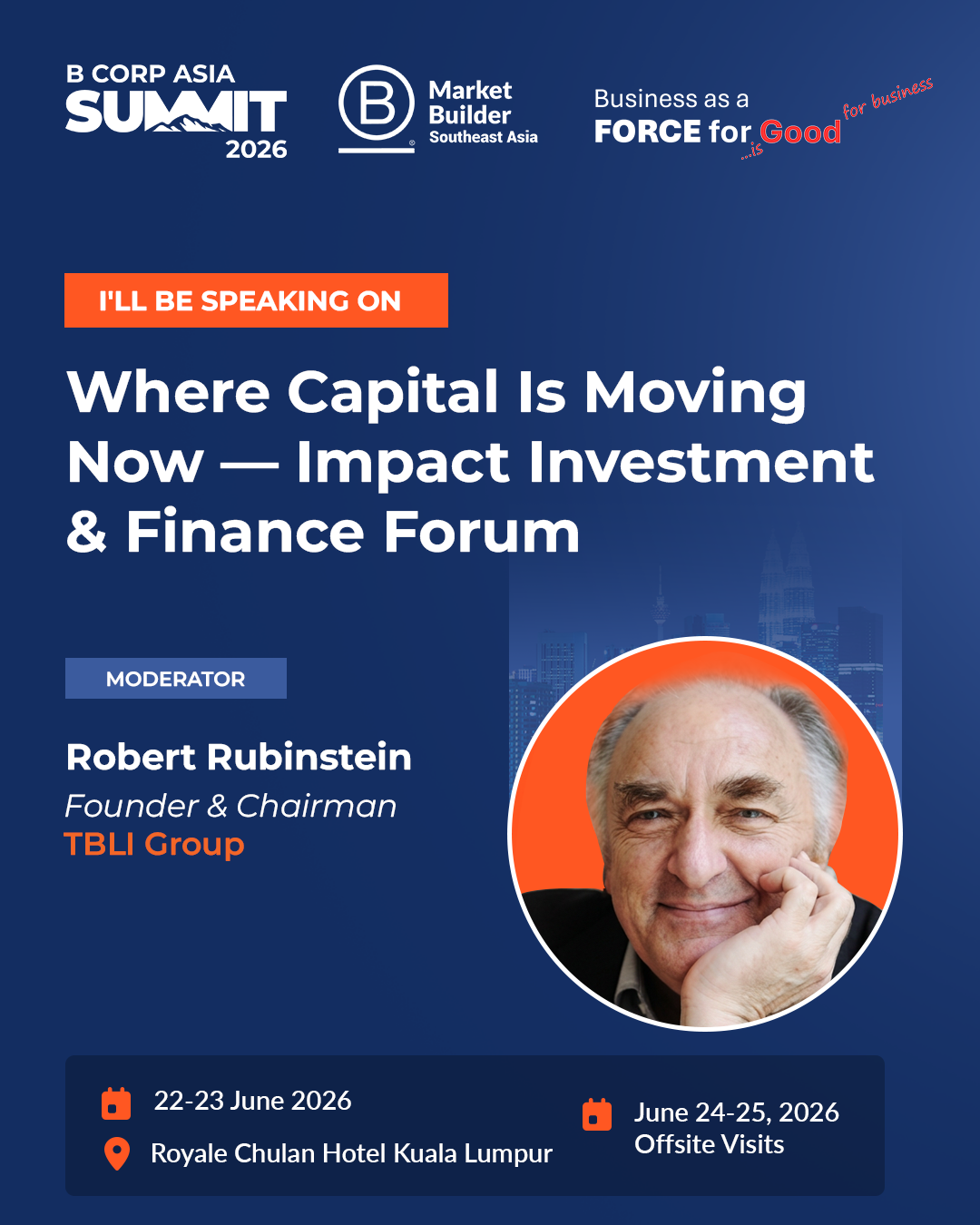
B Corp Asia Summit 2026-June 22-23, 2026 Excited to share that I'll be speaking at the B Corp Asia Summit 2026 happening in Kuala Lumpur on 22–23 June! I'll be speaking in the session Where Capital Is Moving Now — Impact Investment & Finance Forum— and I can’t wait to be in the room with leaders from across Asia who are pushing this conversation forward. If you’re attending, come say hi. If you’re not yet registered, click the link below. Seats are limited. Use this promo code: TBLI during registration and enjoy a special discount. #BCorpAsiaSummit2026 #BusinessAsAForceForGood #Genashtim #BCorp
|
|||||
|
TBLI Group Herengracht 450, 1017 CA Amsterdam, The Netherlands |