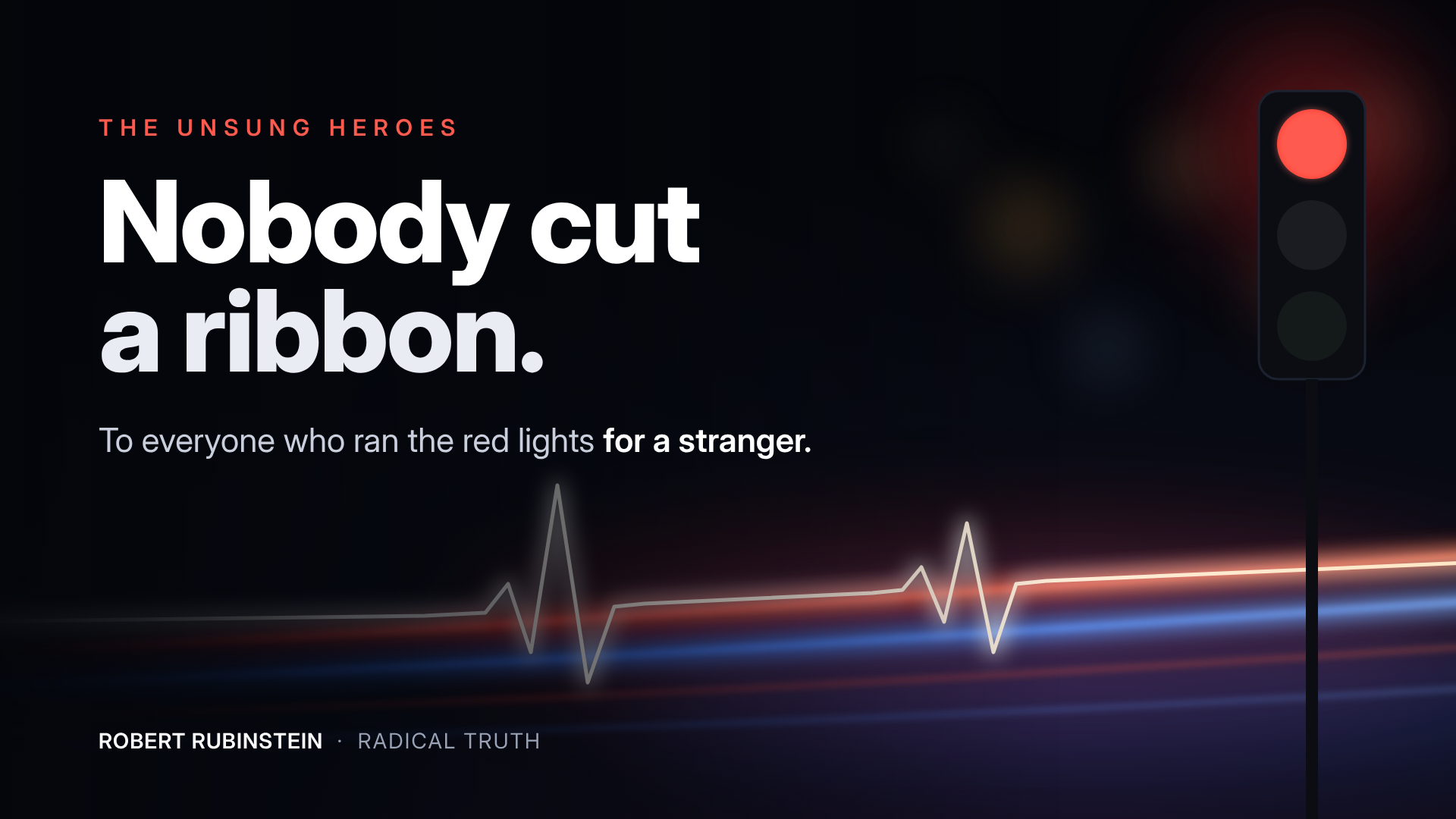
The Ambulance Ran Every Red Light.
Nobody Cut a Ribbon.
This weekend my wife had a heart incident.
I will spare you most of it. You either know that feeling or you will one day, and either way you do not need me to describe the moment the floor of an ordinary Saturday falls away.
What I want to describe is what happened next. Because it was the most impressive display of competence I have seen in thirty-five years, and I have spent those thirty-five years watching very well-paid people describe competence from a stage.
Minutes
We called. And the ambulance team was at our door in minutes.
Minutes. In a world where a parcel takes three days, a bank takes three weeks to answer an email, and an investment committee takes eighteen months to decide whether a water project in Malawi is worth the paperwork, a team of strangers dropped whatever they were doing and was standing in our home before I had finished being frightened.
They came straight to her. They checked her, calmly and thoroughly, and they talked to her like a person, not a case. No panic. No fuss. No wasted movement. Every one of them knew exactly what the next step was and took it. I have sat through a great many panels about "operational excellence." I had never actually seen it until it knelt down on our floor.
And then they took her to the hospital.
Rieki, my wife, felt secure and happy with all the attention and love that she received from perfect strangers. We all need that.
The red lights
The ambulance drove through every red light between our house and the hospital.
I watched the junctions go past and I thought: this is the only person in our entire society who is licensed to break the rules for a stranger.
Think about that. We have plenty of people who break the rules. Billionaires break them constantly. They route around tax, around regulators, around democracy itself, and then they write a manifesto about why the rules were holding back humanity. But they break the rules for themselves.
The team in that ambulance broke them for my wife. They had never met her. They will probably never see her again. If they had known her name, it would not have changed their speed by a single kilometre an hour.
The room
At the hospital, nobody waited. Nobody asked about her net worth, her follower count, her board seats, or whether her case had a sufficient ticket size.
They looked at her and they moved.
I have spent a career complaining that finance allocates according to who pitches best. In that building, it allocated according to who needed it most. Doctors, nurses, the people with the machines, the person who found me a chair and told me where the coffee was. Everybody knew their job and did it, immediately, without a meeting about it.
Nobody said "let's take this offline." Nobody needed to de-risk anything. Nobody asked for a lead investor.
It was the first time in years I have watched a group of strangers make fast, serious decisions under pressure, and not one of them was on a stage.
Who we interview
Here is what kept going round my head in the waiting room.
Tomorrow, somewhere, a tech founder will be interviewed about his morning routine. He will explain the cold plunge. Somebody will write it down. A podcast will run it under the title "How To Win At Life."
We will pay an actor more to pretend to be a surgeon for twelve weeks than a nurse will earn in her entire career. We will put a man on the cover of a business magazine because he built an app that delivers dog food in nine minutes.
The ambulance team got to my wife in about the same time. Nobody will put them on a cover.
They will go home tonight unknown. Tired. Underpaid. And back at it tomorrow.
Nobody will ask the paramedic about his morning routine. I can tell you what it is. He gets up and keeps strangers alive.
The ones who just get it done
And it is not only the ambulance and the hospital.
It is the dispatcher who answered the call and kept her voice calm so I could keep mine.
It is the teacher who spends her own money on pencils and stays late with the kid who is not doing well at home.
It is the police officer who walks toward the thing everyone else is running away from.
It is the cleaner who sterilised that treatment room before we arrived, at an hour when the founders were still asleep, and who will never be thanked in any annual report.
It is the person who maintains the traffic lights the ambulance ran, and the person who trained the driver to run them safely.
These people hold the whole thing together. Not in a metaphorical, LinkedIn-inspirational way. Literally. Take them away for one week and see how far your portfolio gets you.
They just get shit done. Every day. Quietly. And they do not cut ribbons.
No naming rights on a defibrillator
I wrote recently about ribbon cutters: the men who extract for forty years, then buy absolution with a building that has their name on it.
Nobody's name was on the defibrillator. Nobody's name was on the ambulance. The nurse did not have a foundation. The doctor did not issue a press release about her commitment to cardiac care. They did not need to commit. They did the thing.
And when Silicon Valley shows you the renders of its network states and its freedom cities, look for the ambulance. You will not find one. There is no siren in the render. There is no night shift. There is no team on standby, ready to be at a stranger's door in minutes.
That is what a society actually is. It is people you will never meet, running red lights for you.
What I am asking
Three things. Small ones.
One. Thank one of them, specifically. Not "thanks to all our heroes," which is what we say when we want to clap from a balcony and change nothing. A name. A ward. A school. A station. Write the card. Send the email.
Two. Tell them what happened. They almost never find out. The ambulance team drops you off and never learns how it turned out. I have written about how rare it is for anyone to report back after you help them. These people help us every day and live permanently in that silence. Break it.
Three. Stop being impressed by the wrong people. Next time someone wants you to admire a billionaire's vision, remember who actually showed up when it mattered. Then vote, budget and pay accordingly. Applause is free. Salaries are not.
To everyone who was with us today: the ambulance team, the doctors, the nurses, everyone in that building whose name I did not catch.
You did not ask for this, so I will say it anyway.
Thank you. You are the real economy.
👉 Follow Robert Rubinstein
Discuss my upcoming book Extraction before it launches, and meet non-extractive changemakers on TBLI Circle (free)
|