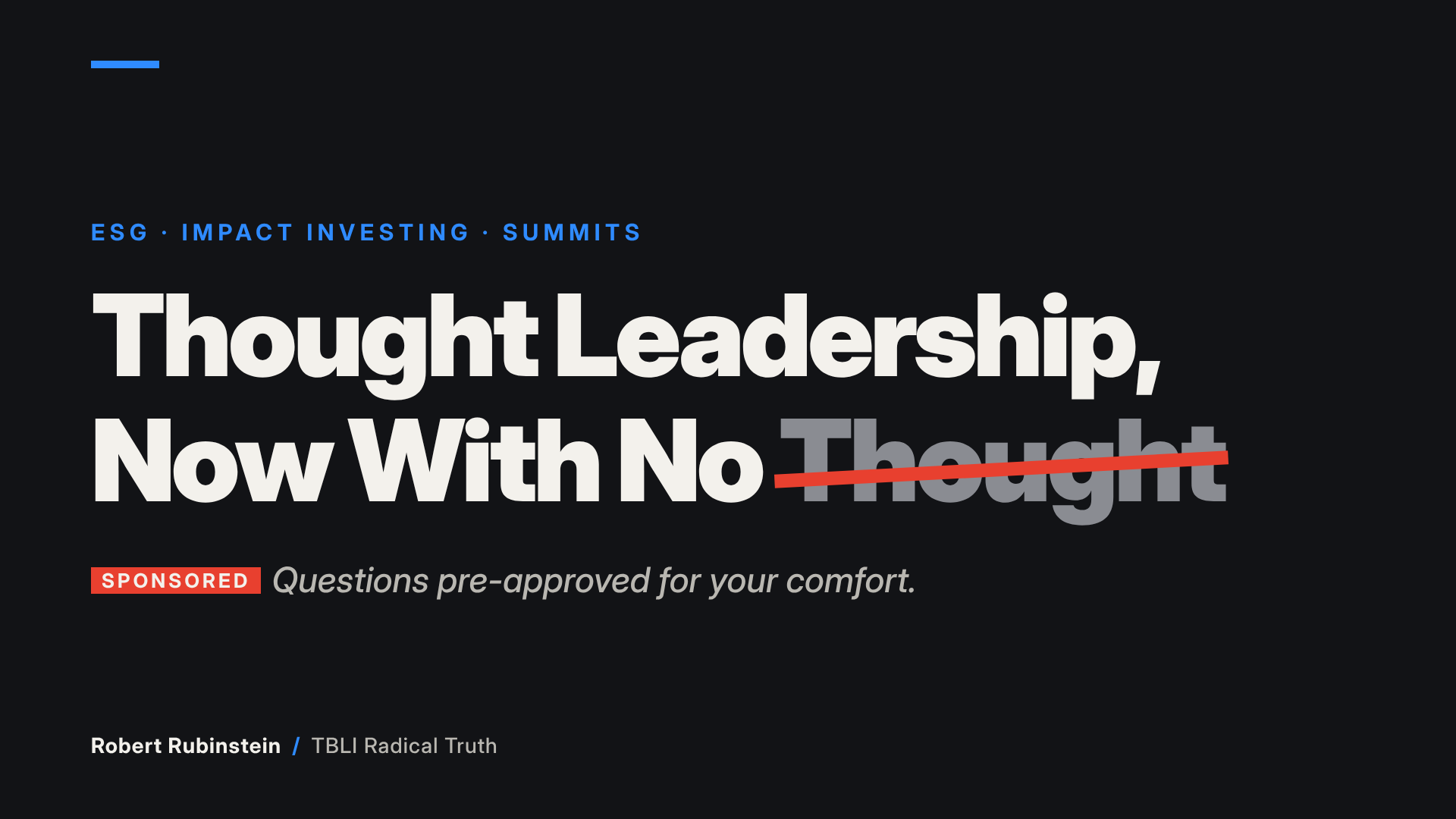
 Thought Leadership, Now With No Thought
A couple of days ago an organisation contacted me. They wanted to sell me data. Information. Insight. "Intelligence on sustainable investment," which is a phrase that should come with a warning label.
I said no thank you. Not because I don't like data. I love data. I said no because I have read the stories. And most of the stories are press releases.
Company X "commits" to net zero. Fund Y "is proud to announce" its alignment. Bank Z "reaffirms its dedication" to a just transition, which it will fund right after it finishes funding the unjust one.
That is not news. That is a brochure that learned to type.
The commitment industry
Let's talk about the word "commit."
In the rest of life, commitment means something. You commit to a marriage. You commit a crime. Either way, something actually happens.
In ESG, a commitment is a sentence. It has no end date, no penalty clause and no witness. It is a New Year's resolution with a logo. And the media prints it, word for word, like a stenographer at a wedding who forgot to check whether anyone turned up.
Nobody follows up. Nobody asks, "You committed in 2019. It's 2026. How's that going?" Because asking would be rude. And rude, in our industry, is the one sin that cannot be offset.
Why nobody asks
I'll tell you why nobody asks. The sponsor is in the room.
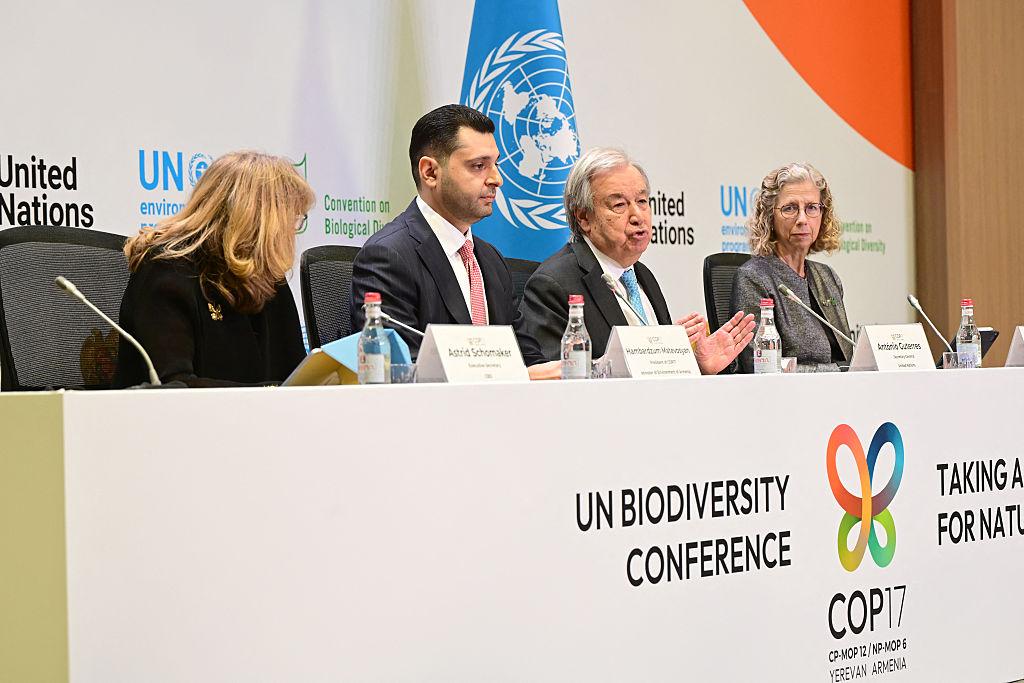
The conference needs the bank. The bank needs the panel. The panel needs a moderator who will say, "What an inspiring journey," and then hand the microphone back like it's hot.
So the questions get softened. Then they get pre-approved. Then they get removed. Then the summit has a session called "Hard Truths in Sustainable Finance," and the hardest truth anyone mentions is that the coffee ran out at eleven.
The media works the same way. The advertiser is the sponsor with a different badge. You can't call the asset manager's transition plan fiction on page four when they bought the back cover.
And so we get a whole ecosystem built on one rule: never bite the hand that feeds you the canapés.
The vocabulary of not saying anything
You can hear it in the language. George Carlin spent his life pointing out that when people stop wanting to tell the truth, they start adding syllables.
So "we did nothing" becomes "we are on a journey."
"We missed the target" becomes "we are recalibrating our ambition."
"We are still financing coal" becomes "we are engaging with high-emitting sectors to support their transition."
"Greenwashing" becomes "a communications challenge."
And "we have no idea what our impact is" becomes "impact measurement remains an evolving field."
Every one of those sentences has been said on a stage, nodded at by a panel and tweeted by a journalist. Not one of them was questioned.
Here is the punchline
The irony is this. Removing critical thought to keep sponsors happy doesn't make the event safer. It makes it boring. And boring is fatal.
The people who actually care about ESG and impact investing, the ones who move real capital, are not stupid. The serious allocator, the family office principal, the pension trustee with a fiduciary duty and a working brain, can smell a press release from the car park.
They don't fly across the world to hear a CEO read their sustainability report out loud. They can read. They came for the argument. They came to hear someone say, "That number doesn't add up," and watch what happens next.
Take that away and what's left? A room full of service providers selling to other service providers, while the actual investors stay home. Everybody gets a lanyard. Nobody gets a deal.
Unless you have critical thought, particularly at your event, you will never attract real investors in the impact space. You'll attract people who want to be seen near the word "impact." That's a different crowd. They bring business cards. They don't bring capital.
Critical is not negative
Let me be clear, because someone in the comments will say I'm "just negative."
Critical thought is not cynicism. It's the opposite. A cynic thinks nothing matters. A critic thinks it matters enough to check.
If impact investing is real (and I've spent nearly 30 years believing it can be), then it can survive a question. If it can't survive a question, it was never impact. It was marketing with a carbon footprint.
The best thing a sponsor can buy is credibility. And you can't buy credibility at an event that's afraid of its own audience.
What I'd like to see
Panels where someone is allowed to disagree. Moderators who follow up. Journalists who ring back a year later and ask, "So, about that commitment." Data that measures what happened, not what was promised.
That's what we did at TBLI Conferences. Some sponsors didn't love it . The investors who showed up did. Now we hold webinars and Podcasts without sponsors, and lots of Radical Truth.
If you want that kind of conversation:
-
Come to our events and TBLI Connect (tbligroup.com/events). Actually come. Bring the awkward question.
-
Join TBLI Circle, for people who would rather think than nod.
-
Watch the Radical Truth interviews on YouTube and listen to the podcast on Spotify. Guests are allowed to say what they think. Some of them do.
-
Use the Better World Prize database (tbligroup.com/bwp-database), our open source tool for measuring ESG and impact by what actually happens.
And to the organisation that wanted to sell me data: thank you. When you have a story that isn't a press release, call me back.
I'll be the one in the front row with his hand up.
Discuss my upcoming book Extraction before it launches, and meet non-extractive changemakers on TBLI Circle (free)
|