 |
|
Tuesday, August 25, 2026 |
|
Author: Robert Rubinstein If you have difficulty reading this email, click here |
The Global Voice of ESG & Impact Investing
|
|
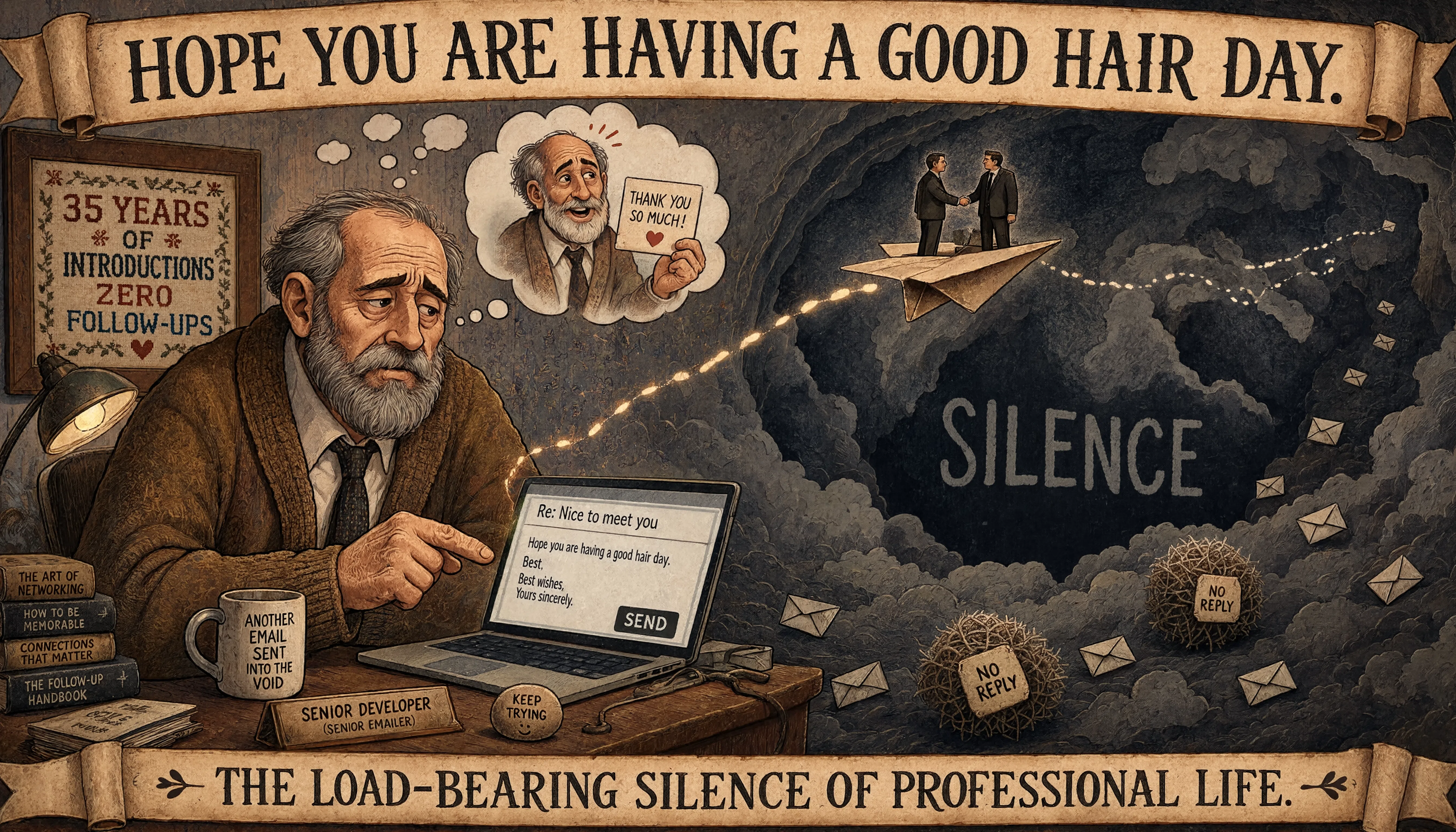
REVE AI Generated Audio VersionHope You Are Having a Good Hair DayI have been making introductions for thirty years. Thousands of them. Two people who should know each other, one email, done. It costs me nothing except the only thing I actually built in this life, which is knowing who is worth ten minutes of your time. And then, silence. Not rude silence. Not hostile silence. Just the ordinary, industrial-grade, load-bearing silence of professional life. The introduction goes out, the two of them meet, something happens or something doesn't, and I find out about it never. The most reliable lie in business"I'll keep you posted." There it is. The four most dependable words in the English language, dependable because they have never once in recorded history been followed by a post. Nobody has ever kept anybody posted. Not once. The phrase has a one hundred percent failure rate, which in any other field would get it recalled. "I'll keep you posted" is not a promise. It's a closing ceremony. It's how you end a conversation without the awkwardness of admitting you're finished with it, the professional cousin of "we should get coffee sometime," which means we should not get coffee sometime, and both of us know it, and we are grateful to each other for the arrangement. Somewhere in my head there is a folder marked Still Waiting. Thirty-five years of people who told me they would keep me posted and never did. It is a very large folder. It has its own weather system. However, I also have a smaller folder of non-extractive authentic eccentrics who do keep in touch and share (TBLI Circle, TBLI Hall of Fame and some others). Then Friday happenedTassianna Tassy , a TBLI Circle member, wrote to me last week. I'd suggested she meet someone. Here is the entire message: "Hi Robert, hope you are having a good hair day! I talked to John the other day. He is interested in using our services to better understand Haiti. He seems to be interested in Kinshasa as well. It was a positive conversation. I wanted to reach out to say thank you." Fifty-two words. Ninety seconds of her life. It made my entire day, and I am not a man who is easily made. Notice what's actually in there. She didn't just say thank you. She told me what happened. Haiti, Kinshasa, positive conversation. That's the part nobody sends. That's the part that turns a favour into information, because now I know the introduction worked, I know why it worked, and I know what to do the next time somebody needs the same thing. That is worth more to me than being thanked. It is worth more to me than being paid, and I want to be careful there, because my accountant reads these. So why doesn't anybody else do it?I've thought about this for years and I have four theories. They get worse. One: they think it's noise. They imagine you're a busy person with a full inbox and that news of their small success would be an imposition. Wrong, in a very specific way. It assumes the person who helped you was doing a transaction. They weren't. They were making a bet on you, with their own credibility as the stake, and nobody who places a bet considers the result an imposition. Two: gratitude feels like a debt. If I tell you it worked, I owe you. If I stay quiet, we're even. This is the accounting of a small mind and it is astonishingly common. People go silent precisely because it went well, because a success creates an obligation and a silence creates nothing, and nothing is cheaper. These are the same people who will tell you, on a stage, that business is about trust. Three, the honest one: it worked, so they don't need you anymore. This is the real answer and the other three are its packaging. Follow-up flows toward need. Watch the timestamps. Somebody who wants an introduction replies in four minutes, at eleven at night, from an airport, with warmth you could heat a house with. Somebody who already got it replies in eleven days, if the introduction failed, and never, if it succeeded. Same person. Different species. And once you see it you cannot unsee it, because the pattern is too clean to be an accident. The gratitude does not decay with time. It decays with usefulness. The moment you are no longer the door, you are furniture. What people are really telling you, without meaning to, is what they thought you were the whole time. Not a person. A resource. And you don't write to a resource to say how it went. You don't thank the cash machine. You don't send a note to the search engine explaining that the restaurant was lovely. You use the thing, you get the outcome, and you move. So the introduction wasn't a relationship, it was an extraction, and the silence isn't rudeness at all. It's an honest accounting. It is the most truthful thing they will ever tell you about the friendship, and they tell it by saying nothing. And here's the part that stings, because I have to be fair. There are people who did this to me and I will still take their call. I'll still make the introduction. I know exactly what I am, I know exactly what the silence meant, and I do it anyway, because the alternative is becoming the kind of man who keeps score, and that man is not any happier. He's just accurate. Four: it didn't work and they're embarrassed. This one I forgive completely, and it's the one that shouldn't exist, because failure is more useful to me than success. If the meeting was a disaster, tell me. I will stop making it. You just saved four other people from the same wasted hour and I will think better of you, not worse. Nobody has ever lost my respect by reporting a failure. They lose it by disappearing. The mathsHere's what makes this genuinely absurd. The entire industry runs on relationships. Every conference, every panel, every two thousand euro ticket, every LinkedIn post about the power of authentic human connection, posted by someone who has not replied to an email since March. Billions of euros of stated belief in the value of a network. And the single cheapest, highest-return act available inside that network, telling the person who helped you what happened, is the one thing almost nobody does. Ninety seconds. No downside. It makes the other person want to help you again, which is the closest thing to a free asset on this earth. And still, silence. We spend a fortune on relationship-building and not two minutes on relationship-keeping. We treat people as a customer acquisition problem when the whole game was always retention. What I'm askingThink of one person who helped you this year. An introduction, a piece of advice, a door held open, a name passed along. Now tell them what happened. Not thank you. What happened. It worked, it didn't, it went somewhere strange, the man was an idiot, the meeting was a home run. Whatever the truth is. Fifty words. You have fifty words. You waste more than that on a subject line. And if you can't manage it, fine. But drop the part at the next conference about how this industry is built on trust. Tassianna, thank you. The hair is fine, and the day was better for it. Join the Reader Community Radical Truth-My upcoming book about extraction #TBLI #RadicalTruth #ImpactInvesting #SustainableFinance
|

Photograph: Amazing Aerial/Alamy US territories hit out at Trump plan to explore deep sea mining in the PacificMar-Vic Cagurangan in Hagatna, GuamUS agency releases plan to lease millions of hectares of seabed off the coast of the Northern Mariana Islands and Guam A US government plan to lease out millions of hectares of seabed near the Mariana Trench for deep sea exploration has drawn opposition from US territories in the Pacific, as the Trump administration remains locked in a race with China for control of critical ocean minerals. On Tuesday, the Marine Mineral Administration (MMA), an agency under the US department of the interior, released a proposal to auction deep sea mining leases for 28m hectares (69m acres) of seafloor off the coast of the Northern Mariana Islands and Guam. The leases would allow companies to explore the seabed and potentially extract deposits of critical minerals – known as polymetallic nodules – that could be used in batteries, electronics and defence technologies. Many environmental groups have opposed deep sea mining, arguing that more research is needed on its effects on marine ecosystems. The Northern Mariana Islands is a self-governing commonwealth of the United States, while Guam is an unincorporated territory of the US. The governor of the Northern Marianas, David Apatang, has said his government would approach the Trump administration’s proposal “with extreme caution”. |
|
TBLI Group Herengracht 450, 1017 CA Amsterdam, The Netherlands |