 |
|
Tuesday,June 9, 2026 |
|
Author: Robert Rubinstein If you have difficulty reading this email, click here |
|||||
The Global Voice of ESG & Impact Investing |
|||||
|
|||||
|
New York, I Barely Recognize You And I Mean That as the Highest ComplimentAudio Version of Text I was a kid who grew up in the city's noise and grit, who knew the subway maps by heart, who understood that New York was magnificent and brutal in equal measure. When I left, I carried it with me — the energy, the ambition, the feeling that anything was possible — but I also left behind a city that was struggling. Crime was rising. The streets felt harder. The spirit was fraying. For fifty years, I have watched New York from a distance, with the particular ache of someone who loves a place they can no longer call home. Something has shifted. I have spent my career in the impact space — working at the intersection of capital, conscience, and human dignity. I believe, fundamentally, that systems can change. That cities, companies, and communities can be redesigned around people rather than against them. But belief is easy. Evidence is harder to come by. Which is why what is happening in New York right now feels so meaningful to me, not just as a former New Yorker, but as someone who has staked a professional life on the idea that things can actually get better. Mayor Zohran Mamdani stepped into office carrying something rare in modern politics: a genuine vision for what a city owes its people. Not a vision built on fear, or on the politics of division, but on the radical — and I use that word deliberately — notion that a great city should work for everyone who lives in it. The results speak for themselves. Crime is down. Not marginally, not statistically, but in the lived experience of the people on those streets. New Yorkers are friendlier. The tension that used to crackle in the air, that low-grade hostility that was just part of the deal when you lived there — it's lifting. I hear it from people who still live there. I see it in the city when I visit. This is what happens when leadership takes seriously the idea that safety and justice are not opposites. That investing in people — in housing, in mental health, in dignity — is not soft. It is the most practical thing you can do for a city. And then there are the Knicks. I know how this sounds. A basketball team as a measure of urban renaissance? But if you grew up in New York, you understand. The Knicks are not just a franchise. They are a mirror. When the city suffers, so do they. When the city rises, something happens in the Garden that you cannot quite explain to someone who didn't grow up feeling it in their chest. This Knicks team has done something I did not think I would live to see: they have made New York believe again. Not in a narrow, sports-fan way, but in a deeper sense. They play with joy. They play for each other. They play with a generosity of spirit — sharing the ball, celebrating one another, refusing the ego-driven isolation that has sunk so many talented teams — that feels almost like a rebuke to everything broken about modern culture. When I watch the Garden erupt, when I see 20,000 New Yorkers completely united in something, I feel something loosen in my chest. That is a city remembering itself. That is people choosing, for a few hours at least, to be part of something larger than themselves. That matters. I would argue, in fact, that it matters enormously. Here is what I have learned from decades in the impact space: culture and policy are not separate forces. They are in constant conversation. A mayor who governs with humanity changes the way citizens relate to one another. A basketball team that plays with joy and solidarity changes the way a city sees itself. These things are connected. Hope is contagious. Dignity is contagious. When you give people reasons to feel proud of where they live and who they are, the city reflects it back. New York is proof of something I care deeply about: that large cities — dense, complicated, beautifully messy cities — can be places where people don't just survive alongside each other, but actually thrive together. That the anonymity of urban life doesn't have to mean coldness. That a city of eight million can have a soul. I grew up believing New York was the greatest city in the world. I left before I could fully understand why I believed that, or whether it was even true. Now, fifty years later, watching from a distance, I think I finally understand. It was never the skyline. It was never the ambition, or the noise, or the mythology. It was always the people. And right now, the people are shining. Let's go Knicks. And thank you, New York, for giving the rest of us something to hope for. Robert Rubinstein is the founder of TBLI Group, a pioneering force in impact investing and sustainable finance. He has spent over three decades working to align capital with human dignity and ecological health. 👉 Follow Robert Rubinstein for more |
|||||
|
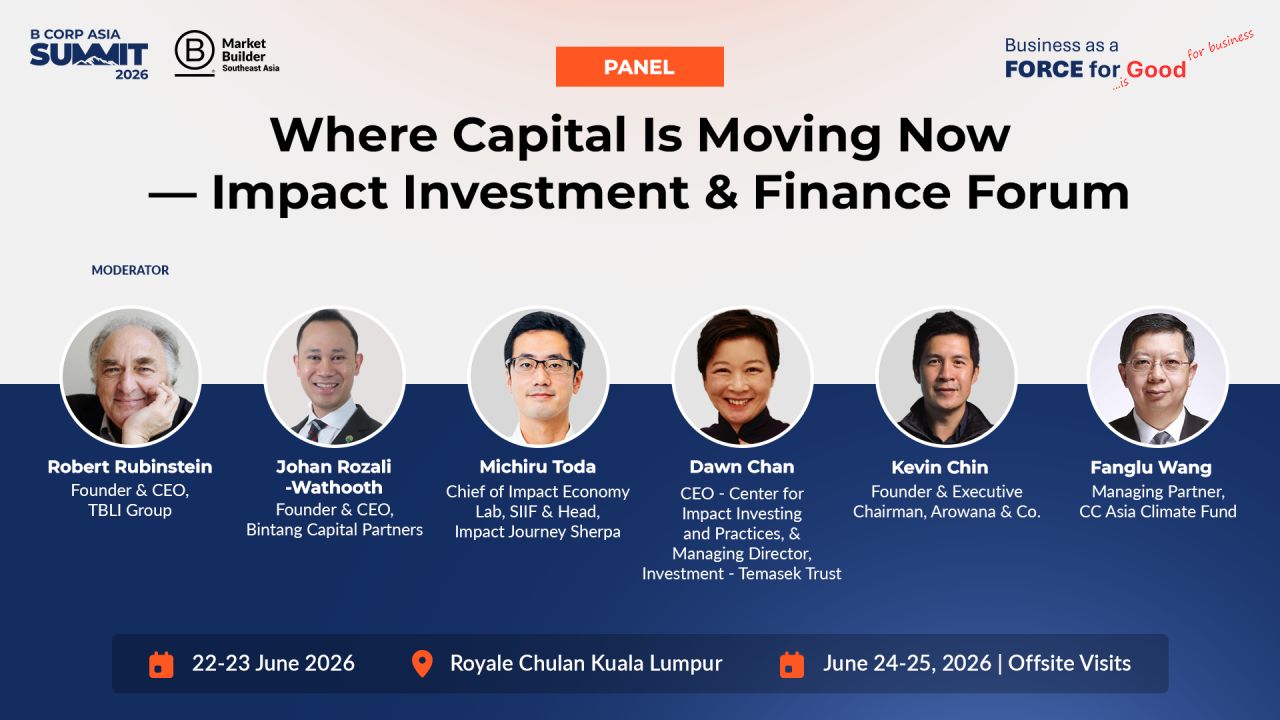
B Corp Asia Summit 2026-June 22-23, 2026 I'm excited to share that I'll be chairing this session-Where Capital Is Moving Now — Impact Investment & Finance Forum— and I can’t wait to be in the room with leaders from across Asia who are pushing this conversation forward. B Corp Asia Summit 2026, taking place in Kuala Lumpur on 22–23 June! If you’re attending, come say hi. If you’re not yet registered, click the link below. Seats are limited. Use this promo code: TBLI during registration and enjoy a special discount. #BCorpAsiaSummit2026 #BusinessAsAForceForGood #Genashtim #BCorp
|
|||||
|
TBLI Group Herengracht 450, 1017 CA Amsterdam, The Netherlands |


.png)