TBLI Radical Truth: The First Mental Health Impact Fund — Joshua Haynes on Nurture Capital & Why 65% of Startups Fail
Welcome to the TBLI Radical Truth Podcast, where we feature pioneers redefining the purpose of capital.
For 25 years, TBLI Group has been the world's leading ESG and impact investing network. Why Radical Truth is different: most finance podcasts protect the industry. Radical Truth interrogates it. Unfiltered conversations with the founders, fund managers, and system-changers actually moving capital toward a liveable future — and calling out the impact-washing that isn't. No sponsors. No pretending.
What if 65% of startup failures had nothing to do with product or market — and everything to do with unhealed founders? In this episode, host Robert Rubinstein, Founder of TBLI Group, sits down with Joshua Haynes, Co-Founding Partner of Masawa — one of the world's first mental health impact investment funds.
With co-founder Sabine Flechet, Joshua is pioneering Nurture Capital: a fund architecture with a 4x carry cap, 10% of carry shared with founders, 50% of carry tied to impact, and coaching and therapy paid from the management fee.
We explore:
Why 65% of early-stage startups really fail
What Nurture Capital changes in due diligence and founder support
Portfolio wins: Five Lives, Kwan, Psyon Games
Why "impact funds are VC funds with an impact sticker"
What every investor can do this week Real experience. No greenwashing.
For anyone serious about the history, present, and future of impact investing, this episode is essential listening.
Most events are full of people handing you business cards they'll never follow up on.
TBLI Connect is different.
The people in this room aren't there to pitch you. They're there because they're genuinely curious, deeply experienced, and building something that matters. They'll challenge your thinking, open unexpected doors, and actually remember your name next week.
This is where careers accelerate — not because someone handed you a referral, but because you found your people.
One conversation at TBLI Connect can change your trajectory.
We've seen it happen. Every. Single. Time.
👉 Join us July 31st — seats are limited and they go fast.
If you're serious about surrounding yourself with the right people, not just successful people, but generous ones, this is the most valuable hour you'll spend this summer.
See you there. Tag someone who needs to be in the room. ⬇️
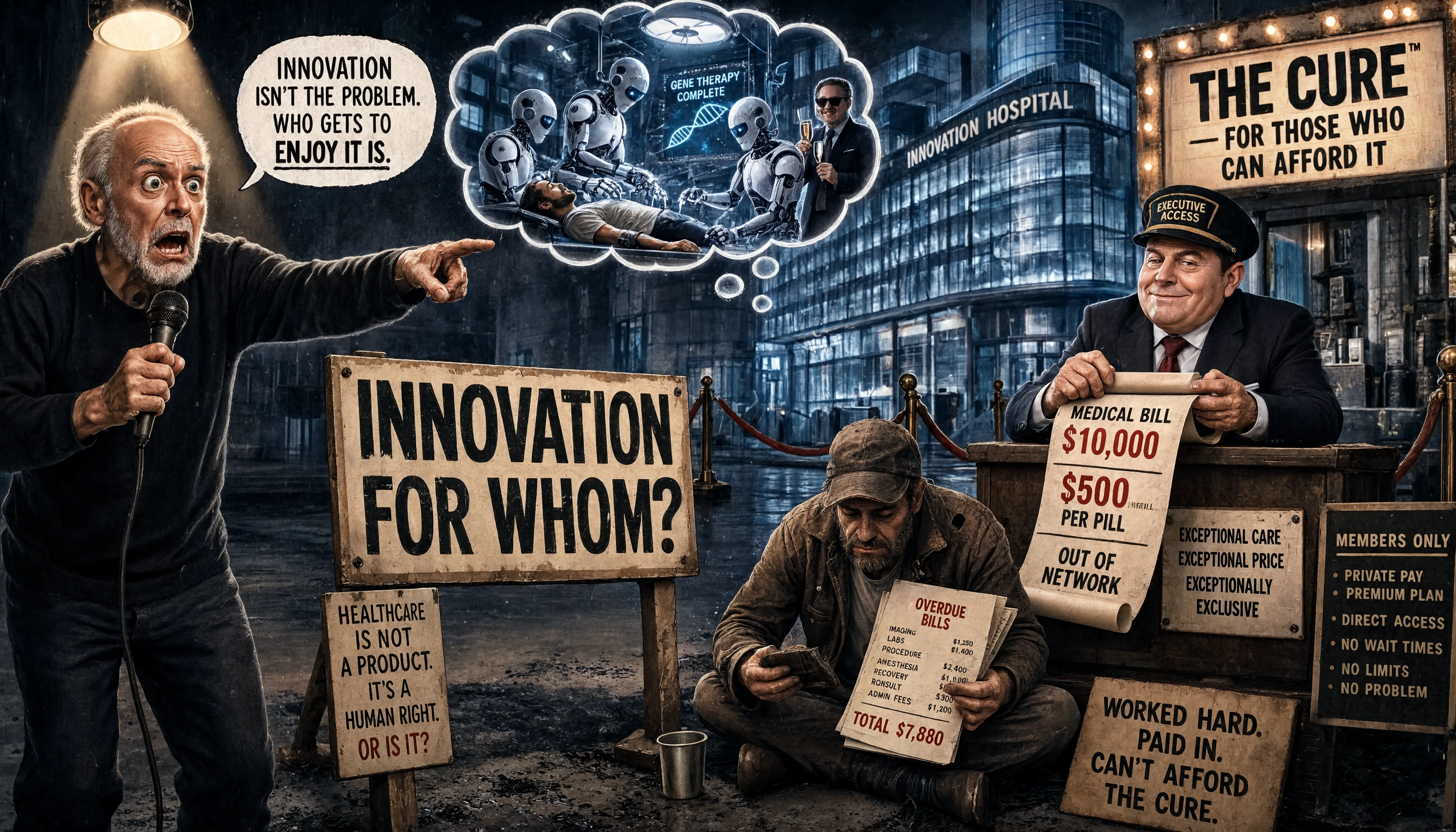
George Carlin had a bit about the American dream — you have to be asleep to believe it. Nowhere is that more obviously true than in how this country talks about "innovation."
America wins. Nobody's arguing that. U.S. venture capital deployed roughly five times what Europe managed in 2025 — Europe scraped together about $85 billion while American VC pulled in the lion's share of a global pool that dwarfs it. Almost all serious R&D from young public companies in this country runs through venture-backed firms. The US builds faster, funds faster, and ships faster than anyone on the planet. Ask any economist, and they'll tell you: America innovates, Europe regulates. It's practically a bumper sticker.
Nobody ever asks the follow-up question. Innovates toward what?
Start with food, because everybody eats. Eighty-five percent of the menu at America's six biggest fast food chains is classified as ultra-processed. Not "not great for you" — ultra-processed, the category scientists now link to obesity, diabetes, heart disease, cancer, and early death. About 70% of the packaged food in this country falls into that bucket, and kids get more than 60% of their daily calories from it. Here's the part that actually explains why: more than half of the $2.9 trillion food corporations paid out to shareholders since 1962 came from ultra-processed food makers alone. That's not an accident of the free market. That's the business model working exactly as designed. Meanwhile, a fast-food burger doesn't even taste like beef anymore; it tastes like the marketing budget that went into convincing you it does. Europe, for all its bureaucratic slowness, still bans additives that the USA hands out like breath mints. They didn't out-innovate them on food. America has just found a more profitable way to feed people less.
Then there's the phone in your pocket. American companies built the algorithm that knows exactly how long to hold your eyeballs hostage. It's genuinely brilliant engineering — variable reward loops, dopamine-timed notifications, feeds that rank content by your predicted engagement probability before you've even decided to look. And it's working: 48% of teenagers now say social media has a mostly negative effect on people their age, up from 32% just a few years ago. Nearly half of parents rank it as the single worst influence on their kid's mental health, ahead of everything else on the list. Teenagers logging four-plus hours a day are showing roughly double the odds of anxiety and depression symptoms. Nobody built that by accident. Nobody at those companies is losing sleep over it either, because the metric that matters isn't your kid's mental health, it's time-on-app. We didn't invent a way to connect people. American companies invented a way to monetize their loneliness and called it a platform.
Weapons are the cleanest version of the argument, because there's no pretending it's about anything else. This country still sells north of 14 million guns a year. There were 408 mass shootings in 2025 — more than one a day, on average — and the first quarter of 2026 already ran ahead of the same period a year earlier. Somewhere in a boardroom, that's a demand curve, not a body count. Carlin used to say the reason they call it the American Dream is that you have to be asleep to believe it; the reason gun manufacturers stay profitable is that grief has never once shown up on a balance sheet as a liability.
Now here's the one place the innovation machine goes quiet.
The country that built the iPhone, split the atom, mapped the genome, and can reverse a World Cup red card with one phone call cannot figure out how to get a diabetic her insulin without bankrupting her family. The USA spend roughly $15,000 per person on healthcare — nearly 18% of GDP. Germany, France, and the Netherlands spend about half that, sometimes less, and their citizens live four to five years longer than Americans do. Almost 30 cents of every healthcare dollar spent in this country goes to administration — people whose entire job is arguing with other people about whether your MRI counts. And two out of every three bankruptcies tied to medical bills anywhere in the developed world happen right here. Medical debt is the single leading cause of personal bankruptcy in this country — not gambling, not divorce, not bad investments. A doctor's bill. America is, as far as anyone can tell, the only country on earth that needed to invent a charity whose entire purpose is buying up and forgiving other people's medical debt before it destroys them; Undue Medical Debt, now run by Allison Sesso, has erased billions in bills nobody could pay. Sit with that for a second: the USA built a nonprofit fire brigade because the healthcare "innovation" itself is the fire. That's not a technology problem. They clearly have the technology. It's the one sector where the profit motive and the human outcome point in opposite directions, and so, uniquely among all of American innovation, they've simply declined to solve it.
And then there's what the country does with people once the system's done with them. America locks up more of its own citizens than any country on earth — roughly 5% of the world's population, and something like a fifth of the world's prisoners. Govt didn't just decide to incarcerate people at that rate. They built a business model around it. Private prison companies get paid per inmate, per bed, per night — which means an empty cell is a loss on someone's quarterly earnings call. We privatized the one institution where the incentive should never, ever be "keep it full," and then acted surprised when it stayed full.
That's the tell. When the money and the mission line up, this country moves faster than anyone in history. When they don't, when the innovation would actually help someone instead of extracting from them, suddenly they're the slowest country in the room, wondering aloud why it's "so complicated."
It was never complicated. It just wasn't profitable enough to fix.
Carlin's line was that they don't want a population capable of critical thinking; they want obedient workers just smart enough to run the machines. Update it for 2026: they don't want a population that's well-fed, mentally healthy, safe, and insured. They want a population engaged, addicted, armed, and one hospital bill away from compliant. Every industry above figured out how to monetize the gap between what people need and what they're given. Healthcare is the one place that gap is so wide and so lucrative to leave open that even the best innovation engine on earth decided not to close it.
So no, America didn't fail to solve affordable healthcare. Failure implies somebody tried and came up short. Nobody tried. You don't spend a century building the most sophisticated profit-extraction machine in human history and then forget, whoops, to point it at the one thing that would've helped people the most. That's not failure. That's the plan working.
They just never tried, because sick and scared pays better than healthy and affordable. And until enough people notice they're the product, not the customer, that bill's going to keep coming due, with interest.
As climate and conflict collide, Indigenous leaders confront overlapping crises at the UN
The 19th session of the Expert Mechanism on the Rights of Indigenous Peoples will focus on violence, disaster relief, artificial intelligence, and more.
Although it’s been nearly 20 years since more than 100 countries adopted the United Nations Declaration on the Rights of Indigenous Peoples, the rights and lives of those it is meant to protect remain under constant threat from compounding crises. Indigenous lands are battered by record-breaking storms, dessicated by drought, and vanishing under rising seas. Amid these climate-driven threats, Indigenous peoples continue dying by the hundreds in wars and while defending their lands, even as they are persecuted by government officials.
“Climate change, militarization, extractivism, and legal marginalization reinforce one another,” said Binota Moy Dhamai, who is Tripura from the Chittagong Hill Tracts in Bangladesh, and a former chair of the United Nations Expert Mechanism on the Rights of Indigenous Peoples, or EMRIP.
Inside a Microsoft datacentre. The company’s carbon emissions rose by 25 % over the past year to 20m TCO₂e. Photograph: Audrey Richardson/Reuters
Datacentres drive up big tech’s carbon emissions to a third of those of France
Microsoft, Amazon and Google say they still aim to achieve net zero output despite construction boom
In the financial year ending March 2026, the three tech companies emitted 119m mTCO₂e (metric tonnes of carbon dioxide equivalent), or about a third of those of France.
The previous year, they emitted roughly 101m mTCO₂e, roughly equivalent to the 2024 emissions of Czechia.
The US companies’ climate ambitions have been hit in recent years by a boom in demand for cloud services, such as storing data or running servers over the internet, related to training and operating chatbots and other AI products.
Cecilia Rikap, an economics professor at University College London, said: “Claims by Microsoft, Amazon and Google about their clouds being ecologically friendly and sustainable are a marketing strategy. Governments should remember these expanding carbon footprints when the very same companies offer addressing the ecological crisis with AI solutions.
“And, as migration to their clouds expands, and companies store data and train and use AI models and all sorts of digital technologies, these other companies are outsourcing their own digital/AI carbon footprint to cloud giants. Basically, shifting to the cloud helps other corporations obscure their environmental footprint.”
Microsoft, Google and Amazon were contacted for comment.
These increases were documented in the companies’ annual sustainability reports, which they have released over the past weeks. In its report released on Thursday, Microsoft said its carbon emissions had increased by 25% over the past year to 20m mTCO₂e, “driven primarily by the expansion of our datacentre infrastructure”.
Google said its emissions had increased 18% over the past year, “driven by increases in supply chain activities that supported the rapid expansion of our business”. The search company says its AI systems have come up with solutions that have already helped to reduce emissions elsewhere by 41m tonnes of CO2 last year.
Amazon reported a 16% increase in emissions overall, and a 20% increase in supply chain emissions, which included datacentre building and construction. In its report, it still framed this as “making progress” towards its goal of net zero emissions in 2040.
UAE-based clean energy-focused developer Masdar announced that it has secured a $5.1 billion financing package, reaching financial close to build one of the largest solar and battery storage projects in the world, capable of delivering 1GW of continuous clean power.
Described by Masdar as the world’s first gigascale 24/7 renewable energy project, the new Abu Dhabi-based RTC project will include a 5.2GW solar photovoltaic (PV) plant with a 19 gigawatt-hour (GWh) battery energy storage system (BESS), enabling the delivery of 1 GW f continuous baseload clean energy.
Currently being developed in Abu Dhabi by Masdar and Emirates Water and Electricity Company (EWEC), the new RTC project is expected to represent a capital investment of $6.1 billion, including $1 billion in equity funded by Masdar.
The financing package was provided by a consortium of 13 international and local banks, including Abu Dhabi Commercial Bank, Abu Dhabi Islamic Bank, BNP Paribas, Bank of China, Crédit Agricole Corporate and Investment Bank, Dubai Islamic Bank, First Abu Dhabi Bank, HSBC, KfW IPEX-Bank, Natixis, Sumitomo Mitsui Banking Corporation, Standard Chartered, and Societe Generale.
Mazin Khan, Chief Financial Officer at Masdar, said:
“This significant financing commitment demonstrates the confidence of the international banking community not only in a landmark project but also in Masdar’s financial strength, disciplined execution and long-term growth strategy. This milestone further demonstrates our ability to mobilize global capital at scale while delivering innovative renewable infrastructure that supports long-term economic growth and energy security.”
Masdar broke ground on the project in October 2025, and it is expected to be operational in 2027.
 TBLI Radical Truth: The First Mental Health Impact Fund — Joshua Haynes on Nurture Capital & Why 65% of Startups Fail