TBLI Radical Truth: "ESG Is Mostly Greenwashing," Says Harvard & Cambridge Professor Christopher Marquis
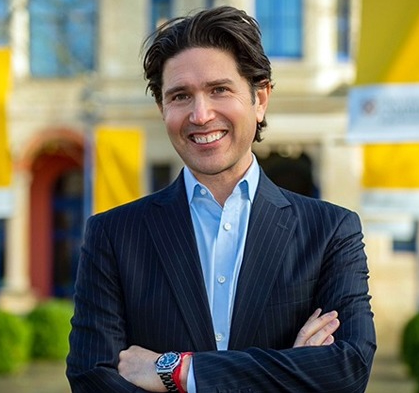
Harvard- and Cambridge-trained business professor Christopher Marquis has spent 25 years studying corporate sustainability — and concluded most of it is a smokescreen. In this episode of Radical Truth, he and Robert Rubinstein take apart the Business Roundtable's famous 2019 stakeholder pledge, the BlackRock/Larry Fink retreat from ESG, and why a $1B+ carbon capture company can raise money without pulling any real CO2 out of the air.
Christopher Marquis is the Sinyi Professor at Cambridge Judge Business School, formerly of Cornell and Harvard Business School, and author of "The Profiteers: How Business Privatizes Profits and Socializes Costs" (named to Thinkers50's 2025 Best New Management Booklist), "Better Business: How the B Corp Movement Is Remaking Capitalism," and "Mao and Markets."
What we cover:
Why companies that signed the Business Roundtable's 2019 stakeholder pledge performed worse on environment and labor than those that didn't
How BlackRock's ESG commitments evaporated the moment Texas pulled its funds — proof it was never about values
Why Climeworks raised over $1 billion for carbon capture that barely removes any carbon — and who really benefits
The "fitness club membership" problem: why everyone wants the ESG badge and nobody uses the machines
Christopher Marquis's book "The Profiteers: How Business Privatizes Profits and Socializes Costs" is out now from PublicAffairs/Hachette.
Radical Truth is the podcast from TBLI Group, hosted by Robert Rubinstein, going into the honest, uncomfortable conversations family offices, LPs, and asset managers have about capital with purpose. New episodes weekly — subscribe so you don't miss the next one.
For anyone serious about the history, present, and future of impact investing, this episode is essential listening.
Most events are full of people handing you business cards they'll never follow up on.
TBLI Connect is different.
The people in this room aren't there to pitch you. They're there because they're genuinely curious, deeply experienced, and building something that matters. They'll challenge your thinking, open unexpected doors, and actually remember your name next week.
This is where careers accelerate — not because someone handed you a referral, but because you found your people.
One conversation at TBLI Connect can change your trajectory.
We've seen it happen. Every. Single. Time.
👉 Join us July 31st — seats are limited and they go fast.
If you're serious about surrounding yourself with the right people, not just successful people, but generous ones, this is the most valuable hour you'll spend this summer.
See you there. Tag someone who needs to be in the room. ⬇️
Join the Radical Truth Community-Free
Most of what passes for "sustainable" or "impact" investing is a comfortable half-truth. We've been saying the polite version for years because the whole truth is inconvenient — and it's costing the industry its credibility.
That's the premise behind Robert Rubinstein's upcoming book, Radical Truth. Ahead of publication, TBLI Circle is opening a free space for the conversation our industry keeps avoiding: what's actually broken in how capital gets allocated, and what it will take to fix it.
Inside: early excerpts from the book, direct discussions with Robert and fellow members, and a serious community that manages appearances.
Membership is free. If you've been having this conversation in your head, come have it out loud.
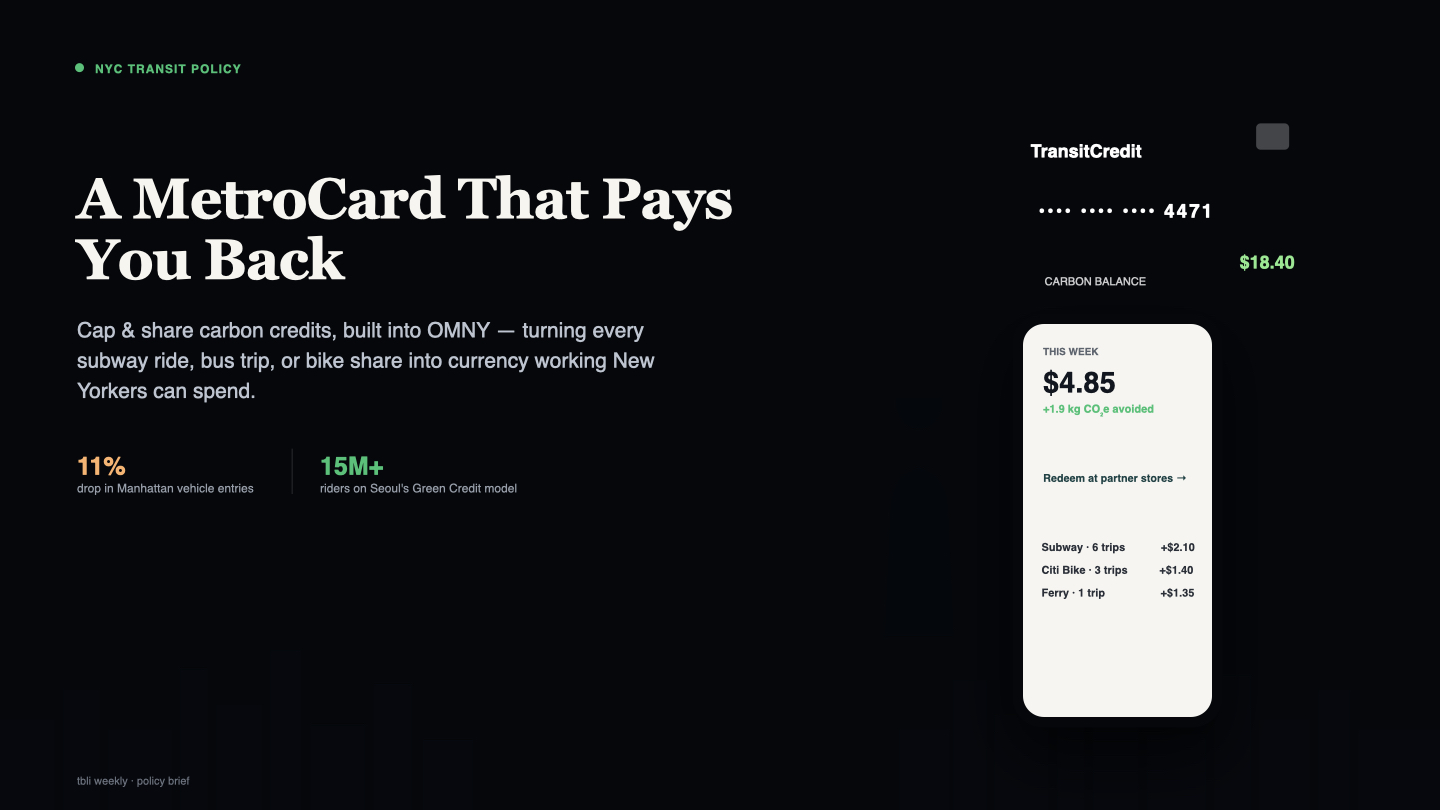
A MetroCard That Pays You Back: The Case for a NYC Cap-and-Share Transit Credit
New York is mid-transition. OMNY is replacing the MetroCard. Congestion pricing has already cut vehicle entries into Manhattan below 60th Street by 11% and generated over $550 million for transit in its first year. The infrastructure and the political appetite for rewarding lower-carbon travel are both, for once, pointed the same direction. What's missing is the mechanism that turns "you took the subway instead of driving" into something a working New Yorker can feel in their wallet.
Here's the idea: a cap-and-share carbon credit system built into the OMNY card or a companion app. Every trip on the subway, bus, ferry, Citi Bike, e-bike, or EV car share is measured against a driving-alone baseline. The carbon avoided gets logged, verified, and converted into a running balance. That balance spends like money — toward transit fares, groceries at partner stores, museum admission, or anything else a participating city partner agrees to accept.
This isn't a hypothetical. It's a pattern that's already working elsewhere, at scale:
South Korea's Green Credit Card has been issued to more than 15 million people. Riders earn points for using public transit, buying eco-friendly products, and cutting utility use — redeemable for cash or donations to environmental funds.
Bologna's Bella Mossa app uses GPS to log walking, cycling, and bus trips and converts them into points good for beer, ice cream, and movie tickets at local businesses — a small-scale proof that "green miles" can function as local currency.
Copenhagen's CopenPay rewarded cyclists and pedestrians with over 100 local business partners in its 2025 expansion, following a pilot that drove a 29% jump in bike rentals.
Washington, DC's CommuterCash and Pool Rewards program pays commuters directly for taking transit during peak hours or carpooling.
Moovit and Greenlines Technology have already built the plumbing for this at the platform level — a "Mobility Carbon Engine" that lets transit apps register verified carbon credits from individual rider trips, with pilots showing an average of 1.23 kg of CO2e saved per trip switched away from driving. Shenzhen and Beijing run comparable green-travel credit platforms for millions of riders.
None of this is speculative technology. It's proven consumer behavior, proven MRV (measurement, reporting, verification) infrastructure, and — critically — a real, if young, market of buyers for verified mobility carbon credits. What no one has done yet is stitch it into a legacy card system as large as OMNY's, in a city with New York's transit density and its combination of subway, bus, ferry, and bike-share networks all under one roof. Japan's Suica card is the closest cultural reference point Robert's brief pointed to: an IC card that already handles fares, retail purchases, and loyalty points (JRE POINT) in one tap. NYC's OMNY rollout is the natural moment to build a carbon layer on top of that same tap.
Why this matters for working people specifically. The New Yorkers who already ride the subway, bike, or walk because they don't own a car are disproportionately lower- and middle-income, and outer-borough. Today they get zero financial credit for the emissions they're already not producing. A cap-and-share system flips that: it stops treating sustainable transportation as a moral default and starts treating it as an asset that pays back. Redeeming credits against fares, groceries, or a museum membership is a real cost offset, not a gesture.
How it could be funded. Four streams, layered: verified carbon credits sold into the voluntary mobility carbon market (the Moovit/Greenlines model shows buyers exist); a modest allocation from congestion pricing revenue, which is already funding transit capital projects; retail and cultural partners who'd rather subsidize a credit than pay for advertising, in exchange for foot traffic; and philanthropic or ESG-driven corporate sponsorship, which has funded similar pilots in Copenhagen and Bologna.
Why it scales past New York. Every piece of this — the point-card infrastructure, the GPS-verified trip logging, the retail partner network, the carbon credit market — has already been proven independently in Seoul, Bologna, Copenhagen, Shenzhen, and DC. New York's contribution would be doing it at subway scale, on a transit card system that's already being rebuilt from the ground up. Once the model is proven here, it's a template any transit-card city — Chicago's Ventra, Boston's Charlie Card, London's Oyster — could adapt to local carbon math and local partners.
The pieces exist. The infrastructure is being rebuilt right now. What's needed is a pilot — one borough, one fare season, a handful of retail and cultural partners willing to accept carbon credits as partial payment — to prove that rewarding the ride New Yorkers already take is good policy, not just good branding.
The Crescent Dunes project in the Nevada desert harnesses the sun’s power to heat a reservoir of potassium and sodium nitrate to 560C. Photograph: UCG/Universal Images Group/Getty Images
Molten salt and human sweat: the weird batteries that could store renewable energy
From Nevada to Manchester, developers are trialling innovative solutions to clean energy’s biggest challenge
In the deserts of the United Arab Emirates a sprawling clean energy project, stretching across an area roughly the size of 12,600 football fields, will play host to a breakthrough allowing solar energy to power the equivalent of half a million homes through the night.
The Gulf state has been steadily combining 5.2GW of solar power capacity with 19GWh of battery storage to create the largest battery scheme in the world.
Meanwhile, about 7,500 miles away, at the US’s National Renewable Energy Laboratory facility in Colorado, researchers and engineers are making some of the smallest batteries the world has ever seen. A fraction of the size of the grid-scale lithium-ion batteries used to store renewable energy, they have been designed to power electronic tags that will track the 3in-long (about 7.5cm) young from salmon and eel species.
As traditional lithium-ion batteries push boundaries in size and scale, alternative battery types could provide the same vital role in harnessing low-carbon energy – but without the scramble for critical minerals such as lithium, cobalt and nickel that have raised concerns for environmental protection and vulnerable communities.
The European Commission announced that it has approved a €63 billion state aid program by France to support the construction of offshore wind projects over 25 years, aimed at contributing towards the transition towards a net zero economy and aligning with the objectives of the EU’s Clean Industrial Deal.
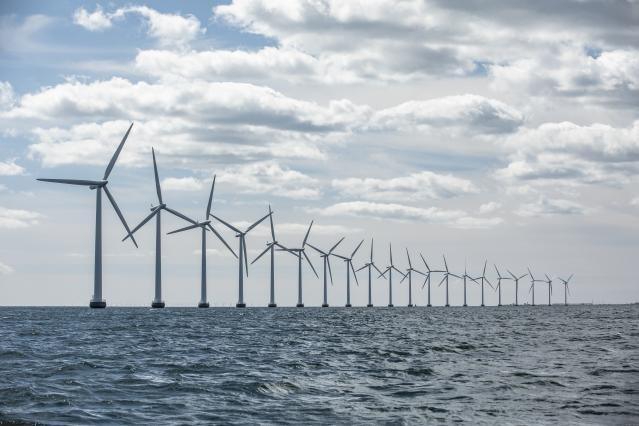
The French program will support the construction and operation of eleven offshore wind farms, in the North Sea, the Atlantic and the Mediterranean. The windfarms are expected to have a combined capacity of up to 11.1 GW and to generate up to 47.8 TW of renewable electricity per year, equivalent to more than 10% of France’s annual electricity consumption.
The Commission’s approval was made under the new Clean Industrial Deal State Aid Framework (CISAF), designed to enable Member States to provide support for goals including clean energy development, industrial decarbonization and clean technology.
Adopted in May 2025, CISAF allows for quicker approval of State aid measures for the roll-out of renewable energy and ensure sufficient manufacturing capacity of clean tech. The framework forms part of the EU’s Clean Industrial Deal, aimed at accelerating decarbonization initiatives while supporting manufacturing in Europe, and addressing key challenges including climate change and industrial competitiveness.
Under the scheme, the aid will take the form of a variable premium under a two-way contract for difference (CfD) which will be calculated by comparing a reference price, determined in the tender offer of the beneficiary (‘pay as bid’), to the market price for electricity. If electricity market prices are lower than the strike price, the state will pay the difference. If they are higher, the companies will pay back the difference to the state. The aid will be granted on the basis of a transparent and non-discriminatory bidding process.
The Commission said that the French scheme aligns with the conditions set out in the CISAF and is necessary, appropriate and proportionate to accelerate the transition towards a net-zero economy and facilitate the development of certain economic activities that are important for the implementation of the CISAF.
Teresa Ribera, Executive Vice-President for Clean, Just and Competitive Transition, said:
“Today’s decision clears the way for France’s offshore wind support scheme. France will continue working towards a fully decarbonised energy system, and the Commission will continue supporting Member States in achieving our common climate objectives.”
The announcement follows the Commission’s recent approval under CISAF of a €23 billion state aid program by Italy to support the deployment of renewable electricity generation.

 TBLI Radical Truth: "ESG Is Mostly Greenwashing," Says Harvard & Cambridge Professor Christopher Marquis