 |
|
Tuesday, August 4, 2026 |
|
Author: Robert Rubinstein If you have difficulty reading this email, click here |
The Global Voice of ESG & Impact Investing
I hate to use the word family, as so many use it without any real meaning. A woman who wanted to be a partner in TBLI claimed "we are family" and then went about stealing money from us and only extracting whatever she could.
|
|
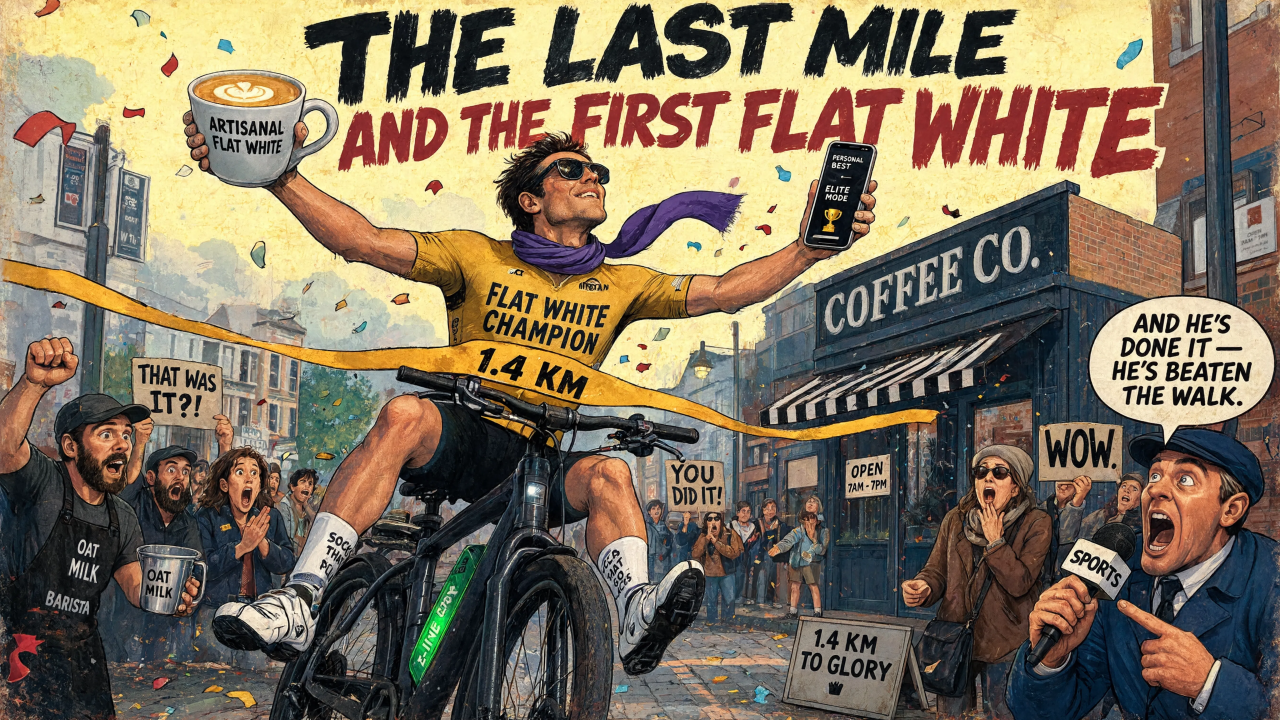
Reve AI Generated The Last Mile and the First Flat WhiteAudio VersionThere is a young man outside my window at this very moment, and he is not pedalling. I want to be precise about this, because precision matters. His legs are moving. There is a rotational quality to the knees. But the bicycle is doing the bicycle-ing, and he is performing a sort of ceremonial genuflection to the concept of cycling, the way a man in a lift might shift his weight to help it get to the fourth floor. He is going 1.4 kilometres. I know this because he told me. He told everyone. He has an app. The machineThe bike cost € 2,800. I asked. He didn't wait for the question, in the way that people who have spent €2,800 on a bicycle never do. It has a "torque sensor," which apparently means the bike can detect the intention of effort and reward it, which is the most Gen Z sentence ever committed to engineering. Not effort. The intention of effort. There is a mode called ECO, which is for when you want the bike to do slightly less of the thing you bought it to do, and a mode called TURBO, which is for the bit outside the coffee shop. There is a small screen. The small screen tells him how many calories he has burned. It is being generous. It is being the kind of generous that a mother is when she says a drawing is very good. The frame is matte black, because gloss is for people who have not thought about it. The tyres are fat, because he might one day encounter gravel. He will not encounter gravel. The nearest gravel is a garden centre in Amstelveen and he does not drive. The battery gives him 60 kilometres of range. He uses 2.8 of them a day, round trip, which means he has purchased approximately three weeks of unused potential, permanently, in advance, and carries it up two flights of stairs every evening to charge it. He has never once ridden it for pleasure. He rides it for the commute, and the commute is shorter than a decent podcast episode. Meanwhile, and I say this gently, there is a tram. It goes to the same place. It costs €1.80. It has a roof. The beanThe destination is a coffee shop with no sign on it. This is not an oversight; this is the entire proposition. If you have to ask which one it is, the coffee is not for you, and frankly neither is the neighbourhood. Inside, the menu is written in chalk by someone with a fine-arts degree and a grievance. There is no "large." There is no "small." There is a single serve and a split, and if you ask for it to go, a young woman with a fringe like a closing curtain will look at you the way a sommelier looks at ice. Today's offering has a card next to it. The card is longer than most rental agreements. It says the beans were grown at 1,900 metres in the Andes, on the shaded eastern slope, tended by a fourth-generation family cooperative. It says the cherries were consumed and partially digested by a small mammal (a civet, a weasel, something with a face and no consent form), and then retrieved, and then washed, presumably quite thoroughly, and then carried down the mountain by donkey, because a van would compromise the flavour profile. The donkey has a name. The donkey's name is on the card. The donkey has better brand recognition than most mid-tier footballers. The coffee costs €7.40. It arrives in a vessel with no handle, so that you may experience the temperature as information. It tastes, and I want to be fair here, genuinely lovely. It tastes like a stone fruit that has read philosophy. It also tastes like eleven minutes of a barista's life and the digestive tract of a nocturnal mammal, and I cannot fully separate those things in my mouth. He photographs it. Of course he photographs it. Not to drink it, but to file it. The coffee is not a beverage, it is a receipt. It is proof of arrival, in the same way the bike is proof of departure. The entire journey has been designed backwards from the photograph. The reckoningHere's what gets me, and I promise this is affection wearing a disguise. We have taken the two cheapest pleasures available to a human being (moving your own body through a city, and drinking a hot brown thing while thinking) and we have successfully attached a payment terminal to both ends. Exercise has been outsourced to a lithium-ion battery. Contemplation has been outsourced to a card with a donkey's CV on it. The generation that will tell you, correctly and at length, about overconsumption and supply chains and the tyranny of stuff, has arrived at a lifestyle that requires an intercontinental mammal-mediated bean logistics operation and a vehicle with a firmware update schedule. To go 1.4 kilometres. For a drink. There is a version of this morning that costs €1.80 and 15 minutes and involves a tram, a pair of legs, and a cup of coffee that has passed through nothing but a kettle. It is available right now. It has been available the whole time. Nobody is stopping anyone. But it doesn't photograph, does it? He's leaving now. TURBO mode. Downhill. What a guy!! My friend, Ben, a MacArthur Genius Award winner, had a great expression. During the period that walkmans took over the world, I asked him "Why don't you have a Walkman?". He responded without missing a beat "WHAT EVER HAPPENED TO WHISTLING?" For full transparency, I started the first bicycle magazine in the Netherlands called Fiets. I love bicycles just not e-bikes. They are the best means of transport in a city, apart from walking and public transport Robert Rubinstein — TBLI Group. Still arguing that finance should serve all stakeholders. Still having bad hair days. Radical Truth Podcasts |
|
|
|
TBLI Group Herengracht 450, 1017 CA Amsterdam, The Netherlands |