|
Author: Robert Rubinstein
|
"Happy New Year! As we enter 2026, we are grateful for the dedicated leaders in the TBLI network who are redefining success and pursuing their big purpose. Thank you for being so supportive."
TBLI Team.
Two roads diverged in a wood, and I - I took the one less traveled by, and that has made all the difference.
|
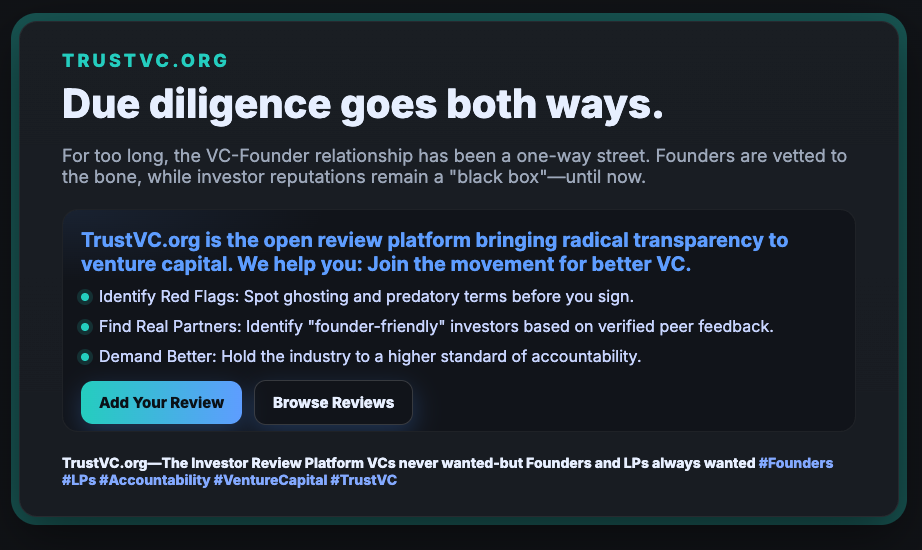
Due diligence goes both ways.
For too long, the VC-Founder relationship has been a one-way street. Founders are vetted to the bone, while investor reputations remain a "black box"—until now.
TrustVC.org is the open review platform bringing radical transparency to venture capital. We help you:
-
Identify Red Flags: Spot ghosting and predatory terms before you sign.
-
Find Real Partners: Identify "founder-friendly" investors based on verified peer feedback.
-
Demand Better: Hold the industry to a higher standard of accountability.
Don't raise capital in the dark. See what your peers are saying.
|
|
TBLI Virtual Mixer

Don’t enter 2026 with a static network.
The final TBLI Virtual Mixer of the year is happening on January 30th. While the rest of the world slows down, this is your opportunity to strategically align with the leaders shaping the future of sustainable finance.
Why join us for this new 2026 session?
-
Refine Your 2026 Strategy: Discuss upcoming mandates and trends while they are top-of-mind.
-
The TBLI Difference: We prioritize Quality over Quantity. No sales pitches, no "fluff"—just genuine conversations with peers.
-
High Value, Low Pressure: Network from the comfort of your home during the holiday season.
Close out the year by investing in the relationships that will define your 2026.
👉 [Link to Register]
Last Mixer achieved 292 matches.
🗓️ January 30 🕓 16:00 CET
Secure your spot now:
|
|

The Great California Billionaire Exodus: A Love Story About Money and Cowardice
California’s proposed 2026 Billionaire Tax Act (Initiative 25-0024) seeks a one-time 5% excise tax on residents with a net worth of $1 billion or more. Currently gathering signatures for the November 2026 ballot, the tax would allow payments to be spread over five years and would likely exclude real estate and pensions.
The measure aims to raise roughly $100 billion, earmarking 90% for healthcare and 10% for education. However, it faces intense opposition; because the tax applies to anyone resident as of January 1, 2026, critics warn of a "billionaire exodus" as wealthy individuals consider leaving the state to avoid the levy.
This has reportedly prompted several high-profile billionaires (such as Peter Thiel and Larry Page) to consider leaving the state before the end of 2025 to avoid the levy.
So let me get this straight. These titans of industry, these masters of the universe, these guys who've been lecturing us for years about "changing the world" and "making a dent in the universe" are now running away from California because they might have to pay a little more in taxes.
How perfectly, exquisitely, predictably pathetic.
You've got Elon Musk, who already fled to Texas—a state with such a passionate commitment to infrastructure that their power grid collapses if someone sneezes—claiming it was about "freedom." Sure, Elon. Freedom. Not the billions in tax savings. Must have been all that oppressive California sunshine getting in the way of your ketamine and Twitter addiction.
And now we've got the Google boys, Sergey Brin and Larry Page, apparently eyeing the exits. These are guys who built their empire on California's public university system, drove on California's roads to their first investors, hired from California's educated workforce, and benefited from decades of California's innovation ecosystem. But now that California wants them to pay a 5% wealth tax on net worth over $1 billion? "Sorry, can't do it. That's socialism. We're out."
Let me repeat that for the people in the back: five percent. Not fifteen percent. Not fifty percent. Five Percent. On wealth over a billion dollars. If you have $1 billion, you'd pay $50 million. You'd still have $950 million. You could lose $50 million in your couch cushions and not notice.
Chamath Palihapitiya—the guy who made his fortune at Facebook helping turn human psychology into an advertising delivery mechanism—he's also reportedly considering his options. And here's the absolute chef's kiss of irony: his fund is called Social Capital.
SOCIAL CAPITAL
You cannot make this up. The man runs an investment fund literally named after the concept of communal value and societal bonds, and he's threatening to bail on California rather than pay 5% to contribute to, you know, actual social capital. The roads. The schools. The infrastructure. The things that made his billions possible in the first place.
It's like naming your company "We Care About Orphans Inc." and then running over an orphan in your Lamborghini on the way to your tax lawyer's office.
The Great California Giveaway
Here's what these billionaires conveniently forget: California didn't just happen to be where they got rich. California made them rich.
Stanford and Berkeley—public and private universities supported by California's education ecosystem—trained their engineers. California's power grid kept their servers running. California's roads moved their products. California's legal system protected their patents. California's relatively functional government kept society stable enough that skilled immigrants actually wanted to come here. California's culture of innovation, funded by decades of public and private investment, created the entire venture capital ecosystem that gave them their seed money.
Sergey Brin and Larry Page didn't invent Google in a vacuum. They did it at Stanford, using NSF-funded research, in an ecosystem built over fifty years of public investment in technology and education. The algorithm that made them billionaires was developed with federal grant money—taxpayer money.
But now California wants to collect on that investment? Now that these guys have more money than they could spend in a thousand lifetimes? Now California wants 5% once to fix the roads their trucks destroyed, to educate the next generation of workers, to house the people priced out by their real estate speculation?
Nope. Too much. Gotta go.
"If you want to know what God thinks of money, just look at the people he gave it to."
DOROTHY PARKER
👉 Follow Robert Rubinstein for more
|

Date: June 22-23, 2026,
Location: Kuala Lumpur, Malaysia
This B Corp Asia Summit 2026 brings together thought leaders and practitioners to showcase the emerging trend that Business as a FORCE for Good is Good for Business.Global MNCs, as well as Asian SMEs share how incorporating positive impact on how you run your business translates into financial success.
Pay US$90 by 15th January 2026 to secure Early bird rate and free offsites
|
| |
The Trump administration has given corporations plenty of convenient excuses to retreat from their climate commitments, with its moves to withdraw from the Paris Agreement, roll back emissions regulations, and scale back clean energy incentives.
But will the world’s largest corporations follow its lead?
Some multinational companies have indeed scaled back. For instance, Wells Fargo dropped its goal for the companies the bank finances to reach net-zero emissions by 2050, saying the conditions necessary for meeting that goal, such as policy certainty, consumer behavior and the pace of clean technology development, hadn’t fully materialized. Oil giant BP told investors that earlier optimism about a fast transition to renewable energy was “misplaced” given the changing regulatory environment.
However, many others, including the world’s largest retailer, Walmart, aren’t trading their long-term risk planning for Washington’s focus on short-term cost savings. They are continuing their climate policies, but often doing so quietly to avoid scrutiny.
These companies still face ongoing pressure from state and local governments, the European Union, customers and other sources to reduce their impact on the climate. They also see ways to gain a competitive advantage from investing in a cleaner future.
For my new book, “Corporations at Climate Crossroads,” I interviewed executives and analyzed corporate climate actions and environmental performance of Global 500 and S&P 500 companies over the past decade.
These companies’ climate decisions are driven by a complex interplay of pressures from existing and future laws and the need to earn goodwill with employees, customers, investors, regulators, and others.
States wield influence, too
In the U.S., state climate regulations affect multinational corporations. That’s especially true in California – the world’s fourth largest economy and the state with the largest population.
While President Donald Trump dismantles U.S. climate policies and federal oversight, California and the European Union have moved in the opposite direction, become de facto regulators for global businesses.
California’s newly enacted climate laws extend its cap-and-trade program, now called “cap and invest,” which is designed to ratchet down corporate emissions. They also lock in binding targets to reach net-zero greenhouse gas emissions by 2045. And they set clean-power levels that rival the Europe Union’s Green Deal and outpace most national governments.
Other states have joined California in committing to meet the goals of the international Paris climate agreement as part of the U.S. Climate Alliance. The bipartisan coalition of 24 governors, from Arizona’s to Vermont’s, represents over half of the U.S. population.
Several states have been considering “polluters pay” laws. These laws would require companies to pay for their contributions to climate change, with the money going into funds for adaptation projects. Vermont and New York passed similar laws in 2024.
Climate laws still apply in Europe and elsewhere
Outside the U.S., several countries have climate regulations that multinational companies must follow.
The European Union aims to cut its emissions by at least 50% by 2030 through policies including binding climate reporting rules for large corporations and carbon taxes for goods entering the EU, along with initiatives to support innovation and competitiveness in clean energy and green infrastructure. It has recently recalibrated its approach to focus on the largest corporations, reducing administrative burden of smaller firms. The EU’s broader “Fit for 55” framework still aims to cut its emissions by 55 percent by 2030 through policies like binding climate reporting rules. Most notably, the carbon taxes for goods entering the EU has, as of January 2026, transitioned from a reporting exercise into a direct financial liability—a shift supported by initiatives to boost competitiveness in clean energy and green infrastructure.
Beyond Europe, companies face similar emissions reporting requirements in the United Kingdom, New Zealand, Singapore, California and cities such as Hong Kong.
While companies can pause their storytelling, they must still invest in the hard data infrastructure required to count their carbon.
While timelines for some of those laws have shifted, the underlying momentum remains. For example, while California temporarily halted a law requiring companies to publish narrative reports on their climate risks (SB 261), the mandate for hard emissions data (SB 253) remains on track for 2026. This “quantitative yes, qualitative maybe” status means that while companies can pause their storytelling, they must still invest in the hard data infrastructure required to count their carbon.
The International Court of Justice gave legal backing to such initiatives in July 2025 when it issued an advisory opinion establishing that countries around the globe have a legal obligation to protect the climate. That decision may ultimately increase pressure on global businesses to reduce their contributions to climate change.

- Egypt secured €688 million ($750 Million) via the Global Green Bond Initiative, backed by the European Investment Bank and UNDP, to strengthen climate finance and adaptation under its Climate Strategy 2050.
- The financing package is expected to cut 10 million tons of carbon dioxide equivalent emissions and support adaptation measures benefiting 8.3 million people.
- Parallel progress on NDC 3.0, transparency reporting, and a national MRV system signals deeper alignment with global climate governance frameworks.
Cairo Moves to Lock In Long Term Climate Finance
Cairo has stepped up its climate finance agenda with the mobilization of €688 million through the Global Green Bond Initiative, reinforcing Egypt’s push to align national development with climate resilience and emissions reduction goals under its National Climate Change Strategy 2050.
The funding was detailed in a 2025 climate action report reviewed by Dr. Manal Awad, Minister of Local Development and Acting Minister of Environment. Acting in its role as Egypt’s national authority to the Green Climate Fund, the Ministry of Environment secured the financing through a structure supported by the European Investment Bank and the United Nations Development Programme.
The capital is earmarked to strengthen climate finance infrastructure and deploy innovative financing mechanisms, with a clear emphasis on adaptation. According to the report, the program is expected to reduce emissions by 10 million tons of carbon dioxide equivalent while delivering adaptation benefits to 8.3 million people across participating countries.
Expanding the Climate Investment Pipeline
The report also highlighted progress on blended finance and private capital mobilization. The Green Climate Fund approved a $200 million Novastar Investment Fund alongside a $50 million equity allocation to Egypt focused on climate technology investments.
Together, these flows signal a deliberate effort to crowd in institutional capital and accelerate climate solutions that move beyond pilot scale. For policymakers and investors, the emphasis on adaptation finance is notable, reflecting mounting regional exposure to heat stress, water scarcity, and climate related economic disruption.
Diplomacy and Negotiation at COP30
Egypt’s financing push is unfolding alongside intensified diplomatic engagement. Representing President Abdel Fattah El Sisi, Dr. Awad participated in climate negotiations during the 30th Conference of the Parties to the United Nations Framework Convention on Climate Change, held from November 10 to 21, 2025, in Belém, Brazil.
She took part in coordination across the African and Arab Group as well as the Group of 77 and China, with negotiations spanning emissions mitigation, adaptation, capacity building, technology transfer, and climate finance. The report also cited her participation in the Ninth Ministerial Meeting on Climate Action in Canada, reinforcing Egypt’s positioning within multilateral climate governance.
Read full article
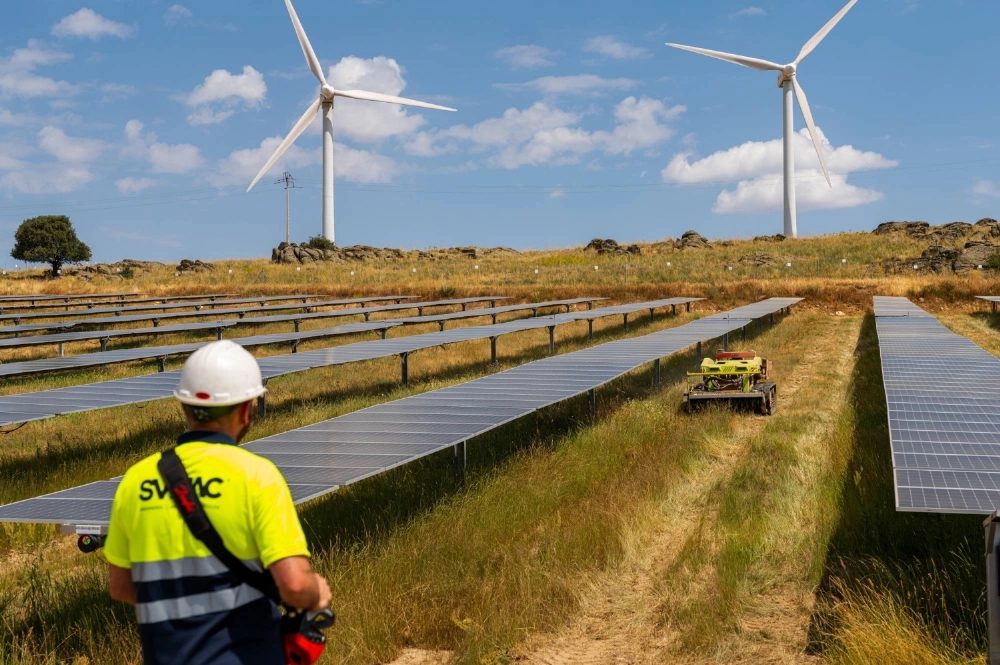 In Japan, key stakeholders, including corporations and industry groups, are working to make ESG investment a pillar of sustainable growth despite global headwinds. | BLOOMBERG
As the pursuit of sustainable economic growth becomes a pressing global challenge, ESG investment, an approach that incorporates nonfinancial elements such as environmental performance, social responsibility and corporate governance into investment decisions, has reached a critical juncture.
Momentum behind ESG investment has faltered in recent years. The second administration of U.S. President Donald Trump adopted an adversarial stance toward the concept, while even in Europe, long regarded as the driving force behind ESG initiatives, policy support has shown signs of being rolled back.
Yet the fundamental importance of ESG from a long-term investment perspective continues to grow. In Japan, key stakeholders including corporations and industry groups are pushing back against the global headwinds and working to make ESG investment a pillar of sustainable growth.
Global ESG investing gained real momentum after the United Nations launched the Principles for Responsible Investment framework in 2006, encouraging investors to factor environmental, social and corporate governance issues into their decisions.
In Japan, interest in ESG investment accelerated following the introduction of the Stewardship Code in 2014 and the decision by the Government Pension Investment Fund to sign the PRI.
In recent years, however, the growth of ESG-branded funds has stalled. According to Daisuke Motori, head of research at Morningstar Japan, outflows from sustainable investment funds exceeded inflows by ¥125.8 billion between July and September 2025. This marked the 13th consecutive quarter of net outflows for ESG-related funds in Japan.
“Funds labeled as ESG are facing severe situations in terms of relative performance (compared with other funds),” said Tamami Ota, head of ESG research at the Financial and Capital Market Research Department of Daiwa Institute of Research.
Since the inauguration of the second Trump administration, efforts to combat climate change and promote diversity, equity and inclusion, or DEI, have been scaled back in the United States. Concerned about political backlash, many companies have also wound down or quietly abandoned their ESG initiatives.
Even Europe, long a global leader in ESG, is showing signs of fatigue. Governments there have begun relaxing certain environmental regulations in a bid to maintain industrial competitiveness. Russia’s invasion of Ukraine has intensified worries about energy security and has fueled calls for greater self-reliance in both security and economic policy.
ESG regulations often mean “higher short-term costs for companies, due to capital investment and the development of internal systems,” said Junichi Sakaguchi, chief responsible investment officer at Sumitomo Mitsui DS Asset Management. Overly stringent rules push up costs and become a heavy burden, especially for small and midsize enterprises.
At the same time, Sakaguchi recognizes a notable shift in Western policy. “In recent years, Europe and the United States have adopted a more transition-focused approach,” he said. “Rather than excluding electric power and steel companies because of their high carbon dioxide emissions, they are encouraging capital investment that helps these sectors reduce their emissions.”
Commenting on this change, Ota said they “have returned to a considerably more realistic approach.”
Despite the anti-ESG sentiment gaining ground overseas, the impact on Japan is expected to be limited. Instead, attention is increasingly turning to how individual Japanese companies will pursue their own ESG strategies.
|
|
|
|