TBLI Weekly is out-Mamdani:The Billionaire Class's Worst Nightmare!


Tuesday, January 27, 2026


Author: Robert Rubinstein

Your weekly guide to Sustainable Investment

TBLI Radical Truth Podcast

Can we actually "abolish" medical debt? w Allison Sesso

In this episode of TBLI Radical Truth, we sit down with Allison Sesso, President & CEO of Undue Medical Debt. This groundbreaking nonprofit has already erased over $10 billion in medical debt, restoring financial dignity to millions of Americans.

Medical debt is an American crisis, with 1 in 4 people burdened by healthcare costs that lead to bankruptcy and systemic inequity. Allison explains the "Radical Truth" behind their highly leveraged model: how they turn every $1 donated into $100 of debt relief by targeting those most in need.

In this conversation, we explore:

  • The Abolishment Model: How Undue Medical Debt buys and retires debt at scale.

  • Economic Intervention: Why debt relief is a powerful tool for social equity and financial health.

  • Systems Change: Moving from traditional charity to a transformative financial solution.

  • Philanthropy at Scale: The impact of visionary backers like MacKenzie Scott on their mission.

Whether you are interested in impact investing, social justice, or innovative philanthropy, this episode provides a strategic roadmap for solving one of society’s most "intractable" problems.

#Medical Debt, #Debt Relief, #Undue Medical Debt, #Allison Sesso, #Social Impact, #Philanthropy, #Financial Justice, #Healthcare Reform, #TBLI Radical Truth, #Impact Investing, #Economic Equity.

This is TBLI Radical Truth 

Listen to the full podcast


TBLI Virtual Mixer


Let me tell you about conferences.

Some genius decided the best way to connect people is to:

Fly them across the world
Cram them in an overpriced hotel
Feed them rubber chicken
Make them sit through panels where everyone says the same thing
Give them 17 minutes to "network" in a hallway
Then send them home

Cost: $2,500 plus airfare and hotel Result: Three business cards and mild food poisoning

Brilliant.

Here's a crazy idea: What if you could skip all that bs and just... TALK TO THE RIGHT PEOPLE?

TBLI Virtual Mixer does this thing—stay with me here—where they actually MATCH you with people based on what you're working on and what you need.

Revolutionary, I know.

✅ 90 minutes of your life (not three days)
✅ Zero travel (your couch is fine)
✅ Actual conversations with impact investors who have capital to deploy
✅ No keynote speeches about "the future of sustainability" from people who flew private

Friday, Jan. 30 | 16:00-17:30 CET

The best deals happen in the right conversations. This is where those conversations happen.

Without the extraction

👉 https://luma.com/s00apk85

65 people already figured this out. You might want to join them.

#TBLI #ImpactInvesting #NoBS


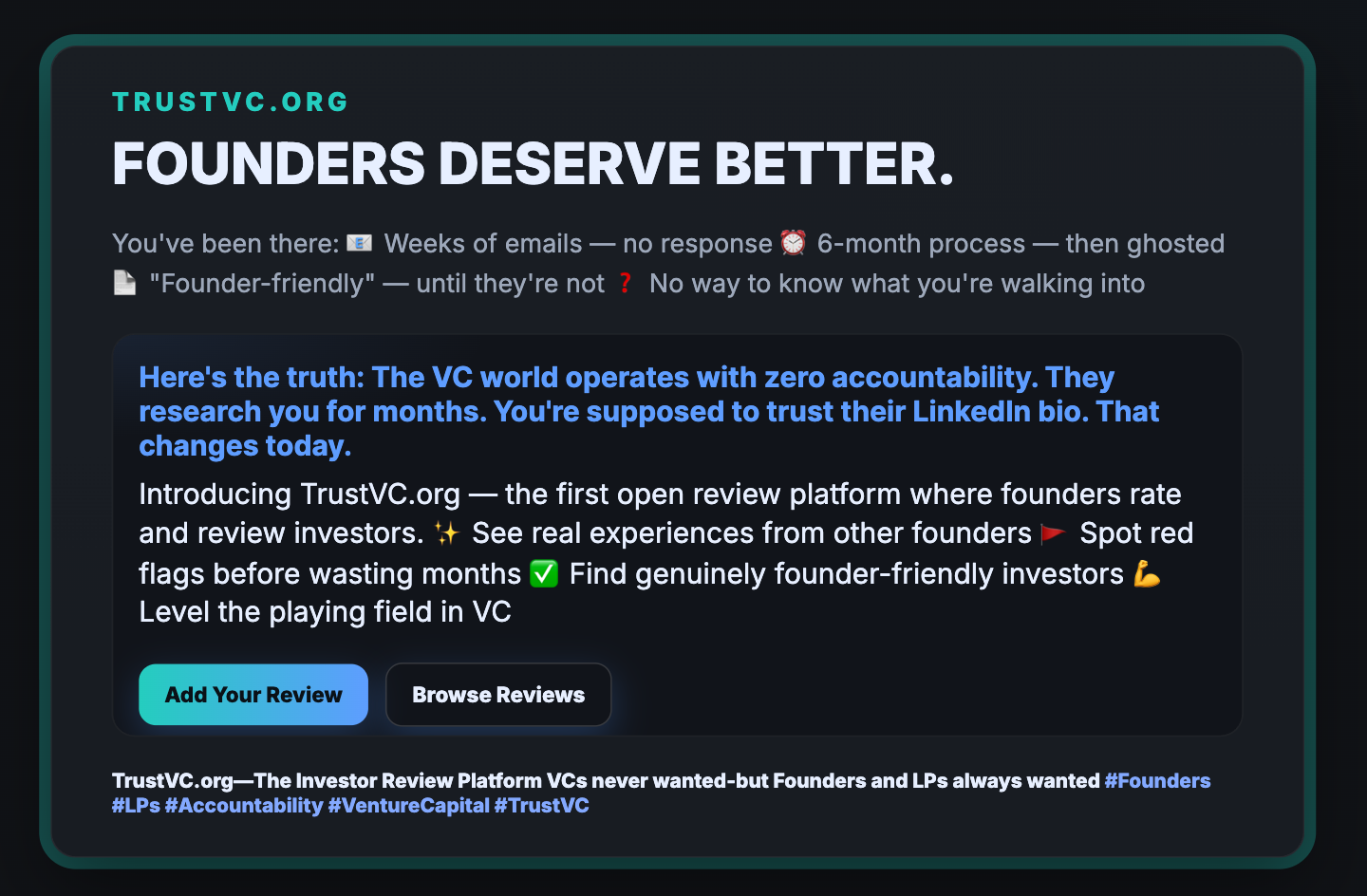
FOUNDERS DESERVE BETTER. 

You've been there: 📧 Weeks of emails — no response ⏰ 6-month process — then ghosted 📄 "Founder-friendly" — until they're not ❓ No way to know what you're walking into

Here's the truth: The VC world operates with zero accountability. They research you for months. You're supposed to trust their LinkedIn bio.

That changes today.

Introducing TrustVC.org — the first open review platform where founders rate and review investors.

See real experiences from other founders 🚩 Spot red flags before wasting months ✅ Find genuinely founder-friendly investors 💪 Level the playing field in VC

This is the platform VCs never wanted to exist—but founders and LPs always needed.
Your equity is precious. Know who deserves it.

👉 https://www.trustvc.org/

Tag a founder who needs this 👇

#TrustVC #VCFundraising #StartupLife #FounderFirst #VCTransparency #StartupFunding #Entrepreneurship #VentureCapital #FounderJourney #StartupCommunity #Accountability #TransparencyMatters #StartupFounder #RaisingCapital


The Future of Finance Isn't a Debate—It's Being Built. Are You Building It?


While others talk about sustainability, TBLI Circle members are executing breakthrough impact initiatives and shaping the new standards that define responsible finance.


This isn't a network. It's a movement of decision-makers who refuse to watch from the sidelines.


TBLI Circle members:
✅ Shape the standards your competitors will follow tomorrow
✅ Execute breakthrough initiatives first—not fifth
✅ Access the architects of impact investing's next evolution
✅ Collaborate with pioneers redefining fiduciary duty

The transformation is happening with or without you. The only question is: will you lead it or follow it?
 

👉 Join the leaders: TBLICircle.com

#TBLICircle #ImpactInvesting #SustainableFinance #ESG #ResponsibleInvesting #FutureOfFinance #LeadershipInFinance #SystemicChange #ImpactLeadership

Reve AI generated

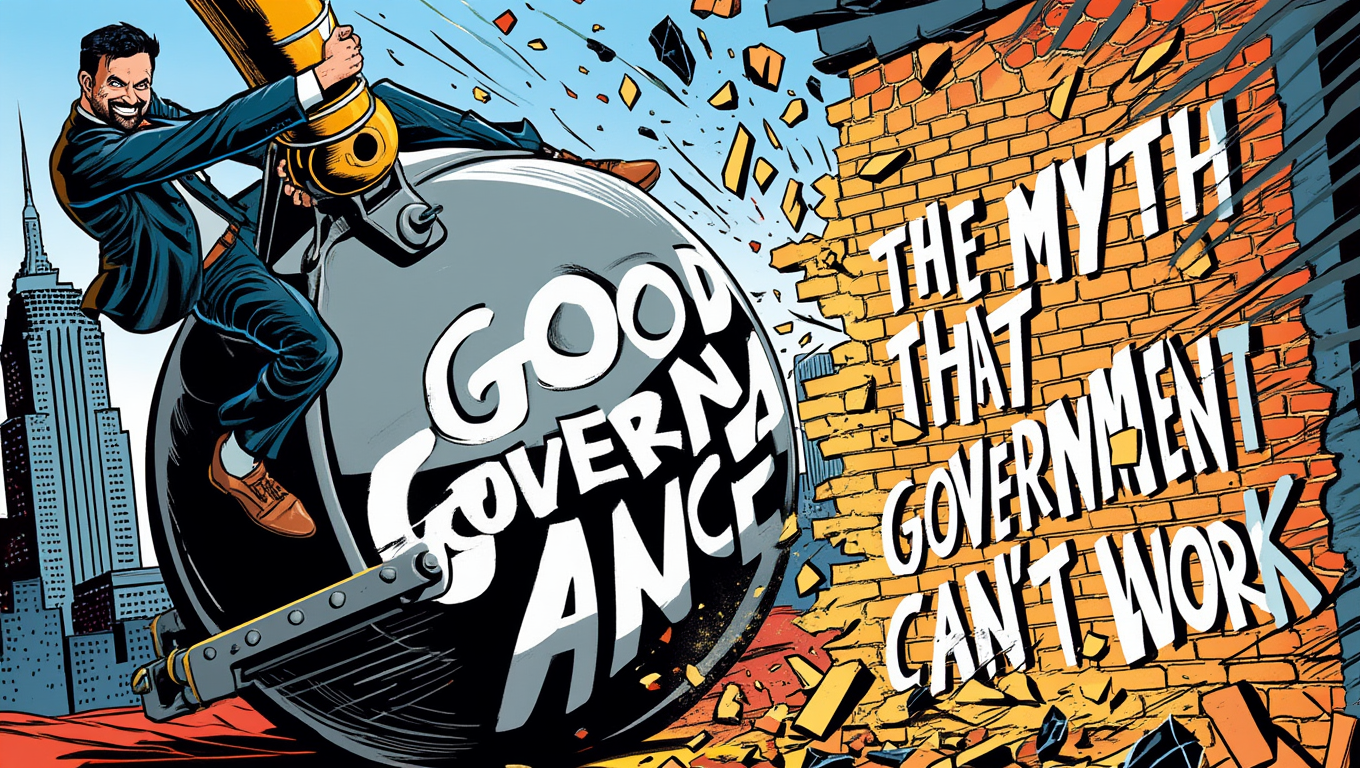
The Billionaire Class's Worst Nightmare: Why Zohran Kwame Mamdani Scares the Hell Out of the Ruling Class


Robert Rubinstein

The Oligarchs Are Trembling in Their Silk Pants: Why Zohran Kwame Mamdani Scares the Hell Out of the Ruling Class

A Radical Truth About What Happens When Government Actually Works

How NYC's new mayor is proving that effective government terrifies the billionaire class – and why that matters for cities everywhere


You know what the billionaire class fears more than estate taxes, worker organizing, or finding out their private jet has middle seats? A government that actually works.

And that's exactly what just walked through the doors of Gracie Mansion.

Zohran Kwame Mamdani just became Mayor of New York City, and somewhere in a mahogany-paneled room overlooking Central Park, a hedge fund manager just spilled his $47 smoothie all over his Hermès loafers. Because here's the thing nobody in the ruling class wants you to figure out: government isn't broken because it's supposed to be broken—it's broken because they need it to be broken.

The Beautiful Con: How the Ultra-Wealthy Sabotaged Government

For decades, the ultra-wealthy have run the same brilliant scam: Defund government. Watch it struggle. Point at the struggling. Say, "See? Government doesn't work! Better let us handle everything." Then privatize the profit and socialize the losses. It's like slashing someone's tires and then selling them a bicycle at a 3,000% markup while explaining that cars were always a bad idea.

The whole con depends on one critical assumption: that government will always be wasteful, slow, and ineffective. That public services will always disappoint. That the average person will eventually just give up and accept that Jeff Bezos should own the fire department.

And then this Ugandan-born, Muslim assemblyman—first name Zohran, middle name Kwame, last name Mamdani—mobilizes over 100,000 volunteers, gets elected Mayor of New York City, and starts making government work from Day One.

Cue sound of monocles popping out across the Upper East Side.

The Fiorello LaGuardia Protocol: When Mayors Actually Govern

Mamdani is pulling what we might call the Fiorello LaGuardia maneuver: actually focusing on making people's lives better. Revolutionary concept, right? It's so crazy it just might work. LaGuardia read comics to kids on the radio during newspaper strikes. He showed up at fires. He made government present in people's lives in ways that mattered.

Now imagine that energy applied to 2025 New York. Imagine a mayor who understands that when the subway works, when trash gets picked up, when schools have what they need, when people can actually afford to live in the city—that's not socialism, that's not even particularly radical. That's just governing.

But to the oligarch class? That's terrorism.

Why Wall Street and the Billionaire Class Are Terrified

This isn't just about New York. This is about the showcase, the example, the proof of concept. If Mamdani succeeds—if he shows that government can be responsive, effective, and actually improve people's daily lives—then the whole "government bad, privatization good" narrative collapses like a condo built by a Trump contractor.

Because here's what keeps the billionaire class up at night (besides deciding which superyacht to helicopter to): If New York City proves that government works, then people in Chicago start asking questions. Then people in Los Angeles. Then people in London, Paris, Berlin—all these places where governments seem paralyzed, unable to make bold decisions or deliver basic services.

What if people realize their governments aren't ineffective because government is inherently ineffective, but because the system has been deliberately sabotaged by people who profit from the sabotage?

What if people start expecting their governments to actually govern?

The horror. The absolute horror.

The 100,000-Strong Grassroots Movement That Changed Everything

Let's talk about those 100,000 volunteers who worked their asses off to elect this guy. That's not a political campaign—that's a movement. These people didn't knock on doors because they believed in some slick consultant's message-tested talking points. They did it because they saw someone who actually gave a damn about whether they could afford rent, whether their kids had good schools, whether the city worked for them instead of just for the people with private drivers.

The establishment didn't see this coming because they couldn't imagine it. A Muslim immigrant named Zohran Kwame Mamdani mobilizing a grassroots army in New York City to prove that government can work? That's not supposed to happen in the script. The script says people are apathetic. The script says ethnic names are liabilities. The script says you need hedge fund money and real estate developer approval.

Turns out the script was bullshit.

Global Implications: From New York to Europe and Beyond

And it's not just an American story. Look at Europe right now—governments seemingly frozen, unable to make bold decisions, watching their citizens lose faith in public institutions. The same playbook: austerity, privatization, the slow death of public services, the rise of cynicism.

Mamdani's success in New York could be the crack in the dam. If he can show what effective governance looks like—if he can demonstrate that government doesn't have to be a slow-moving disappointment factory—then suddenly every ineffective government looks like a choice rather than an inevitability.

And that's dangerous as hell to entrenched power everywhere.

The Real Threat: Competent Government That Serves People

This is what truly terrifies them: the idea that government could be run by people who actually care about outcomes, who measure success by whether people's lives improve rather than whether the donor class gets their tax breaks and zoning variances.

The billionaire class has spent forty years convincing us that government is the problem. That public services will always disappoint. That the only solution is to hand everything over to private companies who will definitely, totally, absolutely do it better and not at all use their monopoly power to extract every possible penny while delivering the minimum possible service.

If Zohran Kwame Mamdani succeeds—if he shows that government can be efficient, responsive, and effective—that entire worldview crumbles. And when that worldview crumbles, people start asking uncomfortable questions like "Why exactly are we letting private equity firms buy up all the housing?" and "Why does my insulin cost more than my rent?" and "Maybe we should tax billionaires?"

That's why they're scared.

The Radical Truth About How Government Actually Works

Here's the radical truth: None of this is complicated. Government works when the people running it give a shit about the people they're governing. It fails when it's run by or for people whose only interest is extracting wealth.

Zohran Kwame Mamdani represents a simple, terrifying idea: What if we tried actually governing again? What if we stopped pretending that public services have to suck? What if we held leaders accountable not for how well they serve donors, but for how well they serve people?

The oligarchs know the answer. They know that when government works, people like it. They trust it. They expect it. And they start wondering why they're supposed to be so grateful to billionaires for "creating jobs" while those same billionaires dodge taxes and fight worker protections.

This Is the Moment: NYC as a Blueprint for Progressive Governance

New York City, under Mayor Mamdani, could become proof that another way is possible. That government doesn't have to be slow, wasteful, and disappointing. That public services can work. That people can have nice things without having to beg some tech bro for permission.

And if that happens—if New York shows the way—then other cities might try it. Then other countries. Then every place where people are tired of being told they can't have functioning transit or affordable housing or decent schools because "the money just isn't there" while billionaires launch vanity space programs.

The opportunity is enormous. The threat to entrenched power is existential. No wonder they're terrified. And no wonder the rest of us should be paying very, very close attention.

Early Returns: Hope in Action and Results-Driven Leadership

So far, I am massively impressed with Mayor Mamdani and the team he has gathered and their focus on delivering something every day that improves lives. I wasn't able to vote for Mamdani—I haven't had residence there for some time. But if I could have, I would have happily voted for him.

Because here's what he understood that the consultants and the cynics never did: People don't need to be convinced that government can work. They need to be shown. They need to feel it in their daily lives. They need to see that someone is actually fighting for them, not just talking about fighting for them during campaign season.

That's what those 100,000 volunteers were responding to. Not a policy paper. Not a ten-point plan. But a vision of what their city could be if someone actually gave a damn.

Antoine de Saint-Exupéry wrote: "If you want to build a ship, don't drum up people to collect wood and don't assign them tasks and work, but rather teach them to long for the endless immensity of the sea."

Mamdani taught people to long for a city that works. A government that serves. A future where public institutions actually deliver on their promises. And that longing? That's what the oligarchs can't buy, can't suppress, and can't survive.

Because the funniest thing about the ruling class is that they're not scared of your anger—they're scared of your hope. Hope is what mobilizes 100,000 volunteers. Hope is what elects a Muslim immigrant named Zohran Kwame Mamdani. Hope is what makes people believe government could actually work for them.

And that, my friends, is the joke they never saw coming.

"If you want to build a ship, don't drum up people to collect wood and don't assign them tasks and work, but rather teach them to long for the endless immensity of the sea."

Antoine de Saint-Exupéry

👉 Follow Robert Rubinstein for more

 

Date: June 22-23, 2026,
Location: Kuala Lumpur, Malaysia

Pay US$90 by 26th January 2026 to secure Early bird rate and free offsites

Save your spot!!


This B Corp Asia Summit 2026 brings together thought leaders and practitioners to showcase the emerging trend that Business as a FORCE for Good is Good for Business.Global MNCs, as well as Asian SMEs share how incorporating positive impact on how you run your business translates into financial success.

Save your spot!!


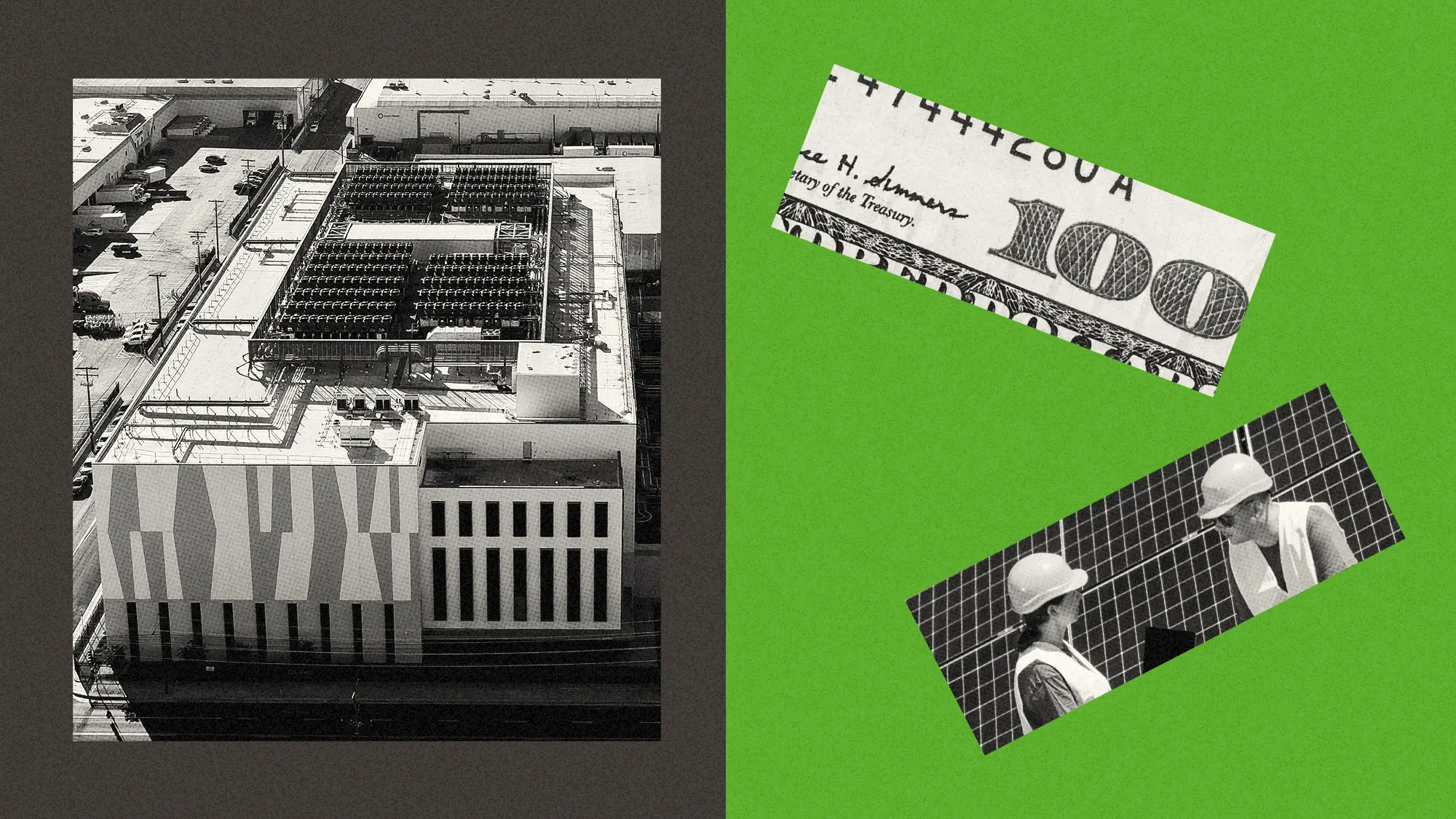
Grist / Getty Images

Data centers are facing an image problem. The tech industry is spending millions to rebrand them.

Through television ads and online campaigns, industry-backed groups are promising jobs, clean energy, and lower electricity bills.

With community opposition growing, data center backers are going on a full-scale public relations blitz. Around Christmas in Virginia, which boasts the highest concentration of data centers in the country, one advertisement seemed to air nonstop. “Virginia’s data centers are … investing billions in clean energy,” a voiceover intoned over sweeping shots of shiny solar panels. “Creating good-paying jobs” — cue men in yellow safety vests and hard hats — “and building a better energy future.” 

The ad was sponsored by Virginia Connects, an industry-affiliated group that spent at least $700,000 on digital marketing in the state in fiscal year 2024. The spot emphasized that data centers are paying their own energy costs, framing this as a buffer that might help lower residential bills, and portrayed the facilities as engines of local job creation.

The reality is murkier. Although industry groups claim that each new data center creates “dozens to hundreds” of “high-wage, high-skill jobs,” some researchers say data centers generate far fewer jobs than other industries, such as manufacturing and warehousing. Greg LeRoy, the founder of the research and advocacy group Good Jobs First, said that in his first major study of data center jobs nine years ago, he found that developers pocketed well over a million dollars in state subsidies for every permanent job they created. With the rise of hyperscalers, LeRoy said, that number is “still very much in the ballpark.” 

Other experts reflect that finding. A 2025 brief from University of Michigan researchers put it bluntly: “Data centers do not bring high-paying tech jobs to local communities.” A recent analysis from Food & Water Watch, a nonprofit tracking corporate overreach, found that in Virginia, the investment required to create a permanent data center job was nearly 100 times higher than what was required to create comparable jobs in other industries. 

“Data centers are the extreme of hyper-capital intensity in manufacturing,” LeRoy said. “Once they’re built, the number of people monitoring them is really small.” Contractors may be called in if something breaks, and equipment is replaced every few years. “But that’s not permanent labor,” he said.

Read Full Article

Corporate Climate Action Gains Scale as SBTi Crosses 10,000 Validated Companies

  • 10,000 companies now have validated science based targets representing more than 40 percent of global market capitalization
  • Validations span over 90 countries with fastest recent growth in Asia led by Japan
  • Milestone reflects investor, regulatory and supply chain pressures shaping net zero credibility

At the start of 2026, corporate climate action reached a new threshold as the Science Based Targets initiative confirmed 10,000 companies now have validated emissions targets aligned with pathways to net zero by 2050. The surge reflects rising internal and external pressure on firms to quantify decarbonization trajectories, manage financial and operational risks and prepare for a policy environment that increasingly rewards credible transition plans.

Global Scale and Regional Shifts

Reaching 10,000 validated companies places the SBTi platform among the largest coordination mechanisms in the climate economy. Collectively, participating companies account for more than 40 percent of global market capitalization across nearly every major sector. They are headquartered in more than 90 countries, spanning energy, heavy industry, consumer goods, finance, technology and sports.

Europe still represents a substantial share of total validations, but the fastest growth over the past two years has been in Asia. Japan now leads globally with more than 2,000 validated companies, followed by the United Kingdom, the United States and China. The shift mirrors emerging regulatory scrutiny in Asian financial centers, increased investor engagement and supply chain pressures originating from multinational buyers demanding verifiable emissions data.

The SBTi validated its first company in 2015, passed the 1,000-company mark in 2021 and added more than 2,800 companies in 2025 alone. The acceleration coincides with the mainstreaming of decarbonization across procurement functions, financial disclosures and investor due diligence.


How To Rethink Energy Demand To Build a Sustainable, Resilient Future

Climate tech can make buildings and data centers more responsive to the grid, reducing cost and emissions.

Jan 26, 2026 7:30 AM ET
Campaign: Growth Through Sustainability

This article is authored by Dave Regnery, Chair and CEO, Trane Technologies

Every year around the world, buildings and industry waste hundreds of billions of dollars on electricity we aren’t using. Research shows that about 30% of electricity is wasted after the meter. That’s energy, emissions and cost our world can’t afford to waste. These are not only avoidable losses - they present a clear call to rethink how we manage energy demand.

Meanwhile, global electricity demand is forecast to grow at close to 4% annually, a surge equivalent to adding the consumption of Japan to the world’s grid every year. While renewable energy is advancing at an unprecedented pace - clean sources powered 40 percent of the world’s consumption last year - the variability of supply is driving the need to prioritize demand-side management.

Unlocking the value of global energy demand management

As leaders convene at the upcoming World Economic Forum Annual Meeting, the formation of a new Working Group on Energy Demand Management and Demand Flexibility offers a pivotal moment. This diverse group of developers, technology providers, energy companies and manufacturers will define a shared vision: transforming passive energy consumption into dynamic, intelligent energy management.

By enabling every building, factory and data center to be more flexible and responsive in their interactions with the grid, we can cut costs, reduce emissions, create new market opportunities and build greater resilience into our energy systems.

At Trane Technologies, we see this transformation in action every day. Our purpose is to boldly challenge what’s possible for a sustainable world. As a global climate innovator, we deliver energy-efficient technologies and solutions at scale, reducing energy use, saving cost and powering sustainable performance. We are transforming energy management and sustainability in buildings, industry, data centers and transport. And we are infusing artificial intelligence (AI) across our businesses for smarter, more efficient and more sustainable outcomes for customers, communities and the planet.

Read full article


TBLI Group Herengracht 450, 1017 CA Amsterdam, The Netherlands
To receive our free TBLI Weekly Subscribe here
TBLI Group Logo

This email was sent to [EMAIL]. You are receiving this email because you have signed up on our website, TBLI Weekly or subscribed to our email list.

Unsubscribe | Privacy Policy | Cookies Policy

Privacy Policy and Cookies Policy