TBLI Weekly is out- Impact Mafia is Heading for a Total System Failure


Tuesday, Feb. 17,  2026


Author: Robert Rubinstein

Your weekly guide to Sustainable Investment

TBLI Radical Truth Podcast

Shareholder Activism Meets Climate Action—How to Drive Big Oil's Energy Transition w/ Mark van Baal

Welcome to TBLi Radical Truth Podcast, where knowledge inspires and we explore bold strategies for shareholder activism, climate finance, and transforming the energy industry from within through ESG engagement and impact investing.
In this episode, we're joined by Mark van Baal, founder and executive director of Follow This—the Amsterdam-based shareholder activism organization mobilizing thousands of green shareholders and institutional investors to compel Big Oil companies like Shell, BP, ExxonMobil, Chevron, and TotalEnergies to align with the Paris Climate Agreement and accelerate the energy transition to renewable energy. After a decade as a climate journalist inspired by Al Gore's "An Inconvenient Truth," Mark pioneered a revolutionary approach to climate action: using shareholder resolutions and proxy voting to pressure fossil fuel companies to shift their billions from oil and gas exploration into clean energy and carbon reduction.
In "Shareholder Activism Meets Climate Action," Mark reveals how Follow This transformed from a single €30 share purchase in Shell in 2015 into a global movement that drove climate resolutions supported by over €4 trillion in assets under management from major institutional investors including pension funds, asset managers like AXA and Amundi, and sustainable investment leaders. He shares insights on how shareholder engagement and ESG voting drives measurable climate progress—from Shell's first-ever climate ambition announcement to BP and Equinor setting emissions targets—and why climate resolutions focusing on financial risks from declining fossil fuel demand are becoming critical tools for protecting shareholder value and accelerating decarbonization. Mark demonstrates how activist investors and responsible shareholders are using corporate governance, proxy season, and AGM voting to force energy companies to address Scope 3 emissions, product emissions, and the financial sustainability of fossil fuel business models in a net-zero economy.

TBLiIRadical Truth Podcast brings you climate leaders in shareholder activism, ESG engagement, and sustainable finance who are driving systemic change in energy, fossil fuels, and corporate climate responsibility. Let's begin our conversation with Mark van Baal on shareholder activism, climate resolutions, and transforming Big Oil through investor pressure.
This is TBLI Radical Truth Podcast.

Listen to the podcast

#myanmar, #kachinconflict #humanrights #activism #juntas #extractiveindustries #responsibleinvestment #ESG #supplychain #ethics #warzone #warcrimes #humanitariancrisis


TBLI Virtual Mixer


WRONG ROOM: "What can I extract from this conversation?" "How do I position myself to win?" "Who can I use to get ahead?"

RIGHT ROOM (TBLI Virtual Mixer): "How can we create value together?" "What resources can I share?" "Who can I connect to help them succeed?"

Feb 27 | 16:00-17:30 CET

Same 90 minutes. Completely different energy.

Meet impact investors, entrepreneurs, and fund managers who actually believe in: → Shared value creation → Collaborative capitalism
→ Transparent relationships → Abundance over scarcity

AI matches you with people who share your values, not just your sector.

Find the right room.

👉 https://luma.com/d7bj8rla

#TBLI #ImpactInvesting #CollaborativeCapital

Feb 27 | 16:00-17:30 CET

Find your people. The ones who share, not extract.

👉 https://luma.com/d7bj8rla

#TBLI #ImpactInvesting #HonestyForOnce


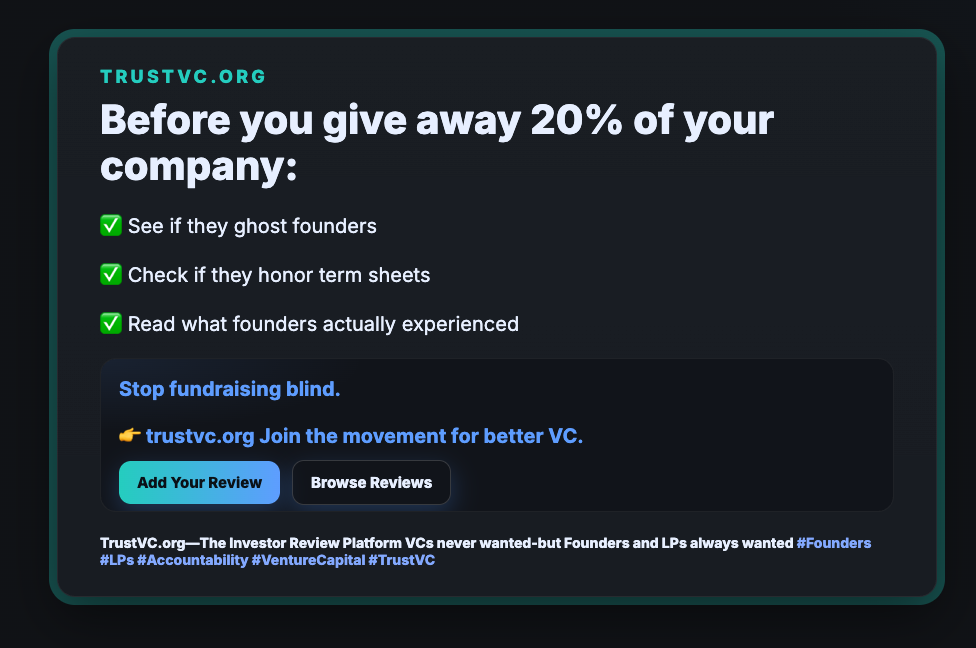
VCs do 6 months of due diligence on you.

You do 6 minutes of Googling on them.

This is insane.

Before you give away 20% of your company, shouldn't you know: → Do they actually respond to founders? → Have they changed terms on other deals? → Are they supportive when things get hard? → Would founders work with them again?

TrustVC.org answers these questions.

Real founder reviews. Real patterns. Real accountability.

The investor review platform VCs never wanted—but founders and LPs always needed.

👉 https://www.trustvc.org/

Stop fundraising blind.

#TrustVC #VCFundraising #StartupLife #FounderFirst #DueDiligence #VentureCapital #StartupFunding


Want 2026 to be your best year in impact investing?

Here's what separates breakthrough years from mediocre ones:

❌ Working harder alone ✅ Working smarter with the right network

TBLI Circle members are having their best years because they:

→ See breakthrough deals 6 months before everyone else → Co-invest with trusted partners (reduced risk, increased firepower) → Get warm intros to LPs when raising capital → Become an impact investing thought leader from other exerpsrt who are not extractive→ Share due diligence (save months of work) → Learn from others' about true state of the art.

How professionals have breakthrough years.

Not by grinding harder. By leveraging the right network.

👉 TBLICircle.com

Make 2026 your best year. Join the network that compounds advantage.

👉 Join the circle: tblicircle.com
👉 TBLICircle.com-2 week trial period

#TBLICircle #ImpactInvesting #BestYear #NetworkAdvantage #SustainableFinance


Grok AI Generated


The Great Unmasking: Why the Impact Mafia is Heading for a Total System Failure

By Robert Rubinstein

You ever notice how the more syllables a corporate buzzword has, the more likely it is that someone is lying to you?

Take "Sustainability." Five syllables. Sounds heavy. Sounds important. It sounds like a guy in a lab coat holding a clipboard. But in the hands of the Impact Mafia, "sustainability" is just a fancy way of saying, “We’re going to keep doing exactly what we’ve been doing, but we’ve hired a graphic designer to make the PowerPoint slides green.”

Welcome to the endgame of the Greatest Financial Magic Show on Earth. For twenty years, these guys—the ESG grifters, the Impact Dons, the Davos Darlings—have been running a beautiful racket. They’ve sold the world a dream where you can save the polar bears, fix income inequality, and still make a 22% return by investing in a tech company that sells data to dictators.

It’s "lipstick on a leveraged grenade." It’s regular investing, but with a veneer of sanctimony so thick you could ski on it. But the curtains are tearing, the smoke machine is leaking, and the rabbit just died inside the hat. The "Radical Truth" is this: the Impact Mafia isn’t just going to lose their reputation. Reputation is cheap; you can buy a new one with a $10 million donation to a university wing. No, they are going to lose their clients, their business models, and their talent.

They aren’t just failing; they’re becoming obsolete.

1. The Clients: The "Sucker" is Waking Up

The Impact Mafia treats asset owners like toddlers. They pat them on the head, hand them a 140-page "Impact Report" filled with pictures of smiling children in distant lands, and say, "Don't worry about the actual numbers, look at the colorful arrows! Look at the 'Theory of Change'!"

But here’s the thing about rich people: they eventually notice when they’re being played. The clients are starting to realize that "catalytic capital" is just code for "we lost your money," and "blended finance" is just a way for the Mafia to take the management fees while the taxpayer takes the risk.

When the "market-rate returns with impact" never show up, and the world keeps getting hotter and more unstable, the clients don't just get annoyed. They leave. They’re going to take their trillions and move them to people who actually know how to deploy capital, not just people who know how to host a panel discussion about it. The "Impact Mafia" will be left in a room by themselves, still holding their $2,000 conference tickets, wondering why the phone stopped ringing.

2. The Business Model: White Papers Don't Pay the Rent

The current impact business model is a "Conference Industrial Complex." It’s built on a foundation of air. It’s a circular economy where consultants sell frameworks to investors, who hire measurement firms to verify the frameworks, who then present the results at a summit sponsored by the consultants.

It’s financial necromancy—trying to bring a dead system to life by waving a magic wand made of "Impactese" vocabulary. But the "Talk-Talk-Talk" model has a shelf life. We are entering an era of radical transparency. You can’t hide behind a glossy PDF anymore when satellites can track your carbon emissions in real-time and AI can cross-reference your "diversity goals" with your actual payroll.

When the "metrics mirage" evaporates, the business model collapses. You can't charge 2-and-20 for "impact" when the only thing you’ve impacted is the occupancy rate of five-star resorts in Switzerland.

3. The Talent Exodus: The Puppies Have Grown Teeth

This is the one that’s really going to hurt. The Impact Mafia relies on a steady stream of "next-gen" talent—bright, idealistic kids from elite universities who genuinely want to change the world. They hire them as "Impact Analysts," which is a fancy term for "someone who makes the charts look pretty."

These firms don’t just want labor; they want a human shield for their lack of action. They lure in the best and brightest with promises of "changing the system from the inside." But when these high-performers arrive, they realize they aren’t "catalysts"—they’re just glorified accountants for the status quo. They find that their job isn't to unlock capital; it's to massage data until a standard private equity deal looks like a gift from God.

Talent is a sensitive instrument. It can smell "bullshit" from a mile away. When these kids realize their "purpose-driven" career is actually a "purpose-driven" recruitment scam, they don't just get quiet. They leave. And they don't just go to another Mafia firm. They go "underground." They join the real entrepreneurs—the ones the Mafia refused to fund. They take their knowledge of the Mafia’s inner workings and use it to build systems that are actually immune to the old games.

What happens when a "thought leadership" firm loses its thinkers? You’re left with the "B-Team"—the people who are either too comfortable to care or too mediocre to notice they’re part of a scam. The ultimate nail in the coffin is the silence in the office when the only people left are the ones who have nothing left to say.

The Last Laugh

The Impact Mafia thinks they’re the masters of the universe. They think they can "engineer" a better world without ever having to sacrifice their seat at the top of the pyramid. They’ve created the financial equivalent of the Emperor’s New Clothes, complimenting each other on imaginary portfolios while the world burns.

But the world doesn't care about your "Synergistic Opportunities." The planet doesn't give a damn about your "Theory of Change." Money speaks louder than words, and right now, the money is realizing it’s been shouting into a void.

The fraudsters will lose because they forgot the first rule of real business: Value must be real. If you sell a product that doesn't work, to people who don't need it, using people who don't believe in it, you're not an "industry leader." You're a target.

So, to the Impact Mafia: enjoy the champagne while it’s cold. Because the clients are checking the bill, the talent is heading for the exits, and the "Radical Truth" is finally coming for your business model. And man, is it going to be a beautiful sight to watch.

👉 Follow Robert Rubinstein for more
Read Full Article

 

Eric Kounce TexasRaiser via Wikipedia

Despite Rollbacks, U.S. Fossil Fuels Face Tough Road Ahead

E360 Digest February 16, 2026

  • Last week, the Trump administration declared the federal government has no legal authority to regulate greenhouse gases, its latest move aimed at weakening regulations and boosting fossil fuels. And yet, analysts continue to see waning fortunes for miners and drillers.

    On Thursday, the administration rejected the scientific finding that greenhouse gases pose a danger to human health, which gives the government authority to regulate carbon dioxide and other heat-trapping gases. In its announcement, the Trump administration also eliminated limits on emissions from cars and trucks. Going forward, it could further roll back limits on power plants, oil wells, and other sources. The moves are likely to face legal challenges.

    The weakening of environmental regulations belies the downward trajectory for fossil fuels under President Trump, analysts say. Over the last decade and a half, coal burning has seen a precipitous decline, as has production. Today, the U.S. coal fleet is the smallest it has been in decades, having shrunk roughly in half since 2010, according to a new analysis from Carbon Brief. It notes that the vast majority of remaining coal plants are nearing retirement. 

    The administration is extending the lives of some aging coal plants, but there are no new coal plants under construction in the U.S. Last year solar, wind, and batteries made up 96 percent of new power capacity, with natural gas comprising the rest.

    Oil is faring better than coal, with production hitting a record high last year. But output is expected to stagnate. According to the International Energy Agency, the proliferation of EVs globally is blunting demand for oil. As global production outpaces demand, prices are too low to justify a ramp-up in U.S. drilling, according to Wood Mackenzie.

    Oil executives say the shale boom, in which advances in fracking turned the U.S. into the world’s top oil producer, may be coming to an end. Over the long term, U.S. production is headed for decline, according to the Energy Information Administration. 

    Natural gas remains a bright spot for U.S. fossil fuels, with production projected to reach new highs in 2026 and 2027, the EIA projects. A recent boom in gas exports continues to drive demand for U.S. gas.

Read Full Article


© Annaspoka | Getty Images


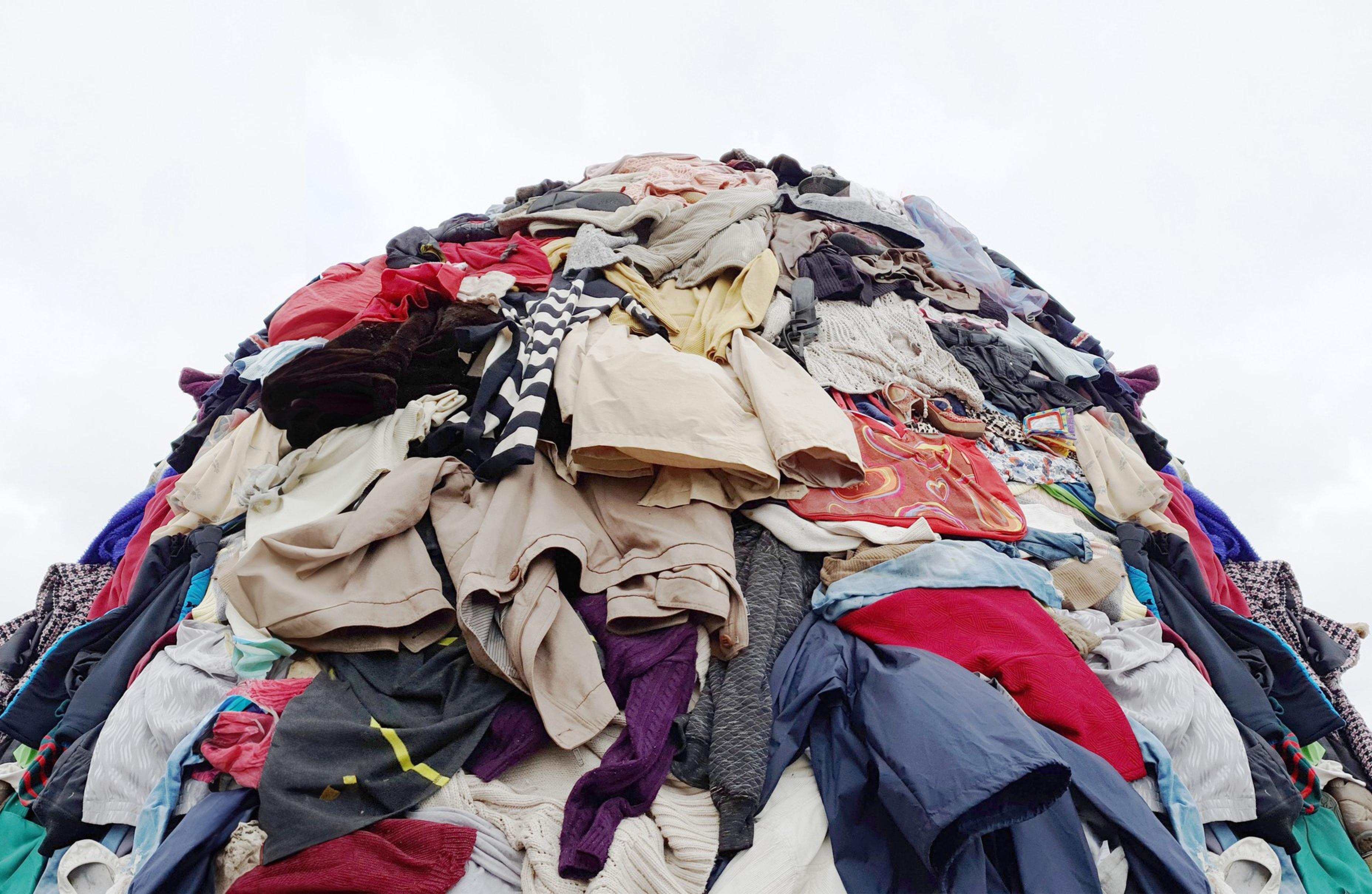
New EU rules to stop the destruction of unsold clothes and shoes

The Delegated and Implementing Acts will support businesses in complying with new requirements.

The European Commission today (Feb 9) adopted new measures under the Ecodesign for Sustainable Products Regulation (ESPR) to prevent the destruction of unsold apparel, clothing, accessories and footwear.

The rules will help cut waste, reduce environmental damage and create a level playing field for companies embracing sustainable business models, allowing them to reap the benefits of a more circular economy.

Every year in Europe, an estimated 4-9% of unsold textiles are destroyed before ever being worn. This waste generates around 5.6 million tons of CO2 emissions – almost equal to Sweden’s total net emissions in 2021.

To help reduce this wasteful practice, the ESPR requires companies to disclose information on the unsold consumer products they discard as waste. It also introduces a ban on the destruction of unsold apparel, clothing accessories and footwear.

The Delegated and Implementing Acts adopted today will support businesses in complying with these requirements by:

  • Clarifying derogations: The Delegated Act outlines specific and justified circumstances under which the destruction will be permitted, for instance, due to safety reasons or product damage. National authorities will oversee compliance.
  • Facilitating disclosure: The Implementing Act introduces a standardised format for businesses to disclose the volumes of unsold consumer goods they discard. This applies from February 2027, giving businesses sufficient time to adapt.

Instead of discarding stock, companies are encouraged to manage their stock more effectively, handle returns, and explore alternatives such as resale, remanufacturing, donations, or reuse.

The ban on destruction of unsold apparel, clothing accessories and footwear and the derogations will apply to large companies from 19 July 2026. Medium-sized companies are expected to follow in 2030. The rules on disclosure under the ESPR already apply to large companies and will also apply to medium-sized companies in 2030.

"The textile sector is leading the way in the transition to sustainability, but there are still challenges. The numbers on waste show the need to act. With these new measures, the textile sector will be empowered to move towards sustainable and circular practices, and we can boost our competitiveness and reduce our dependencies."

Jessika Roswall, Commissioner for Environment, Water Resilience and a Competitive Circular Economy


TBLI Group Herengracht 450, 1017 CA Amsterdam, The Netherlands
To receive our free TBLI Weekly Subscribe here
TBLI Group Logo

This email was sent to [EMAIL]. You are receiving this email because you have signed up on our website, TBLI Weekly or subscribed to our email list.

Unsubscribe | Privacy Policy | Cookies Policy

Privacy Policy and Cookies Policy