TBLI Weekly is out- AUM in Article 8 and 9 Funds Pass $10 Trillion


Tuesday, Feb. 10,  2026


Author: Robert Rubinstein

Your weekly guide to Sustainable Investment

TBLI Radical Truth Podcast

Myanmar Crisis 2026 – The Hidden Cost of Capital

Robert Rubinstein: Welcome to TBLI Radical Truth, the platform dedicated to the pioneers redefining the purpose of capital. Today, we aren't just discussing financial returns; we are exposing the human cost of irresponsible investment.

By January 2026, the humanitarian crisis in Myanmar has reached a staggering breaking point: 3.6 million people are internally displaced. While the world looks away, the military regime is weaponizing the country's natural wealth—jade mining, rare earth minerals, and mega-hydro projects—to fund a war against its own citizens.

I’m your host, Robert Rubinstein, and joining me today as co-host is Dr. Rieki Crins.

Dr. Rieki Crins: Robert, the scale of the atrocities is chilling. The United Nations has documented systematic war crimes—entire villages burned and ethnic minorities facing genocide-level persecution in Kachin, Rakhine, and Shan States. Yet, the "blood money" continues to flow through global supply chains and extractive industries.

Robert Rubinstein: Our guest today is a courageous Kachin human rights activist working on the ground in Myanmar. They are at the frontlines, gathering evidence of war crimes under a military dictatorship and demanding accountability from a regime operating with total impunity.

In this episode of TBLI Radical Truth, we pull back the curtain on:

  • The 2026 Humanitarian Reality: The current state of the conflict zones in Kachin and beyond.

  • The Finance-War Connection: How extractive industries—gold, timber, and jade—bankroll the junta.

  • The Failure of International Sanctions: Why current global pressures are missing the mark.

  • ESG and Responsible Investment: What investors must know about their exposure to Myanmar.

Robert Rubinstein: This is more than a Myanmar story—it’s a wake-up call for global finance. Are your investments enabling atrocities?

Please welcome our guest, a brave voice for the silenced. This is TBLI Radical Truth.

Listen to the podcast

#myanmar, #kachinconflict #humanrights #activism #juntas #extractiveindustries #responsibleinvestment #ESG #supplychain #ethics #warzone #warcrimes #humanitariancrisis


TBLI Virtual Mixer


Everyone at TBLI Virtual Mixer has the same allergy:

Extraction.

They're allergic to:

❌ Businesses built on exploiting information asymmetry
❌ Investors who only care about their exit
❌ "Partnerships" where one side gets screwed
❌ Success measured purely by personal wealth accumulation
❌ Capitalism that requires someone else to lose


Instead, they're addicted to:
✅ Businesses that create shared value
✅ Investors who measure impact + returns
✅ Actual partnerships where everyone wins
✅ Success measured by problems solved
✅ Capitalism that lifts everyone


These are the authentic eccentrics.


The ones building finance that doesn't require extraction.

And they show up to TBLI Virtual Mixer because everyone ELSE there gets it too.

Feb 27 | 16:00-17:30 CET

Find your people. The ones who share, not extract.

👉 https://luma.com/d7bj8rla

#TBLI #ImpactInvesting #HonestyForOnce


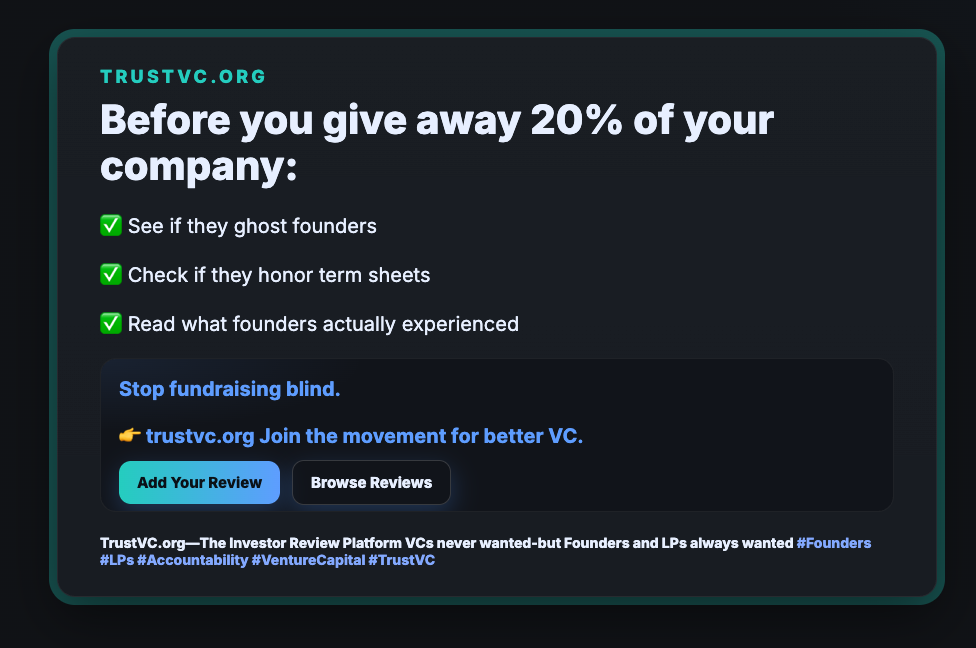
Before you give away 20% of your company:

✅ See if they ghost founders
✅ Check if they honor term sheets
✅ Read what founders actually experienced


Stop fundraising blind.

TrustVC.org—The Investor Review Platform VCs never wanted-but Founders and LPs always wanted


👉 https://www.trustvc.org/


Tag a founder who needs this 👇

#TrustVC #VCFundraising #StartupLife #FounderFirst #VCTransparency #StartupFunding #Entrepreneurship #VentureCapital #FounderJourney #StartupCommunity #Accountability #TransparencyMatters #StartupFounder #RaisingCapital


There are two rooms in finance right now.

ROOM ONE: People debating whether impact and returns are compatible. People forming committees to study ESG integration. People attending their 47th panel on "The Future of Sustainable Finance." People waiting for regulatory clarity that's never coming. People optimizing their sustainability reports for ratings agencies.

Everyone's very busy. Very concerned. Very... still talking.

ROOM TWO: People who already proved impact and returns work together. People who SET the standards everyone else will follow. People who BUILT the future everyone else is still discussing. People who CREATE the clarity by establishing precedents. People who don't give a fuck about ratings—they care about reality.

Room One has conferences.
Room Two has TBLI Circle.

Here's what nobody tells you:

You don't get invited to Room Two by being better at Room One.
You don't get there by attending more panels. You don't get there by having prettier ESG reports. You don't get there by talking louder about sustainability.

You get there by DOING.

TBLI Circle members are in Room Two because they:
→ Deploy billions in actual impact capital (not "impact-aligned" capital) → Write the playbooks the industry will study in five years → Set the precedents that become tomorrow's standards → Build the infrastructure everyone else will license → Create the networks that control deal flow
The transformation of finance is happening in Room Two. With or without you.
The only question is: Which room are you in?
Stop talking. Start building. Join Room Two.

👉 TBLICircle.com-2 week trial period

#TBLICircle #ImpactInvesting #RoomTwo


Craiyon AI Generated

The ESG Charade: How "Sustainable" Nations Bankroll Myanmar's Blood-Soaked Junta

A Critical Examination of Corporate Virtue Signaling While Fueling Genocide

"Your favorite 'sustainable' bank is likely processing payments for attack helicopters while claiming to hit UN goals. It’s time to stop pretending ESG reports mean anything if they don't include a refusal to bankroll a genocide."

So here's the thing about the modern financial system: everybody's got a sustainability report. Everybody's committed to ESG. Everybody's signed up for the UN Sustainable Development Goals. And everybody—and I mean everybody—is full of it.

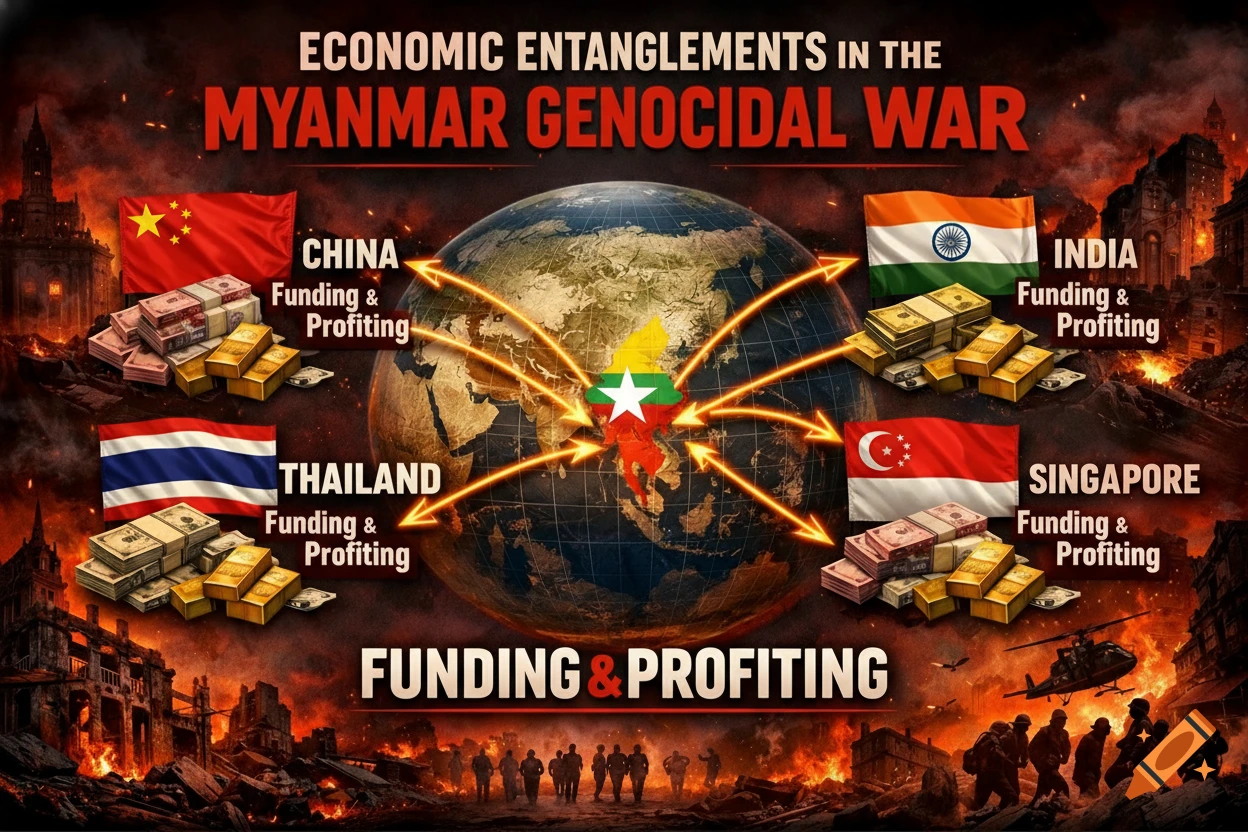
You want to know what real "stakeholder capitalism" looks like? It looks like Singapore-listed companies are paying $5.57 million to Myanmar's military since the coup, while the junta bombs schools, murders children, and displaces millions. It looks like Thai banks are processing payments for attack helicopters while publishing glossy reports about their commitment to "responsible banking." It looks like India is sending election observers to legitimize a sham election while simultaneously shipping military equipment to the generals doing the killing.

Let me break this down for you, because the level of hypocrisy here is so staggering it would make even the most cynical among us blush.

The Singapore Shuffle 

Singapore—that gleaming city-state of efficiency and order, that beacon of Asian values and good governance—has been one of Myanmar's top foreign investors. Between October 2021 and February 2022 alone, Singapore companies pumped $277 million into Myanmar. That's more than any other country. More than China. More than anyone.

And here's the beautiful part: they did this while the military was actively committing what the UN calls "crimes against humanity." The company Emerging Towns & Cities (ETC) has been particularly industrious, paying the Myanmar army's Office of the Quartermaster General—you know, the folks procuring ammunition, bombs, and jet fuel for genocide—millions of dollars for a real estate deal on military land.

When this came to light, what happened? Singapore Stock Exchange suspended trading. ETC commissioned "independent reviews." They found that payments were made "verbally" with "no formal written invoices" at below-market exchange rates. In other words, they were deliberately obscuring war crime financing through creative accounting.

The punchline? ETC "divested" by selling to Grand Ally Pte Ltd—a Singapore company set up by ETC's own executives. It's like selling your drug money to your cousin and calling yourself reformed. But hey, they filed the paperwork, so it's all legal, right?

Singapore authorities tout their commitment to the UN Guiding Principles on Business and Human Rights. They've issued "sanctions guidance." They've investigated companies. And yet, as of 2024, ETC was still paying the Myanmar military. Grand Ally is still registered in Singapore. The money still flows.

The Thai Banking Bonanza

Thailand deserves special recognition in this hall of shame. While Singapore at least pretended to care when caught, Thailand's banks have gone full steam ahead.

According to the UN Special Rapporteur on human rights in Myanmar, five major Thai banks facilitated weapons transactions for the junta in 2024. We're talking about payments for overhauling Mi-35p attack helicopters, components for MiG-29 fighter jets, and K-8W light attack aircraft. Between April 2022 and March 2024, weapons trade through Thailand doubled from $60 million to over $120 million.

When confronted, Siam Commercial Bank denied everything, claiming the transactions weren't "connected to the arms trade" and that they perform due diligence. This is like a getaway driver saying he had no idea the bank was being robbed—he thought his passengers were just making a really urgent withdrawal.

Thai companies also supplied $80 million in aviation fuel to the junta. You know what aviation fuel is used for? Flying planes. You know what the Myanmar military uses planes for? Bombing civilians. Airstrikes against civilian targets increased fivefold in the six months leading up to the UN report. But sure, Thai banks, keep processing those transactions. Your ESG reports look fantastic.

India's Democratic Doublespeak

India—the world's largest democracy—presents perhaps the most galling hypocrisy. While publishing reports about its commitment to human rights and democratic values, India has:

  • Supplied military equipment, infrastructure, and training to the junta

  • Allowed the junta to participate in BIMSTEC summits

  • Sent election observers to Myanmar's 2025 sham election, lending democratic credibility to a fundamentally undemocratic farce where all opposition parties are banned

Prime Minister Modi's government framed this as "supporting democratic processes." In reality, it's like sending election observers to a prison where the warden is the only candidate and calling it democracy.

Indian companies also play a crucial role in the jet fuel supply chain that powers the junta's bombing campaigns. Swan Energy, an Indian conglomerate with murky ties to Gautam Adani's investment funds, has been central to aviation fuel deliveries. This is the same fuel used to bomb schools, hospitals, and refugee camps.

China and Russia: At Least They're Honest

Here's the thing about China and Russia: they never pretended to care about human rights. China has supplied $267 million in weapons since the coup. Russia has provided over $400 million. Together, they account for two-thirds of the $1 billion in arms imported by the junta since 2021.

China South Industries Corporation (CSIC) is helping the junta produce aerial bombs. Chinese state-owned NORINCO supplies weapons. China is the predominant supplier of drones—the junta's weapon of choice against ethnic armed groups and resistance forces.

Russia's relationship with the junta has only intensified. Min Aung Hlaing has visited Russia seven times since 2021, including four visits in the first nine months of 2025. They're helping Myanmar pursue nuclear power ambitions. They're supplying jet fighters and advanced drones.

But here's the difference: China and Russia never published ESG reports claiming to respect human rights. They never signed pledges about responsible business conduct. They're arms dealers who act like arms dealers. There's a certain brutal honesty to it.

👉 Follow Robert Rubinstein for more
Read Full Article

 

Date: June 22-23, 2026,
Location: Kuala Lumpur, Malaysia

Save your spot!!


This B Corp Asia Summit 2026 brings together thought leaders and practitioners to showcase the emerging trend that Business as a FORCE for Good is Good for Business.Global MNCs, as well as Asian SMEs share how incorporating positive impact on how you run your business translates into financial success.

Save your spot!!


EU Sets Voluntary Standard For Permanent Carbon Removals To Shape Global Carbon Markets

by ESG News • February 4, 2026

  • EU launches first legally grounded voluntary methodologies for permanent carbon removals, covering DACCS, BioCCS and biochar
  • Certification framework aims to unlock investment while addressing greenwashing and governance risks in emerging carbon markets
  • New EU Buyers’ Club and future methodologies could expand carbon farming finance and bio-based construction innovation

Brussels Moves To Define Permanent Carbon Removal Rules

Brussels has taken a decisive step toward regulating a fast-growing but controversial corner of the climate economy. The European Commission adopted its first certification methodologies under the Carbon Removals and Carbon Farming Regulation, creating the world’s first voluntary standard designed specifically for permanent carbon removals.

The framework establishes clear definitions for what constitutes a verified tonne of carbon removal, how permanence must be ensured, and how liability and leakage risks will be managed. For executives and investors navigating the fragmented voluntary carbon market, the move provides long-awaited clarity around governance and credibility.

Wopke Hoekstra, European Commissioner for Climate, Net-Zero and Clean Growth, stated, “The European Union is taking decisive action to lead the global effort in carbon removals. By establishing clear, robust voluntary standards, we are not only fostering responsible and climate action within Europe but also setting a global benchmark for others to follow. This a vital step toward achieving our climate neutrality targets and ensuring a sustainable future.”

Wopke Hoekstra, European Commissioner for Climate, Net-Zero and Clean Growth

Certification Opens Door For Investment And Market Scaling

The newly adopted methodologies cover three categories viewed as technologically mature enough to support early market deployment: Direct Air Carbon Capture and Storage (DACCS), Bioenergy with Carbon Capture and Storage (BioCCS), and biochar.

With governance rules now in place, project developers can begin applying for EU certification, shifting the bloc’s carbon removal strategy from policy drafting to operational rollout. Early certification is expected to accelerate private financing flows into emerging carbon removal technologies, a sector that has struggled with credibility concerns and inconsistent accounting standards.

For corporate buyers and institutional investors, the voluntary nature of the framework offers flexibility while anchoring projects within a transparent regulatory environment. The Commission’s approach builds on existing EU climate legislation, aiming to maintain environmental integrity without imposing excessive administrative complexity on project developers.

The initiative also positions Europe at the forefront of global carbon removal governance at a time when countries and corporations are seeking durable solutions to offset hard-to-abate emissions.

Governance And Policy Oversight Remain Central

The delegated regulation will now undergo scrutiny by the European Parliament and the Council of the EU for up to four months. If approved without objection, it is expected to enter into force shortly after publication in the Official Journal, potentially enabling the first certified projects within months.

The Commission is already preparing the next phase of methodologies, expected in 2026. These include carbon farming frameworks covering agriculture, agroforestry, peatland rewetting and afforestation, which could provide farmers with results-based payments and diversify rural income streams. Additional methodologies targeting carbon storage in bio-based construction materials aim to encourage circular bioeconomy practices and give building owners verifiable data on carbon performance.

Read Full Article


AUM in Article 8 and 9 Funds Pass $10 Trillion: Morgan Stanley Report


Continued overall inflows and capital appreciation increased the assets under management in funds classified as Article 8 and 9 under the EU’s Sustainable Finance Disclosure Regulation (SFDR) to reach more than $10 trillion at the end of 2025, although global sustainable funds saw net outflows in the year, according to a new “Sustainability Fund Update: 2025 in Review” report released by Morgan Stanley.

Under the SFDR regulation, Article 8 funds include those that promote environmental or social characteristics, while Article 9 funds include sustainable investing as their objective.*

According to the report, Article 8 and 9 AUM increased by 23% $10.2 trillion in 2025. While the funds saw net inflows of around $420 billion during the year, Article 9 funds actually experienced net outflows of $23 billion, offset by more than $55 billion net inflows to Article 8 funds.

By asset class, the report found that Article 8 net inflows were positive across fixed income, money market, equity and allocation, while Article 9 only saw net inflow in fixed income, and equities saw the greatest outflows.

The strong outflows in Article 9 equity funds occurred alongside significant underperformance, with the funds underperforming the broader market by 601 basis points over 2025, while Article 8 equity funds underperformed by a more modest 98 bps, according to Morgan Stanley.

The report also found that the number of Article 8 and 9 funds has continued to increase, but the pace of growth has slowed with 779 new Article 8 funds launched in 2025, compared with 936 in 2024, and 44 Article 9 funds in 2025, falling by nearly half from 85 in 2024.

While SFDR funds experienced positive flows in 2025, the report found that global sustainable funds – based on Morningstar’s definitions of sustainable investment funds, including categories of General ESG Investments and Sustainability Themed Investments – experienced net outflows of $63 billion through the year. Despite the net outflows, however, global sustainable investment AUM increased 17% in 2025, remaining steady at a 6% share of broader market AUM.

*The European Commission has proposed a major update to the SFDR, which would effectively replace the Article 8 and Article 9 classifications with a new simplified categorization system for financial products making ESG claims, based on concerns that the categories were being used as de-facto sustainability labels.


TBLI Group Herengracht 450, 1017 CA Amsterdam, The Netherlands
To receive our free TBLI Weekly Subscribe here
TBLI Group Logo

This email was sent to [EMAIL]. You are receiving this email because you have signed up on our website, TBLI Weekly or subscribed to our email list.

Unsubscribe | Privacy Policy | Cookies Policy

 
Privacy Policy and Cookies Policy