TBLI Weekly is out! Who is TBLI Hero?

Tuesday, October 28 - 2025

 
TBLI Weekly Header

Author: Robert Rubinstein

Your weekly guide to Sustainable Investment


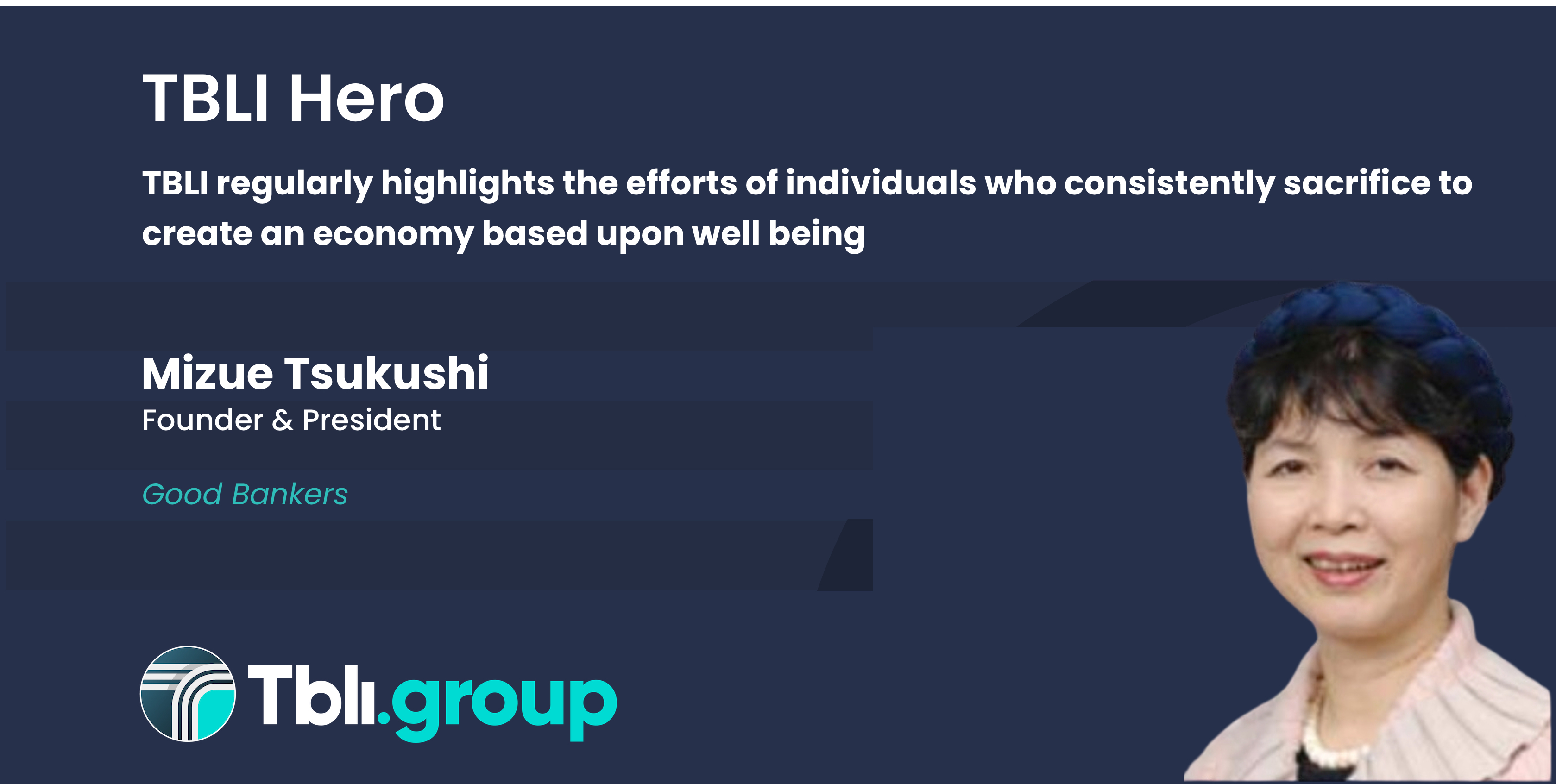
TBLI Hero: Mizue Tsukushi — Building Finance Around Human Values

At TBLI, we regularly highlight the efforts of individuals who devote their lives to building an economy based on well-being rather than short-term gain. Few embody this spirit more deeply than Mizue Tsukushi, founder and CEO of The Good Bankers Co., Ltd.

For more than three decades, she has been a tireless pioneer in Japan’s responsible investment movement—long before ESG became a global buzzword. Her unwavering belief that finance must serve people and the planet has reshaped how investors, companies, and policymakers think about value creation.

Mizue’s work demonstrates that true leadership means persistence, courage, and moral clarity. By bridging ethics and enterprise, she has shown that capital can be a force for compassion and sustainability.

We celebrate Mizue Tsukushi as a TBLI Hero for her lifelong commitment to building a financial system rooted in purpose, integrity, and care for future generations. In addition, Mizue has been a staunch supporter of TBLI. Thank you 


TBLI Radical Truth Podcast

 TBLi Radical Truth Podcast “How to Bring Clarity to ESG Data”– with Frank Tobé

Welcome to TBLi Radical Truth Podcast, where knowledge inspires and we shine a light on the people and ideas reshaping sustainable finance.

In this episode, we’re joined by Frank Tobé, co-founder of ESG Book, a global leader in ESG data and technology. Frank has been at the forefront of building digital infrastructure to bring greater transparency, accessibility, and consistency to ESG reporting and analysis.

In “How to Bring Clarity to ESG Data,” we explore why reliable sustainability data remains one of the biggest challenges for investors, companies, and regulators. Frank shares how ESG Book is creating a universal platform that makes ESG information more standardized, comparable, and actionable—empowering decision-makers to move from compliance to real impact.

TBLi Radical Truth Podcast features thought leaders who are cutting through complexity and unlocking the future of ESG and impact investing.
Let’s begin our conversation with Frank Tobé.

This is TBLi Radical Truth 

Listen to the full podcast


TBLI Virtual Mixer

Not Another Zoom Call — A Space That Feels Human.

The TBLI Virtual Mixer is designed for 1-on-1 connection and values-based collaboration.
Come as you are. Leave recharged.
📅 OCtober 30h at 16:00 CET
👉 https://luma.com/91tw4ymk
#ImpactNetworking #TBLICircle #AuthenticConnections


See how it works → (2 min video)


TrustVC

Founders: You deserve better than ghosting.
LPs: You deserve better than surprise red flags.

The information asymmetry ends now.

TrustVC.org is live.
The unbiased review platform VCs never wanted.
The due diligence tool founders & LPs always needed.

✔️ Rate VCs
✔️ Uncover the truth
✔️ Reward the best

Bringing sunlight to startup funding.
🔗 https://www.trustvc.org/


Join TBLI Circle — Transform Finance for Impact


TBLI Circle

The Future of Finance is Here
While others debate sustainability, leaders are building it.

With TBLI Circle, you can:
✅ Execute breakthrough initiatives first.
✅ Access exclusive, unadvertised deal flow.
✅ Shape the standards your competitors will follow.
✅ Connect with decision-makers controlling billions.

Don't watch from the sidelines. Lead the transformation.

👉 Join TBLI Circle Today

The right network doesn't just open doors—it builds new ones.


Welcome to the Three-Ring Economic Circus (And Why You're Being Clowned)

Robert Rubinstein 
October 28th

Anyone who believes that exponential growth can go on forever in a finite world is either a madman or an economist. — Kenneth E. Boulding

Let’s get this out of the way upfront. Our global economic system isn’t just broken; it’s a goddamn death cult run by lunatics who’ve never met a finite resource they didn’t want to infinite.

I’m talking about the Growth Cult.

Picture this: you’re at a party, and a guy is having a heart attack. The economists in the corner don’t call a doctor. They shout, “Give him cocaine! He needs stimulation! MORE STIMULATION!”

That’s our system. The patient—our planet, our society—is having a coronary, and the prescription is a double dose of whatever’s killing him.

Growth isn’t policy anymore; it’s a state religion. It has its high priests (Nobel laureates with their heads firmly in the theoretical sand), its cathedrals (Wall Street, the WEF), and its holy, unquestionable dogma: “Thou shalt grow by 3% annually, or be cast into the outer darkness of recession, where there is wailing and the frantic updating of CVs.”

We’ve been running this economic marathon for seventy years, and we’re so terrified of stopping that we don’t realize we blew past the finish line decades ago and our kneecaps are shot.

Let’s talk about what “growth” really is. It doesn’t mean more happiness. It means more transactions.

If I pay you to punch me in the face, GDP goes up. If we get a divorce and hire lawyers, GDP goes up. If I get cancer and spend my life savings on treatment, GDP goes up. The economy is literally feeding on our misery.

And the kicker? The system treats the depletion of natural resources as income. It’s like a company selling off its factory, piece by piece, and calling it a profit. The high priests call this “sustainable development.” I call it a suicide pact with fancy terminology.

They’ll smile condescendingly and say, “Ah, but technology will decouple growth from resource use!” Sure. And I’ve got a bridge in Brooklyn I’d like to sell you. It’s made of pure efficiency. In the real world, efficiency just means we can destroy the planet at a slightly better rate.

The real joke? It’s not even working. GDP has tripled since the 60s, but happiness hasn’t budged. The 1% has captured 38% of all new wealth since 1995, while the bottom 50% got a crumbs-on-the-floor 2%. The solution? “Trickle-down economics.” Here’s a thought: maybe instead of waiting for wealth to trickle down, we could just not hoard it at the top?

But that’s heresy. In the Growth Cult, redistribution is the ultimate sin. You can’t take from the “job creators”™—they might stop creating those wonderful minimum-wage jobs we’re all so grateful for.


Then There’s the Other Extreme: The Degrowth Delusion

If the Growth Cult is a cocaine addict, the Degrowth movement is the reformed addict who now thinks everyone should live in a monastery. They’ve seen the damage, but their solution is… extreme.

Their basic premise is right: infinite growth on a finite planet is batshit crazy. But their solution often sounds like austerity dressed up as enlightenment. “You don’t need all that stuff anyway!”

Easy to say when you’re a tenured professor in Paris. Harder to swallow when you’re working three jobs in Detroit.

They romanticize poverty, talking about “voluntary simplicity” in a way that’s condescending to those experiencing involuntary complexity. There’s even a whiff of neo-colonialism: “We got ours, but you in the Global South should stay poor for the planet’s sake.”

And they’re politically naive. They think if they just explain it clearly, politicians and CEOs will say, “Oh, you’re right! Let’s make less money for the good of humanity!” Good luck with that. You might as well try to convince a shark to become vegan with a PowerPoint on the ethics of eating fish.


The Radical Truth: The Post-Growth Reality

So, what’s the alternative? It’s not perpetual growth, and it’s not forced degrowth. It’s Post-Growth. And the most radical idea in this whole circus is one word: Enough.

Imagine you’re in a restaurant. You’ve finished a meal. The waiter offers dessert. You say, “No thanks, I’ve had enough.”

A normal interaction, right? No one screams, “BUT THE DESSERT ECONOMY WILL COLLAPSE!”

Yet apply that to the broader economy—the idea that maybe we have enough stuff and should focus on better rather than more—and suddenly you’re a dangerous radical.

Post-growth isn’t about going backwards. It’s about growing up. A healthy economy for infants focuses on growth. A healthy economy for adults focuses on maintenance, development, and fulfillment. Ours has been a spoiled, destructive adolescent for a century.

In a post-growth economy, we’d measure what actually matters:

  • Health, not just healthcare spending.

  • Time affluence—imagine a 20-hour workweek!—not just monetary wealth.

  • Community strength, not the number of security systems sold.

We’d still have innovation, but directed at what enhances life, not what generates the most profit. We’d ask not just “Can we?” but “Should we?

The transition is hard because our entire system is a house of cards built on the assumption of perpetual growth. But these are human systems. We built them. We can change them.

The good news? The transition is already happening. In community land trusts, worker co-ops, and repair cafes. It’s a quiet rebellion against the screaming insanity of the circus.

The Growth Cult sells a story of scarcity: there’s never enough. The Post-Growth reality recognizes the abundance that already exists and asks how we can share it more wisely. The real scarcities aren't material—they're scarcities of care, connection, and meaning. And no amount of GDP growth can fix that.

This is the radical truth: We already have enough to create good lives for everyone on this planet. The scarcity is manufactured. The "need" for endless growth is a con.

We can keep running this three-ring circus until the tent collapses on our heads. Or we can have the courage to step out and build an economy that serves life, not the other way around.

What’s it going to be?

#PostGrowth #BeyondGrowth #RadicalTruth #EconomicTransformation #Degrowth #WellbeingEconomy #NewEconomy

👉 Follow Robert Rubinstein for more


This is an adaptation from the upcoming book, "Radical Truth." Think your network needs to hear this? Share it. Let's start a real conversation.
Read full article 

‘Change course now’: humanity has missed 1.5C climate target, says UN head

Exclusive: ‘Devastating consequences’ now inevitable but emissions cuts still vital, says António Guterres in sole interview before Cop30

A flooded village in the low-lying island nation of Kiribati. The UN secretary general says Indigenous communities must be better represented at Cop climate summits. Photograph: Jonas Gratzer/LightRocket/Getty Images

By and 

Humanity has failed to limit global heating to 1.5C and must change course immediately, the secretary general of the UN has warned.

In his only interview before next month’s Cop30 climate summit, António Guterres acknowledged it is now “inevitable” that humanity will overshoot the target in the Paris climate agreement, with “devastating consequences” for the world.

He urged the leaders who will gather in the Brazilian rainforest city of Belém to realise that the longer they delay cutting emissions, the greater the danger of passing catastrophic “tipping points” in the Amazon, the Arctic and the oceans.

“Let’s recognise our failure,” he told the Guardian and Amazon-based news organisation Sumaúma. “The truth is that we have failed to avoid an overshooting above 1.5C in the next few years. And that going above 1.5C has devastating consequences. Some of these devastating consequences are tipping points, be it in the Amazon, be it in Greenland, or western Antarctica or the coral reefs.

He said the priority at Cop30 was to shift direction: “It is absolutely indispensable to change course in order to make sure that the overshoot is as short as possible and as low in intensity as possible to avoid tipping points like the Amazon. We don’t want to see the Amazon as a savannah. But that is a real risk if we don’t change course and if we don’t make a dramatic decrease of emissions as soon as possible.”

The planet’s past 10 years have been the hottest in recorded history. Despite growing scientific alarm at the speed of global temperature increases caused by the burning of fossil fuels – oil, coal and gas – the secretary general said government commitments have come up short.

Fewer than a third of the world’s nations (62 out of 197) have sent in their climate action plans, known as nationally determined contributions (NDCs) under the Paris agreement. The US under Donald Trump has abandoned the process. Europe has promised but so far failed to deliver. China, the world’s biggest emitter, has been accused of undercommitting.

Read full article

Wind power has cut £104bn from UK energy costs since 2010, study finds
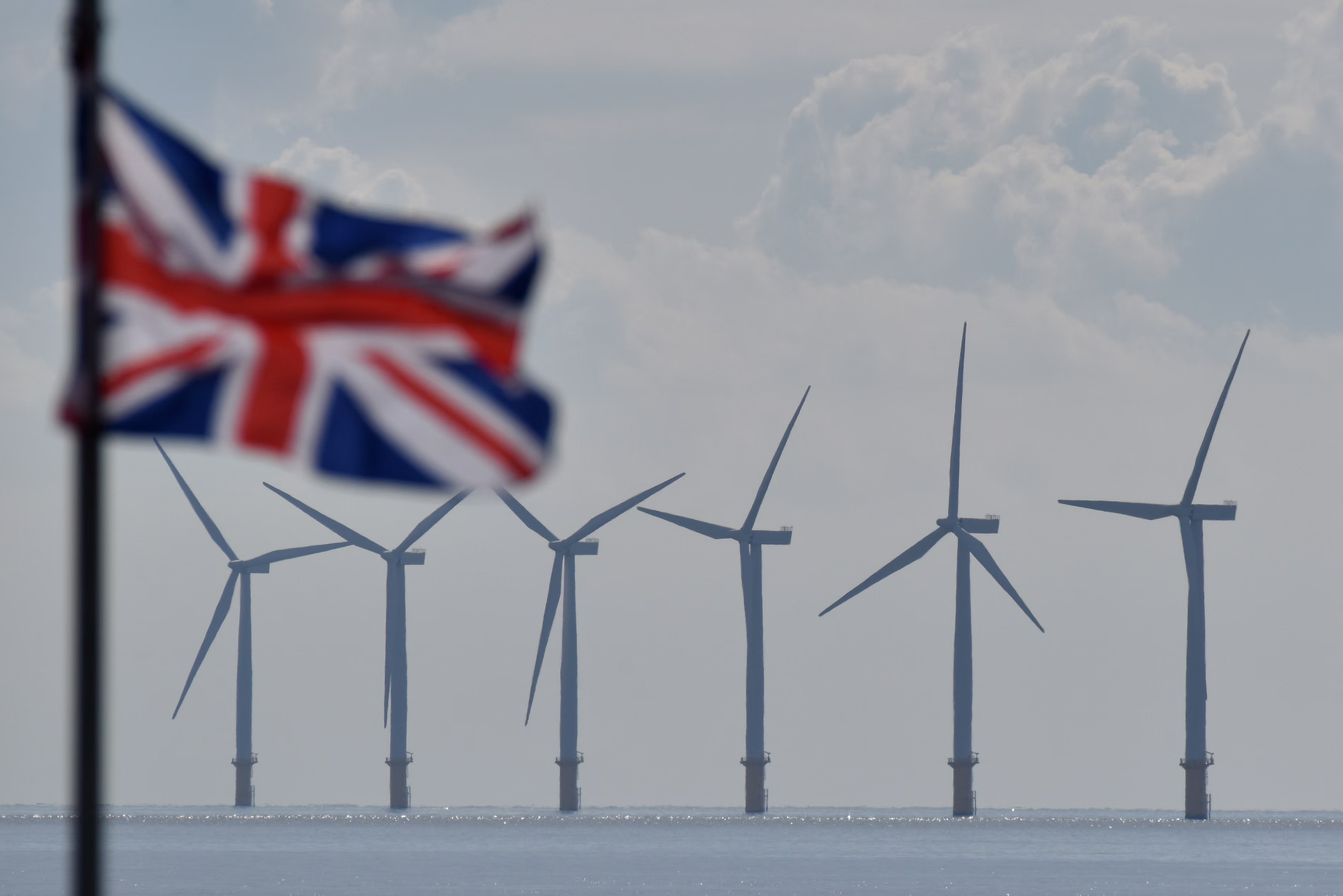

Surging renewable energy generation across Europe has lowered gas demand and prices, researchers say. Photograph: John Keeble/Getty Images
 Environment editor


Wind power has cut at least £104bn from energy costs in the UK since 2010, a study has found. Users of gas have been among the biggest beneficiaries, the research suggested.

Research by University College London found that from 2010 to 2023, energy from windfarms resulted in electricity bills being lower by about £14.2bn than they would have been if gas had been needed to generate the same amount of power.

However, the reduction in the cost of gas that could be attributed to wind generation – owing to the cut in demand and not needing to build new infrastructure – was much greater, at about £133.3bn.

Over the same period, consumers paid about £43.2bn in green subsidies, levied on electricity bills rather than gas bills. The net result was a reduction of £104.3bn in UK energy bills over the 13-year period, according to the researchers.

Surging renewable energy generation across Europe made demand for gas – and thus gas prices – lower than they would otherwise have been, and meant electricity companies had less need to build costly new gas-fired power stations, according to the analysis. The way that the UK’s energy market works also means gas-fired power stations are in effect allowed to set the price of electricity.

The analysis applied to 2010-23, leaving out the lingering impacts of the leap in gas prices in early 2022, when Russia invaded Ukraine.

Colm O’Shea, a former hedge fund manager, now a master’s student at UCL and lead author of the report, said: “Far from being a financial burden, this study demonstrates how wind generation has consistently delivered substantial financial benefits to the UK. To put it into context, this net benefit of £104bn is larger than the additional £90bn the UK has spent on gas since 2021 as a result of rising prices related to the war in Ukraine.

“This study demonstrates why we should reframe our understanding of green investment from costly environmental subsidy to a high-return national investment.”

Mark Maslin, a professor of Earth system science at UCL, said the UK’s consumers would benefit to a greater extent if the electricity market were reformed to reflect the reality that wind generation was reducing bills. “At some stage, the UK government must decouple gas and electricity prices,” he said. “That would mean gas prices would reflect the global markets, while the electricity price would reflect the savings from wind and solar.”

Ana Musat, the director of policy at RenewableUK, the trade body for the wind sector, said: “This research highlights the long-term economic benefits for UK plc of investing in renewable energy generation. The only way to reduce energy costs for good is to minimise our exposure to volatile global fossil fuel prices and increase the share of electricity generation from clean homegrown sources.”

Read full article

India’s Renewable Energy Mix Hits Major Milestone

Cyrene Oraya Reyes

India’s renewable energy mix has crossed a crucial threshold, with more than half of its installed power capacity now coming from non-fossil fuel sources.

According to government and industry reports, India has reached a significant milestone in its energy transition journey. As of early 2025, 50.3% of the country’s total installed electricity capacity comes from non-fossil sources. This includes solar, wind, hydroelectric, nuclear, and biomass energy. The achievement marks a major step toward India’s target of 500 gigawatts of non-fossil fuel power by 2030.

The country’s total installed capacity is approximately 429 gigawatts. Out of this, about 215 gigawatts are now generated by clean sources. Solar energy is leading the way, contributing nearly 82 gigawatts. Wind energy follows at over 45 gigawatts. Hydropower and other renewable forms make up the rest. This transition places India among the few major economies where clean power dominates the energy mix.

This progress is significant in the context of India’s commitment to climate goals made under the Paris Agreement. The country pledged to reach 50% of its electricity generation capacity from non-fossil sources by 2030. That target has now been met five years ahead of schedule.

The central government credits this success to a combination of policy, innovation, and private sector participation. Initiatives like the International Solar Alliance and Production Linked Incentive schemes for solar panel manufacturing have accelerated growth in renewable energy infrastructure. Large solar parks, wind corridors, and grid modernization projects have also played key roles in scaling up clean power sources across the country.

However, it’s important to note that installed capacity is not the same as energy output. While non-fossil sources now account for over half the capacity, fossil fuels, especially coal, still dominate actual electricity generation. This is because coal plants typically run more consistently, while solar and wind depend on weather and daylight conditions. Nonetheless, as battery storage and grid integration improve, clean energy’s share in actual usage is expected to grow rapidly in the coming years.

India’s renewable energy mix is also a response to rising energy demand. With a population of over 1.4 billion and rapid urbanization, the country needs reliable electricity to support its economic development. Clean energy provides a sustainable path forward, reducing dependence on imported fossil fuels and limiting greenhouse gas emissions.


Read full article


TBLI Group Herengracht 450, 1017 CA Amsterdam, The Netherlands
To receive our free TBLI Weekly Subscribe here
TBLI Group Logo

This email was sent to [EMAIL]. You are receiving this email because you have signed up on our website, TBLI Weekly or subscribed to our email list.

Unsubscribe | Privacy Policy | Cookies Policy

Privacy Policy and Cookies Policy