|
|
Author: Robert Rubinstein |
Your weekly guide to Sustainable Investment |
|


|


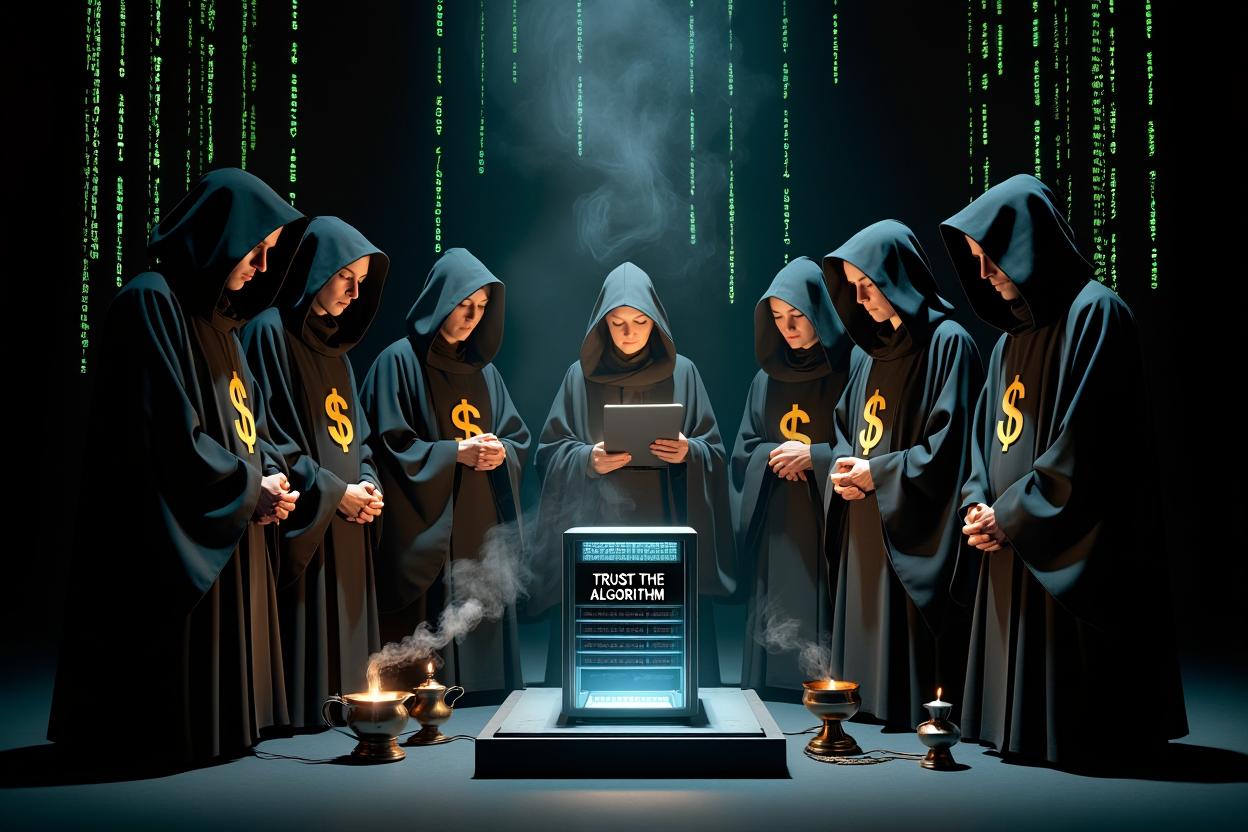 Reve AI generated
The Algorithmic PriestsRobert RubinsteinThis is an adaptation from the upcoming book, "Radical TruthFinancing Our Collapse, Funding Our Survival." Think your network needs to hear this? Share it. Let's start a real conversation.Do you remember when the financial crisis hit? Hundreds of thousands of employees were let go. Then something that seemed to defy logic happened. Despite the fact that so many employees were laid off, the financial sector didn’t get smaller, as would be the case in most industries. It got bigger. Were all those laid off employees creating any value? Did they ever. Important to reflect on that to fully understand the financial sector. On our guided tour through the financial train wreck, we will meet the newest clergy in the Church of Capitalism: the Algorithmic Priests. Trading was once done by sweaty guys in bright colored jackets screaming at each other ? Well, they have been replaced by something far more terrifying – algorithmic traders. That’s right, the financial world decided human greed wasn’t efficient enough, so they automated it. The Rise of the Machines: How We Got HereBack in the good old days—and by “good old days,” I mean when financial destruction was limited by human stamina—trading had physical constraints. You could only screw over so many people before your voice gave out from yelling “BUY! SELL!” across the trading floor. It was artisanal financial destruction, handcrafted by Ivy League sociopaths who at least had to look their colleagues in the eye while they crashed pension funds. Let me take you on a journey through time. The 1980s: cocaine fueled traders wearing suspenders, manually entering orders while quoting Gordon Gekko. The 1990s: the first trading software appears, and suddenly the cokeheads have computers to help them destroy value more efficiently. The 2000s: algorithmic trading starts gaining traction, because apparently letting humans make disastrous financial decisions wasn’t catastrophic enough. Then 2008 happens. The global economy implodes because a bunch of math whizzes convinced everyone they had eliminated risk through the magic of securitization— a euphemism for taking a pile of dog shit, mixing it with some cat shit, calling it “diversified animal waste securities,” and selling it as premium fertilizer. Instead of responding to this catastrophe by saying, “Hey, maybe we should be more careful with these complex financial instruments,” Wall Street looked at the smoking ruins of the global economy and thought, “You know what this situation needs? MORE MATH.” So while millions of people were being evicted from their homes, the financial sector was busy hiring every physics PhD they could find to build even more complex systems. Because clearly, the problem with the old models wasn’t that they were fundamentally flawed—they just weren’t complicated enough! The transition happened quickly. Trading floors emptied out. Those iconic scenes of traders throwing hand signals and screaming into multiple phones disappeared. They were replaced by server rooms where the only sound is the gentle hum of computers systematically extracting wealth from the economy, interrupted occasionally by the popping of champagne corks in the executive suite upstairs. What’s truly remarkable about this transition wasn’t just the speed—it was the complete absence of a moral sense. No one asked the fundamental question: “Should we be doing this?” The Holy Trinity of Quantitative BullshitThe modern financial system now worships at the altar of three sacred deities: High frequency Trading – The God of SpeedBecause stealing pennies isn’t profitable unless you do it a billion times per second. These algorithms operate in microseconds—literally faster than you can blink. While you’re reading this sentence, HFT algorithms have executed thousands of trades, skimming microscopic amounts of money from each one like financial mosquitoes sucking the blood of the markets. The high priests of HFT will tell you they’re “providing liquidity” and “tightening spreads.” That’s like a pickpocket claiming they’re “improving wallet efficiency” and “optimizing cash distribution.” They’ve spent billions to shave milliseconds off their execution times. They’ve built dedicated fiber optic lines between Chicago and New York. They’ve positioned servers physically closer to exchange matching engines. There are companies that spent millions placing microwave towers in a straight line across the country to transmit data a few microseconds faster. Think about that level of insanity for a second. While schools are falling apart and bridges are collapsing, the finest engineering minds of our generation are figuring out how to move a buy order for Microsoft stock a nanosecond faster so some hedge fund can make an extra nickel. What a waste of brainpower. And the best part? When HFT goes wrong—which it does with alarming regularity—it doesn’t just affect the idiots who built it. No, it crashes entire markets. Remember the Flash Crash of 2010? The market dropped nearly 1,000 points in minutes because algorithms essentially got into a feedback loop of panic selling. Imagine a world where giving a toddler the nuclear launch codes and then being surprised when they push the button because it lights up and makes fun noises. Machine Learning Models – The God of PatternGlorified pattern recognition software that mistakes correlation for causation more often than your drunk uncle at Thanksgiving dinner. These algorithms comb through terabytes of historical market data looking for patterns, completely ignoring the financial equivalent of Heisenberg’s Uncertainty Principle: the act of observing and exploiting a pattern changes or destroys the pattern itself. These quants will gather decades of market data, carefully clean it up to remove “anomalies” (also known as “the parts that don’t fit their theory”), and then build models that would have made money in the past—if only they’d had their model in the past. Imagine a world where designing the perfect umbrella after the rainstorm has ended, then being shocked when it doesn’t keep you dry during the hurricane. “Our neural network has discovered a statistically significant correlation between rainfall in Brazil and small cap stock performance in the third quarter!” Great, except by the time you’ve published your findings, every other algorithm has already incorporated that information, rendering your edge nonexistent. It’s a never ending arms race of increasingly esoteric correlations. Next week they’ll be trading based on the number of pigeons in Central Park or the average length of men’s beards in Portland. The dirty secret of these machine learning models is that they’re often no better than dart throwing monkeys, but with fancier mathematics to justify their creators’ seven figure salaries. They work great until they don’t, and when they stop working, their creators don’t say “our model was wrong”—they say “the market conditions changed unexpectedly.” . Hey genius, that’s what markets do. Risk Management Algorithms – The God of False SecuritySophisticated mathematical models have been designed to tell you exactly how fucked you are, approximately three seconds after you’re already fucked. These are perhaps the most dangerous of all because they create the illusion of safety. They’re the financial equivalent of those useless “childproof” caps that somehow manage to confound adults while being easily opened by determined three yearolds. Value at Risk (VaR) models are the crown jewel of this false security. They use historical data to tell you there’s only a 1% chance of losing more than X amount in a day. The problem is that when that 1% day hits, you don’t lose X—you lose 10X or 100X because all the assumptions built into the model collapse simultaneously. What it reminds me of is building a flood wall designed to withstand historical water levels, only to discover that climate change has made those historical patterns irrelevant. What’s particularly insidious about these risk models is how they lull organizations into complacency. “Our model shows we’re well protected against extreme events,” they say, right before an extreme event bankrupts them. Here’s the beautiful irony: Wall Street spent billions developing these algorithms to predict market behavior, completely ignoring that the primary source of unpredictability in markets is… wait for it… the algorithms! The Quantitative CathedralWalk into any major financial institution these days and instead of finding dudes with cocaine residue on their Brooks Brothers ties, you’ll find the new priesthood: PhDs in physics and math who couldn’t get real jobs advancing humanity, so they decided to help billionaires become trillionaires instead. These quants sit in their glass towers, crafting increasingly complex mathematical models that nobody—not even them—fully understands. They’ve created a perfect system where success is attributed to their genius, while failure is just “unprecedented market conditions.” Nice work if you can get it. The modern quantitative finance department resembles nothing so much as a medieval cathedral, complete with its own inscrutable rituals, hierarchies, and sacred texts. At the bottom are the acolytes—fresh graduates with masters in financial engineering who spend their days cleaning data and running backtests. Above them are the priests—those with PhDs who design the algorithms and speak in tongues of stochastic calculus and Markov chains. And at the top sit the high priests—the fund managers and bank executives who interpret the prophecies for the unwashed masses (that’s you and me, by the way). The whole system operates on faith. Faith that the models work. Faith that the past predicts the future. Faith that somewhere in the tangled mess of code and equations is actual wisdom rather than elaborate curve fitting. It’s no different from ancient priests examining goat entrails to predict the next harvest, except the priests now have Bloomberg terminals and the sacrifice is your 401(k). “But our models are based on historical data!” they’ll protest. Yeah, and my retirement plan is based on winning the lottery. Past performance doesn’t guarantee future results, unless you’re talking about Wall Street’s ability to screw over retail investors—that’s remarkably consistent. The language these quants use is deliberately obtuse, designed to intimidate rather than illuminate. They don’t say “we’re guessing”—they say “we’re applying Bayesian inference techniques to establish probabilistic parameters.” They don’t say “we have no clue why this works”—they say “the emergent properties of the system demonstrate robust heuristic validity despite theoretical opacity.” It’s nonsense infused jargon, served on a bed of mathematical equations with a side of Greek symbols. And God help you if you ask them to explain their models in plain English. You’ll get the condescending smile, the slight head tilt, and then: “Well, it’s rather complex, but essentially we’re using a multifactor model with nonlinear regression techniques to identify alpha generating opportunities across uncorrelated asset classes.” Translation: “We’re gambling with other people’s money and collecting fees regardless of whether we win or lose.” The real genius of the Quantitative Cathedral isn’t the math,it’s the marketing. They’ve convinced the world that finance is now a science rather than what it’s always been: educated guesswork driven by greed and fear. By draping their activities in the language and trappings of science, peer reviewed papers, complex formulas, data analysis,they’ve given gambling an academic veneer. “We must make our choice. We may have democracy, or we may have wealth concentrated in the hands of a few, but we cannot have both.”
|
|
|
|