TBLi Radical Truth: Is CQ the New Leadership Standard? Decoding the Formula for Modern Success
Welcome to the TBLi Radical Truth Podcast, where we challenge the fundamental assumptions shaping how we lead, organize, and create value in a rapidly changing world.
In an era defined by VUCA (Volatility, Uncertainty, Complexity, and Ambiguity), traditional leadership models are no longer sufficient. In this episode, we are joined by Stefan Beiten, a serial entrepreneur and the visionary founder of The Argonauts, to discuss a transformative evolution in organizational culture: Conscious Intelligence (CQ).
The New Equation: $IQ + EQ = CQ$
Stefan argues that for leadership to scale and for cultural transformation to truly take root, we must move beyond raw intelligence and emotional awareness. He introduces a new formula for the modern leader: Conscious Intelligence. By "Creating Conversational Fluency™"—a collective language rooted in radical trust—organizations can finally bridge the gap between their higher purpose and the bottom line.
"To change the world, we must change the way we communicate. Trust isn't just a feeling—it’s a fluency." — Stefan Beiten
About TBLi Radical Truth
Real experience. Real results. No greenwashing. For over 25 years, TBLI Group has been the world’s leading ESG and impact investing network—educating, advising, and connecting investors to build a sustainable and equitable future.
Why are the world's most purpose-driven investors, founders, and changemakers showing up every last Friday of the month?
Because the TBLI Virtual Mixer isn't a webinar. It's not a pitch fest. It's not small talk.
It's the place where values-aligned professionals actually find each other — the co-investor you've been looking for, the entrepreneur solving the problem you care about, the collaborator who gets it without a 10-minute explanation.
Our smart matchmaking puts you in the room with the right people. You show up. We do the connecting.
📅 Next mixer: last Friday of the month | 16:00–17:30 CET No fluff. No travel. Just real, purpose-driven conversations. Limited space — join early!
💬 Speed networking with values-aligned peers. Our matchmaking system connects you.
🛡️ The Most Expensive Thing a Founder Can Lose Isn’t Equity. It’s Time.
That VC who ghosted you after the third partner meeting? They’re doing it to someone else right now.
Founders lose deals, momentum, and sanity to VCs who flip terms at the finish line or disappear the moment a check is signed. For too long, these "nightmare stories" stayed in private group chats. Meanwhile, bad-faith investors kept winning.
We’ve moved the conversation from the shadows to the surface. TrustVC surfaces the real patterns:
Who actually responds (and who ghosts).
Who honors their word (and who flips terms).
Who supports the portfolio (and who disappears post-check).
Venture Capital has always used "due diligence" to judge you. It’s time you had the data to judge them. One founder’s hard-earned lesson is the entire community’s strategic advantage.
Stop fundraising blind. Check the record before your next intro.
They are designed for the "take." They thrive on transactional noise. They leave you drained.
TBLI Circle is different.
For over 25 years, we’ve curated a global ecosystem of people who believe capital should move toward good—not just a return. We aren't just discussing the "Triple Bottom Line"; we are institutionalizing it.
If you are working in Impact Investing, ESG, or simply asking: "What if finance actually served the people and the planet?"—this is the community that has been answering that question for a quarter-century.
Why join now?
Zero Noise: We filter out the grifters so you can focus on the work.
Radical Honesty: A private, high-trust sanctuary for non-extractive professionals.
Global Intelligence: Access to a legacy of collective wisdom and values-aligned capital.
This is your moment. Make 2026 the year you look back on as the definitive turning point in your professional journey. Stop networking into a vacuum and start building with people who "get it."
🚀 Take the first step
Ready to experience the best year of your career?
Make 2026 the year you look back on as the turning point.
👉 Join the circle:tblicircle.com 👉 TBLICircle.com-2 week trial period→
TBLI Radical Truth:
The Wealth Whisperer Called Me Today — And Here's What He Really Wanted to Know
How do I convince my Asset Owners to Invest in Impact?
By Robert Rubinstein | TBLI Group | Radical Truth
So I get a call today from someone I hadn't spoken to in a while.
Let's call him what he is: a wealth whisperer. The guy who sits across mahogany tables from billionaires, helps them structure family offices, set up foundations, navigate the byzantine world of asset allocation, and — more recently — tries to steer them toward ESG and Impact investing.
He'd been reading my articles about the Impact Mafia. You know the ones. The pieces where I name names, call out the charade, and refuse to pretend that slapping an ESG label on a fossil fuel company is impact investing.
He was impressed. Or maybe just surprised that someone was still willing to say what everyone in this industry knows but won't say out loud.
Then he asked me the real question.
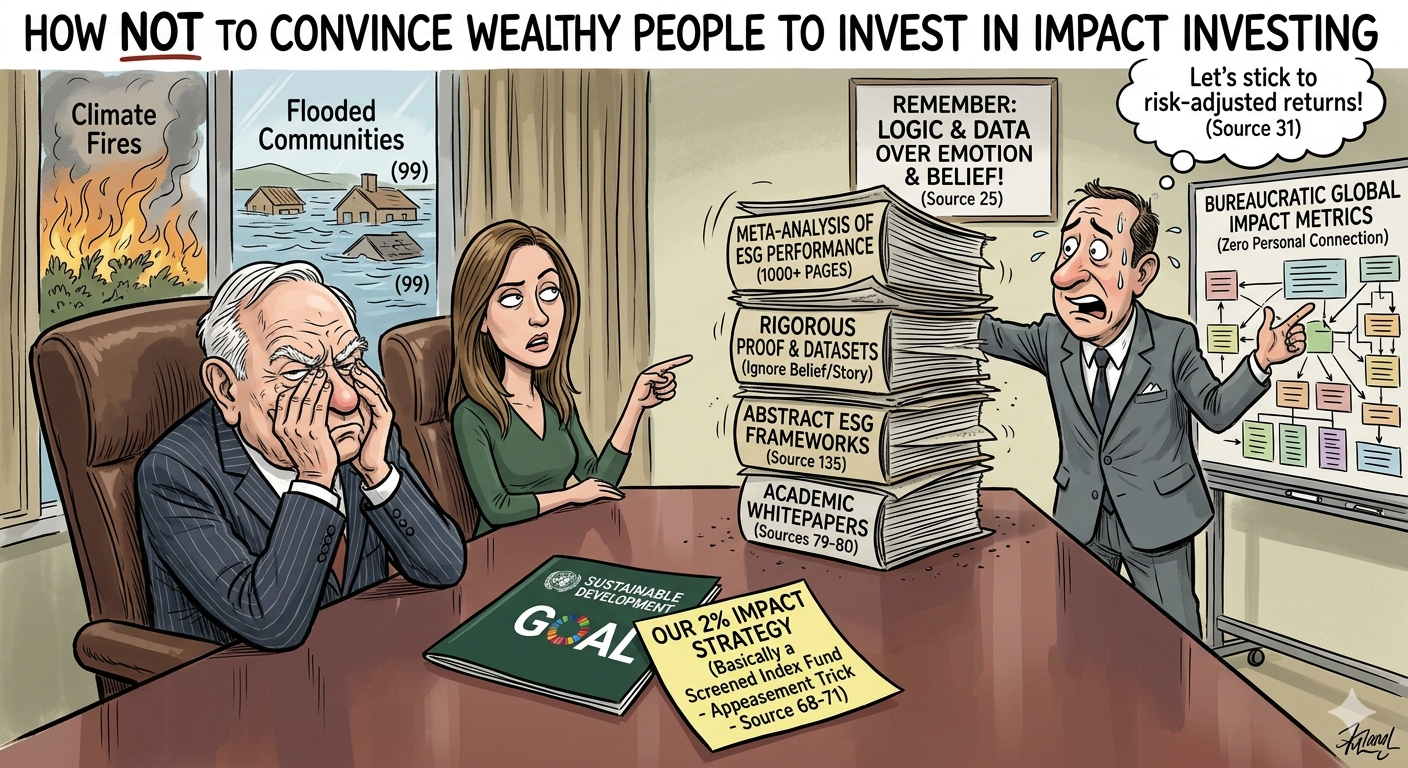
"Robert, what are the triggers? What actually gets a UHNW family to commit — really commit — to a true Impact strategy? And how the hell do you deal with the wealth managers who fight it every step of the way?"
Buckle up. Here's the Radical Truth.
First, Let's Be Honest About Who We're Talking About
Ultra High Net Worth families. People with $30 million, $300 million, sometimes billions. They didn't get there by being naive. They got there by being ruthless, or lucky, or both. Many of them built things. Some of them destroyed things. A lot of them, late in life, start wondering what the scoreboard really means.
They have family offices because their wealth is complicated enough to need a team. They have foundations because at some point someone — a spouse, a child, a near-death experience, or a TED talk — made them feel something.
And somewhere in there, if you're doing your job, is a crack in the armor. A moment of genuine curiosity. A flicker of what if money could actually do something that matters?
I will be speaking on an Oxford-style debate on ‘has impact investing has lost its way?’ at the New Private Markets Impact Investor Global Summit, taking place in-person on 19-20 May in London. The event is a leading global gathering of impact investors in private markets, hosting 700 people from allocators (230+ LPs attended in 2025) and investors with impact-focus strategies including climate, decarbonisation, social impact, nature-based solutions in addition to a host of other themes. For more information on the agenda, speaker and how to register, see the website here:www.peievents.com/en/event/impact-investor-global-summit
Europe’s new growth engine: rewarding impact strengthens competitiveness
Our new report, developed in collaboration with Impact Institute and Singapore Management University, calculates the True Profits of the 20 largest European companies and finds that their combined financial profits of €209 billion would turn into a net societal loss of €19 billion once real social and environmental costs are counted. “Europe does not lack sustainable solutions. It lacks a market that rewards them,” says Werner Schouten, director of the Impact Economy Foundation.
True Profits
The study introduces a new metric: True Profit, a company’s financial profit after accounting for its key positive and negative social and environmental externalities. Grounded in the Impact Weighted Accounts Framework (IWAF), it gives businesses, investors and policymakers a new economic compass: not just which companies are financially profitable, but which are genuinely profitable for society.
Total Negative Externalities of all Assessed Companies in relation to Financial Profit.
Key findings
The report analyses the True Profits of the 20 largest companies in Europe. On the one hand, total annual positive contributions to society of the 20 companies analysed amount to approximately € 427 billion. These benefits include customer value, employee well-being and financial returns to investors.
At the same time:
Climate-related costs alone absorb 60% of companies’ reported profits.
When social and environmental costs are fully accounted for, combined profits of €209 billion would turn into a net loss of €19 billion.
For every euro of revenue generated, companies generate €0.16 in social and environmental costs, which are not reflected in profits.
These findings underline that Europe’s current economic model is heavily dependent on and favours business models that shift costs to society, while disadvantaging companies that invest in cleaner, more resilient solutions.
Making impact profitable: the opportunity for Europe
The report concludes that Europe can be competitive and sustainable, only if markets reward impact. The report argues for making impact profitable through three levers: a True Profit Tax that links corporate tax rates to net societal impact; impact-adjusted interest rates that lower the cost of capital for impactful business models; and balance sheet reform that recognises climate and nature investments as long-term assets.
Most Western executives think their exposure to China begins and ends with the question of whether they buy from or sell to Chinese companies. They are wrong. China’s capacity for innovation, its manufacturing dominance, and its geopolitical influence are changing the competitive landscape that all businesses operate in. Even when Chinese companies aren’t swimming in your part of the ocean, the country’s policies and priorities have a direct impact on the water.
The facts are undeniable. The research institute Rand Corp. estimates that Chinese AI models now operate at one-sixth to one-fourth the cost of comparable American systems, and a U.S. advisory commission warned this week that Chinese AI now dominates global open-source usage rankings. But artificial intelligence is only one expression of a broader shift. The same country that is closing the AI gap also manufactures over 80% of the world’s batteries, builds more commercial ship tonnage in a single year than America has since World War II, and is rapidly becoming the partner of choice for countries looking for an alternative to an increasingly unpredictable United States.
These forces—innovation, industrial capacity, geopolitical realignment—are reshaping the operating environment for every company, including those that don’t trade with China at all. Business leaders who want to prepare their organizations for this changed world need to start by understanding these three fundamental forces and their effects.
In AI, Chinese models have moved from trailing U.S. frontier systems by double digits on standard benchmarks to near-parity, and they deliver these results at a fraction of the cost. Lee Kai-fu, founder of the Beijing startup 01.AI, told Reuters the gap had narrowed to three months in some core technologies, and that China was now ahead in certain areas. Nature describes the Kimi K2 model by Moonshot AI as “another DeepSeek moment,” matching or surpassing some Western rivals on specific tasks.
When it comes to electric vehicles, the transformation is even more vivid. BYD’s Yangwang U8 is an SUV that literally floats and can park sideways like a crab. The company’s Denza Z9GT model charges from 10% to 70% in five minutes and has a range of 800 kilometers. BYD sold over 417,000 vehicles overseas in 2024, aimed for 800,000 in 2025, and ended up selling more than a million. These aren’t cheap knockoffs. They are better products at lower prices.
None of this means the old problems have disappeared. A report by the Office of the U.S. Trade Representative confirms that effective remedies for trade-secret theft remain difficult in China. Academic misconduct is real enough that Beijing itself is now moving to punish universities that fail to sanction research fraud. But here’s the point most Western leaders miss: China is so vast that it doesn’t need the whole system to be world-class. If even 20% of its innovation economy is operating at the frontier, that’s a force larger than most countries’ entire output. And the trajectory is moving in one direction.
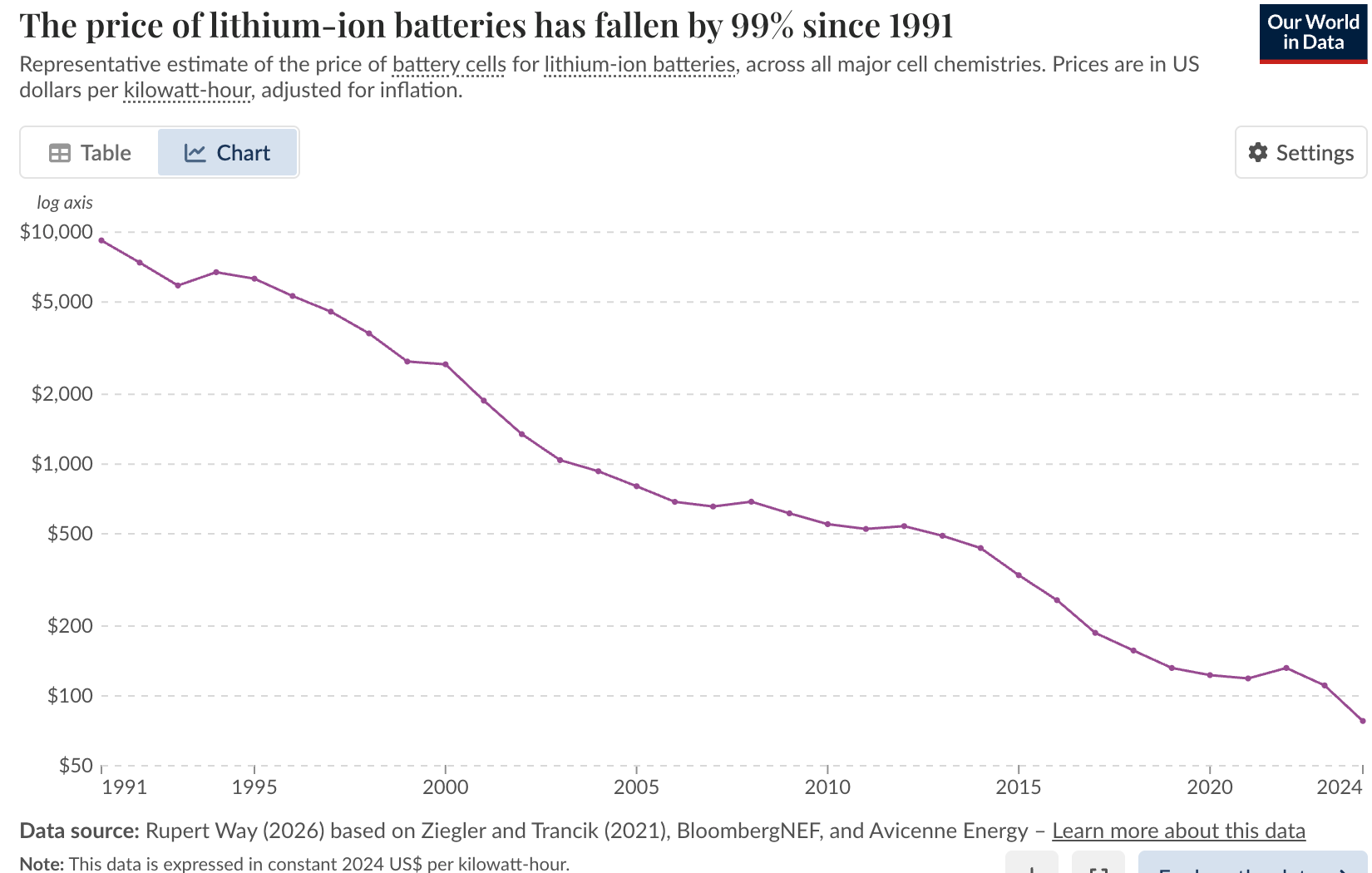
Battery costs have declined by 99% in the last three decades, making electrified transport a reality
Batteries have become much cheaper, making energy storage far more affordable.
By Hannah Ritchie and Pablo Rosado (data work)
First published in 2024; updated and rewritten in March 2026.
Over 20 million electric cars were sold globally in 2025. Most of these cars sold for around $40,000, but some are now as cheap as $10,000.1
Even just two decades ago, these prices and sales figures would have been impossible. That’s because the batteries were far too expensive.
The chart below shows the decline in lithium-ion battery cell prices since 1991. Note that this is shown on a logarithmic scale.
The price declined by more than 99%. In 1991, lithium-ion batteries cost around $9,200 per kilowatt-hour — 33 years later, they cost just $78.
Let’s put that in perspective. The battery cells you’d find in a standard electric car today, which give around 220 to 250 miles (350 to 400 kilometers) of range, cost around $5,000.2
Just a decade ago, this would have cost over $20,000, as much as many would pay for the entire car itself. And back in 1991, almost $600,000.3
What’s promising is that the drop in prices continues: they’ve fallen by a third in just the last few years.
Representative estimate of the price of battery cells for lithium-ion batteries, across all major cell chemistries. Prices are in USdollars per kilowatt-hour, adjusted for inflation.
We send two regular newsletters so you can stay up to date on our work and receive curated highlights from across Our World in Data.
Why have prices fallen?
How did batteries get so much cheaper?
For technologies like batteries, prices fall with production. That's because they follow a learning curve: as cumulative production grows, innovators and engineers find incremental improvements in chemistry, manufacturing, and supply chains, driving a continuous fall in prices. Batteries did not become cheaper because of one big breakthrough, but thanks to thousands of small ones.
In the chart below, we’ve plotted the price of lithium-ion batteries against their cumulative production globally. Both axes are logarithmic.






.png)